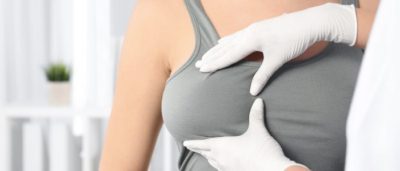
- What Is the Best Solution to Correct Saggy Breasts?
- Take our Plastic Surgery Quiz to find out if you'd be a good candidate for cosmetic surgery.
- What Causes Saggy Breasts?
- What Is Breast Ptosis And How Is It Measured?
- Download Miss Anca Breahna Breast Uplift Guide
- Breast Uplift: A Solution for Droopy Breasts
- What to expect during the Breast Uplift process
- Benefits and Drawbacks of a Breast Uplift
- Breast Implants: A Different Approach to Enhance Your Bust
- The Breast Implant Procedure: What to Expect
- Benefits and Drawbacks of Breast Implant Surgery
- Breast Uplift Before and After Photos
- Combining Breast Uplift with Implants to Fix Saggy Breasts
- The Combined Procedure: What to Expect
- Benefits and Drawbacks of a Breast Uplift with Implants
- Making the Right Choice: Breast Uplift, Implants or Both?
- FAQs about Saggy Breasts, Breast Uplift and Breast Uplift with Implants
- Further Reading about Breast Surgery with Consultant Plastic Surgeon Anca Breahna
- About Anca Breahna – Consultant Plastic Surgeon
What Is the Best Solution to Correct Saggy Breasts?
The issue of saggy breasts is a concern for many women, causing both physical discomfort and psychological distress. In this blog we will discuss the options available to address saggy breasts, comparing breast uplift, implants surgery, and the combination of both.
Chester Consultant Plastic Surgeon Anca Breahna performs different breast procedures to help her patients achieve their aesthetic goals.
Take our Plastic Surgery Quiz to find out if you’d be a good candidate for cosmetic surgery.
What Causes Saggy Breasts?
Sagging breasts, or ptosis, is a natural part of ageing and is due to a combination of factors. Here are the most common causes:
- Ageing: As a woman ages, the ligaments that make up the breast tissue stretch and lose elasticity due to gravity. This causes the breasts to sag. The rate at which this occurs can vary greatly from woman to woman and is largely dependent on genetics and overall physical health
- Hormonal Changes: Hormonal changes throughout a woman’s life can also affect the structure and volume of the breasts. This is particularly true during periods such as pregnancy and menopause
- Weight Fluctuations: Sudden weight gain or weight loss can cause the skin to stretch or contract, leading to sagging breasts. This is because breasts are made up of fatty tissues and hence, when weight changes, it impacts the structure and firmness of your breasts
- Smoking: Smoking can lead to saggy breasts as it weakens and ages skin by damaging the skin’s elastin, a protein that gives skin its elastic appearance and supports breast firmness
- High-intensity workouts: Certain high-impact activities like running and jumping can lead to a breakdown of breast collagen. It’s important to note that this should not discourage anyone from doing these activities. Wearing a supportive sports bra can help counteract this effect
- Pregnancy and Breastfeeding: The enlargement of the breasts during pregnancy followed by their deflation after breastfeeding can lead to sagging. Contrary to popular belief, breastfeeding itself isn’t the primary cause of breast sagging—it’s the changes that occur in the breasts during pregnancy that contribute to sagging
- Lack of Proper Support: Not wearing a bra, or wearing an ill-fitting one, doesn’t provide the necessary support to the breasts, which can lead to sagging over time
It’s important to note that while there are many causes of saggy breasts, it’s a completely natural part of ageing and life experiences. Various interventions, both surgical and non-surgical, can alter the appearance of breasts affected by breast ptosis.
What Is Breast Ptosis And How Is It Measured?
Breast ptosis, commonly referred to as breast sagging, is a natural and gradual process that can occur due to several factors, including ageing, gravity, weight fluctuations, pregnancy, breastfeeding, and a loss of skin elasticity. Over time, the supporting structures of the breast — such as ligaments and skin — begin to stretch, causing the breast tissue to descend on the chest wall and the nipples to point downward or sit lower than they once did.
To accurately assess the degree of sagging, plastic surgeons use a standardised system known as the Regnault ptosis scale. This clinical grading system evaluates the position of the nipple in relation to the inframammary fold (the natural crease beneath the breast), and categorises ptosis into four levels:
-
Pseudo-ptosis: The nipple remains above the inframammary fold, but the lower breast tissue hangs below it.
-
Grade 1 ptosis (mild): The nipple is at the level of the inframammary fold.
-
Grade 2 ptosis (moderate): The nipple sits below the inframammary fold but still above the lowest contour of the breast.
-
Grade 3 ptosis (severe): The nipple is significantly below the inframammary fold and points downward, lying at the lowest point of the breast.
This classification system is an essential tool for surgeons when planning breast surgeries such as augmentation, uplift (mastopexy), or a combination of both. It helps determine not only the severity of sagging but also the most appropriate surgical approach to restore a more youthful, lifted breast contour. In some cases, a breast lift alone may be sufficient, while in others, implants or volume restoration may be recommended in conjunction with a lift.
Understanding your level of ptosis during a consultation allows your surgeon to personalise your treatment plan and ensure natural-looking, long-lasting results tailored to your body and aesthetic goals.
Download Miss Anca Breahna Breast Uplift Guide
Breast Uplift: A Solution for Droopy Breasts
A breast uplift, also known as a mastopexy, is a surgical procedure designed to raise, reshape, and firm the breasts by removing excess skin and tightening the surrounding tissue. This treatment is ideal for women who are experiencing breast ptosis — a condition where the breasts sag due to factors such as ageing, significant weight loss, pregnancy, breastfeeding, or loss of skin elasticity over time.
Unlike breast augmentation, which focuses on increasing breast size using implants, a breast uplift concentrates on restoring a more youthful, elevated breast position. It is a popular option for women who are happy with their current breast size but want to improve the shape, firmness, or nipple position. In some cases, a breast uplift may be combined with implants if volume enhancement is also desired. For more treatment options for droopy breasts, read How to Fix Droopy Breasts: Your Complete Guide to Restoring Confidence and Shape.
What to expect during the Breast Uplift process
The journey to having a breast uplift begins with a thorough consultation with a qualified plastic surgeon, such as Miss Anca Breahna, who will assess your individual anatomy, listen to your goals, and determine whether a mastopexy alone or in combination with augmentation would best meet your needs. During this appointment, factors like skin quality, degree of sagging (ptosis), nipple position, and existing breast volume will all be considered.
The surgical procedure typically involves:
-
Removing excess skin that has stretched over time
-
Reshaping the breast tissue to achieve a more lifted and firm contour
-
Repositioning the nipple and areola to a higher, more youthful location on the breast mound
-
In some cases, reducing the size of the areola if it has become enlarged
The operation usually takes 1.5 to 3 hours under general anaesthesia and is performed as a day case or with an overnight stay depending on your overall health and surgical plan.
Recovery involves wearing a supportive post-surgical bra, avoiding strenuous activities for several weeks, and attending follow-up appointments to monitor healing and results. Swelling, bruising, and mild discomfort are common initially but gradually subside.
Benefits and Drawbacks of a Breast Uplift
A breast uplift can transform both the appearance and confidence of women who are unhappy with sagging or deflated-looking breasts. Here’s a more detailed look at the benefits and potential considerations:
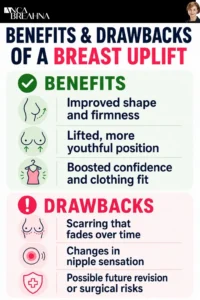
Benefits
-
Enhanced breast shape and firmness without necessarily increasing size
-
Elevated nipple and breast position, improving symmetry and silhouette
-
More youthful and contoured chest profile, often leading to better posture
-
Improved self-esteem and body confidence, particularly in fitted clothing or swimwear
-
Expanded clothing options, as lifted breasts can allow for more flattering fits
Considerations
-
Scarring is an inevitable part of the procedure, though incisions are usually placed in discreet areas and fade over time with proper care
-
Possible changes in nipple sensation, which can be temporary or permanent in rare cases
-
Limited effect on volume, making it unsuitable for women who also desire larger breasts unless combined with implants
-
Potential need for revision surgery in the future, especially if you experience significant weight changes or future pregnancies
-
As with any surgery, there are risks of complications, such as infection, delayed healing, or asymmetry, although these are rare when performed by an experienced surgeon
A breast uplift is not just a cosmetic improvement — it can be a powerful, confidence-restoring experience for women who feel their breasts no longer reflect how they feel inside. By choosing an experienced and compassionate surgeon like Anca Breahna, patients can achieve natural-looking, balanced, and long-lasting results tailored to their unique anatomy and goals.
Breast Implants: A Different Approach to Enhance Your Bust
For women who are dissatisfied with the size, shape, or overall fullness of their breasts, breast implants offer a popular and highly customisable solution. Unlike a breast uplift, which focuses on repositioning and reshaping sagging breasts, breast augmentation with implants is designed to increase volume, enhance contour, and improve symmetry. It is especially beneficial for those who have naturally small breasts, experienced volume loss after pregnancy or weight fluctuations, or who simply wish to achieve a fuller, more proportionate silhouette.
Breast implant surgery is highly individualised, meaning the results are tailored to your specific body shape, lifestyle, and aesthetic preferences. Some women may choose breast implants alone, while others may combine them with a breast lift for both volume and elevation — a particularly effective option when addressing both ptosis (sagging) and volume loss.
The Breast Implant Procedure: What to Expect
Your journey begins with a consultation with an experienced plastic surgeon such as Miss Anca Breahna, who will discuss your goals, assess your anatomy, and guide you through the different implant options. This includes choosing between:
-
Silicone vs saline implants
-
Round vs anatomical (teardrop) shapes
-
Smooth vs textured outer shells
-
Various implant sizes and projection levels
During the consultation, your surgeon will also explain implant placement options — either above the chest muscle (subglandular) or beneath it (submuscular). Each approach has its advantages depending on your natural breast tissue, desired look, and activity level.
Incision sites also vary and will be discussed with you based on your goals and anatomy. The most common options include:
-
Inframammary (under the breast fold): Offers excellent visibility and control for implant placement
-
Peri-areolar (around the nipple): Minimises visible scarring but may not be suitable for all patients
-
Transaxillary (through the armpit): Leaves no scars on the breast but offers less direct access for implant positioning
The surgery is performed under general anaesthesia and typically takes 1 to 2 hours. Most patients can return home the same day, with post-operative instructions and follow-up appointments provided to ensure a smooth recovery.
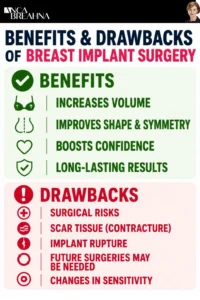
Benefits and Drawbacks of Breast Implant Surgery
Breast implants offer a range of aesthetic and emotional benefits, making them one of the most frequently performed cosmetic surgeries worldwide. However, like any surgical procedure, it’s important to weigh these benefits against potential risks and long-term considerations.
Benefits
-
Increased breast volume, helping achieve your ideal cup size
-
Improved breast shape and symmetry, especially if natural breasts are uneven
-
Restoration of lost volume after pregnancy, breastfeeding, or weight loss
-
Enhanced self-confidence and body image, often leading to greater satisfaction in clothing and social situations
-
Long-lasting results, with modern implants designed for durability and a natural feel
Considerations
-
Surgical risks, including infection, bleeding, or delayed healing
-
Capsular contracture, a condition where scar tissue tightens around the implant, potentially affecting shape or comfort
-
Implant rupture or deflation, particularly with saline implants, which may require replacement
-
Future surgeries, as implants are not lifetime devices and may need to be revised or replaced over time
-
Changes in nipple sensitivity, which may be temporary or permanent in a small number of cases
-
MRI or ultrasound screening may be recommended for silicone implants to monitor for silent rupture
Choosing breast implants is a personal decision that should be made with the guidance of a skilled and empathetic surgeon. Miss Anca Breahna works closely with each patient to help them understand their options and make choices that align with both their aesthetic desires and long-term health. With thoughtful planning and expert execution, breast augmentation can offer natural, satisfying results that positively impact both appearance and confidence.
Breast Uplift Before and After Photos


Combining Breast Uplift with Implants to Fix Saggy Breasts
For many women, especially those who have experienced significant changes due to pregnancy, breastfeeding, ageing, or weight loss, the best solution for enhancing the appearance of the breasts may not be a single procedure, but rather a combination of a breast uplift (mastopexy) with breast implants. This dual approach allows for the correction of sagging (ptosis) while also restoring or increasing volume, resulting in a fuller, more lifted and youthful contour.
This combined procedure is ideal for women who are unhappy with both the position and size of their breasts. While a breast uplift alone reshapes and raises the breast tissue, it does not add volume. Conversely, implants alone may increase size but can exaggerate sagging if the underlying breast structure lacks support. By combining the two techniques, the surgeon can address both concerns simultaneously, offering a comprehensive and balanced transformation.
The Combined Procedure: What to Expect
A breast uplift with implants is typically performed during a single surgical session, though it is more complex than either procedure alone. It requires careful planning and precise surgical technique to ensure that both the lift and augmentation complement one another in achieving natural-looking and long-lasting results.
During surgery, the uplift is performed first, removing excess skin, tightening the breast envelope, and repositioning the nipple-areola complex to a more youthful height. Once the breast has been reshaped and lifted, the surgeon will then insert the implants — either above or below the chest muscle, depending on your anatomy and goals. Implant size, type, and placement are discussed in detail during the consultation phase to ensure optimal outcomes.
While the combination adds some complexity, having both procedures at once offers convenience and faster overall recovery compared to staging them months apart.
Benefits and Drawbacks of a Breast Uplift with Implants
As with any surgical procedure, there are important benefits and considerations to understand before proceeding.
Benefits
-
Comprehensive enhancement by improving both breast shape and volume in one operation
-
Correction of moderate to severe sagging while simultaneously enhancing fullness
-
Better aesthetic balance, especially for women with deflated, low-positioned breasts
-
Fewer operations overall, reducing cumulative downtime and anaesthesia exposure
-
Improved self-image and confidence, particularly for women who feel their breasts no longer reflect their youth or femininity
Considerations
-
Longer surgery time and increased complexity, requiring advanced surgical expertise
-
Greater potential for complications, such as implant malposition or delayed healing
-
More extensive recovery, including swelling, discomfort, and possible restriction of arm movement for a few weeks
-
Scarring, which may be more noticeable than with implants alone, though incisions are carefully placed and often fade over time
-
Future maintenance, as implants may require replacement or revision over the years, especially following major weight changes or ageing
This combined procedure is best performed by a highly experienced consultant plastic surgeon, such as Miss Anca Breahna, who specialises in both aesthetic and reconstructive breast surgery. Her expertise ensures that every aspect of the procedure — from implant selection to nipple positioning — is executed with precision, safety, and artistry.
When done correctly, a breast uplift with implants can deliver striking yet natural-looking results, helping women regain not just physical balance, but renewed confidence in their appearance.
Making the Right Choice: Breast Uplift, Implants or Both?
Choosing between a breast uplift, implants, or both is a personal decision that should be made after careful consideration and consultation with a qualified plastic surgeon. It’s crucial to assess your expectations, understand the potential risks and benefits, and consider your lifestyle and future plans.
A few things to consider:
- Your goals: Are you looking to lift sagging breasts, increase their size, or both?
- Physical examination: A certified plastic surgeon will examine your breasts to evaluate factors like skin elasticity, amount of natural breast tissue, and the degree of sagging
- Risks and complications: Every surgical procedure comes with potential risks and complications, such as infection, changes in nipple or breast sensation, implant leakage or rupture, or unsatisfactory results that may require additional surgery
The choice between a breast uplift, implants, or both is a personal one, based on your specific needs and desired outcomes. By understanding the causes of saggy breasts and the available solutions, you can make an informed decision about the best course of action for you. Whether you opt for a breast uplift, implants, or a combination of both, the goal should always be to improve your comfort and confidence in your body.

FAQs about Saggy Breasts, Breast Uplift and Breast Uplift with Implants
What is the best method to fix saggy breasts, a breast uplift or breast implants?
The best method depends on your specific anatomy and goals. A breast uplift (mastopexy) primarily corrects sagging by removing excess skin and repositioning the nipple, whereas breast implants add volume. If you have significant sagging (ptosis), implants alone may actually worsen the “droop” due to the added weight. Many women choose a combination of both to achieve both lift and fullness.
[Image: Comparing the results of a standalone lift vs. a lift with implants]
Can a breast lift be performed without implants?
Absolutely. A breast uplift is frequently performed on its own. The procedure reshapes the existing breast tissue, removes redundant skin, and elevates the nipple-areola complex to a more youthful position. While it doesn’t add volume, the “compacting” effect often makes the breasts appear firmer and perkier.
What are the benefits of combining a breast lift with implants?
This combined approach addresses two issues simultaneously: position and volume. A lift corrects the sagging, while the implant fills out the “upper pole” (the top part of the breast), which often loses volume after pregnancy, weight loss, or ageing. This results in a more comprehensive rejuvenation.
How long does the recovery period last after a combined breast lift and implant surgery?
Most patients can return to light daily activities and non-strenuous work within 2 to 4 weeks. However, complete healing and the final “settling” of the implants can take several months. You will need to avoid heavy lifting and high-impact exercise for at least 6 weeks to ensure the internal internal sutures and tissues heal correctly.
Are there any risks or side effects associated with these procedures?
Like any surgery, risks include infection, bleeding, and adverse reactions to anaesthesia. Specific to these procedures are risks of scarring, changes in nipple sensation, or implant-related issues like capsular contracture. It is important to remember that gravity and ageing continue after surgery; maintained results are best supported by stable weight and proper supportive bras.
Medical References about Breast Lift and Breast Ptosis
- What is breast uplift surgery? – American Society of Plastic Surgeons
- Breast Ptosis – StatPearls – NCBI Bookshelf
- What to Know About Sagging Breasts – WebMD
- Saggy breasts: Causes and solutions – Medical News Today
- Breast uplift – Mayo Clinic
Further Reading about Breast Surgery with Consultant Plastic Surgeon Anca Breahna
- Read more about What Are the Benefits of a Breast Lift with Implants?
- Read more about Breast Enlargement – Breast Augmentation
- Read more about Mastopexy Augmentation (Uplift With Implants)
- Read more about Do I need a Breast Lift or Implants?
About Anca Breahna – Consultant Plastic Surgeon
 Miss Anca Breahna, PhD, MSc, FEBOPRAS, FRCS (Plast), is a Consultant Plastic, Reconstructive and Aesthetic Surgeon in Chester with extensive experience in cosmetic and reconstructive breast surgery. Her training is especially relevant to mastopexy, where reshaping the breast requires careful judgement of skin excess, breast tissue, nipple position and symmetry rather than simply reducing or increasing volume.
Miss Breahna performs breast uplift surgery in Chester for women affected by breast sagging following pregnancy, breastfeeding, weight change or ageing. Depending on the degree of ptosis, she may recommend a crescent, peri-areolar, vertical or anchor-pattern lift, with treatment planned around the amount of reshaping required and the position of the nipple and areola. As an experienced plastic surgeon in Chester, she also considers whether an uplift alone is appropriate or whether another breast procedure may better address the patient’s goals, while discussing scarring, recovery and realistic long-term expectations in detail.
Back to blog