- Quick Comparison: Breast Implants vs Breast Uplift
- How Do I Know Whether I Need Implants, an Uplift, or Both?
- Who Is Each Procedure Best For?
- Who May Be Suitable for Breast Implants Alone?
- Who May Be Suitable for a Breast Uplift?
- Who May Need a Breast Uplift With Implants?
- What Are the Advantages of Breast Implants Alone?
- What Are the Advantages of a Breast Uplift?
- What Are the Advantages of a Breast Uplift With Implants?
- What Are the Disadvantages of Breast Implants Alone?
- What Are the Disadvantages of a Breast Uplift?
- What Are the Disadvantages of a Breast Uplift With Implants?
- How Does Recovery Compare Between Breast Implants, a Breast Uplift, and Combined Surgery?
- What Is the Typical Recovery Timeline?
- Which Procedure Has the Longest-Lasting Result?
- Download Miss Anca Breahna Breast Uplift Guide
- How Do the Costs Compare?
- What Does Miss Anca Breahna Recommend?
- Breast Uplift Before and After Photos
- Why Is a Personal Consultation Important?
- Breast Uplift or Implants: A Simple Decision Guide
- Book a Breast Surgery Consultation with Miss Anca Breahna
- Frequently Asked Questions About Breast Uplift vs Breast Implants
- Further Reading
- About Anca Breahna – Consultant Plastic Surgeon
The decision between breast implants, a breast uplift, or a combination of both depends on whether the main concern is loss of volume, low nipple position, excess skin, or a combination of these changes. Implants primarily restore volume, while uplift surgery raises and reshapes existing breast tissue.
- Breast implants primarily increase fullness and projection
- A breast uplift raises and reshapes the existing tissue
- Implants alone may suit mild deflation with minimal sagging
- Combined surgery may address both drooping and volume loss
- The correct choice depends on anatomy rather than breast size alone
Using a larger implant to avoid uplift scars can place additional strain on weakened tissues and may worsen drooping over time. The safest approach is the procedure that directly addresses the anatomical cause of the concern.
Quick Comparison: Breast Implants vs Breast Uplift
Breast implants, breast uplift surgery, and combined augmentation mastopexy each address a different aspect of breast shape. The comparison below highlights the main differences, although individual suitability must be confirmed during consultation.
| Feature | Breast Implants Alone | Breast Uplift | Breast Uplift With Implants |
|---|---|---|---|
| Main purpose | Restores volume | Raises and reshapes | Raises and restores volume |
| Corrects sagging | Only very mild cases | Yes | Yes |
| Adds upper-pole fullness | Yes | Limited | Yes |
| Raises nipple position | Usually no | Yes | Yes |
| Removes excess skin | No | Yes | Yes |
| Scarring | Usually shorter | More extensive | More extensive |
| Implant-related risks | Yes | No | Yes |
| Future implant surgery | May be required | Not applicable | May be required |
No single option is universally better because each procedure has a different purpose. The recommendation should reflect breast position, skin quality, existing volume, desired size, and tolerance of scars.
How Do I Know Whether I Need Implants, an Uplift, or Both?

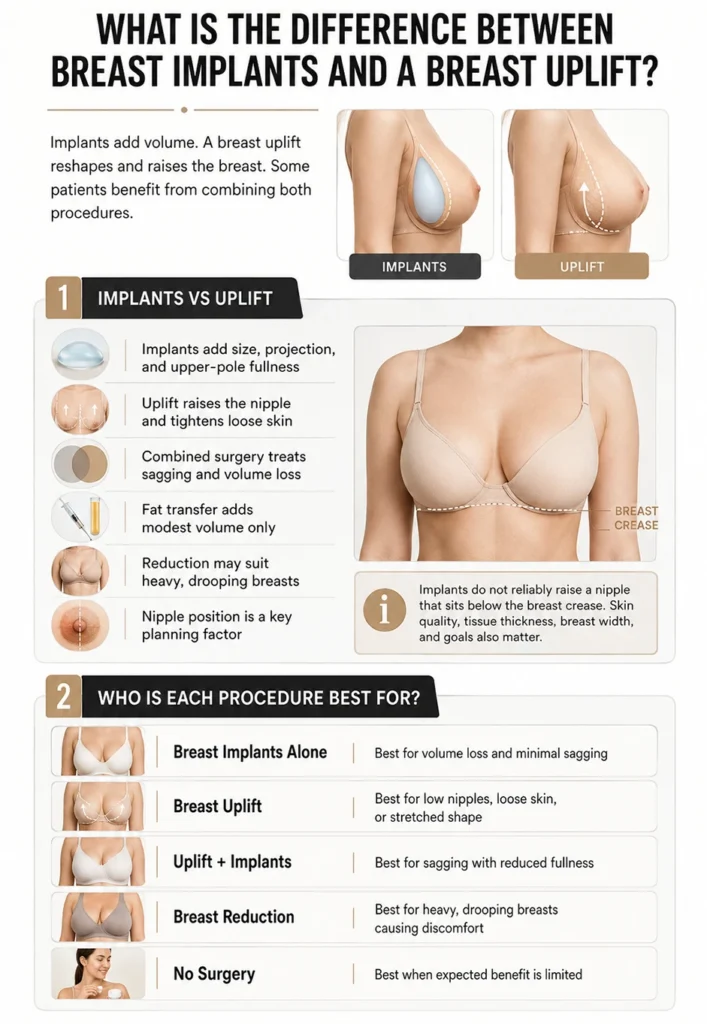
Breast implants add volume by placing an implant beneath the breast tissue, muscle, or in a dual-plane position, whereas a breast uplift removes excess skin and reshapes the natural tissue. In simple terms, implants fill the breast, while an uplift changes its position and form.
- Breast implants increase size, projection, and upper-pole fullness
- A breast uplift raises the nipple and tightens the skin envelope
- Combined surgery addresses both sagging and insufficient volume
- Fat transfer may add modest volume but cannot correct marked drooping
- Breast reduction may be better when sagging is combined with excessive weight
Nipple position is central to treatment planning because implants do not reliably raise a nipple that sits below the breast crease. Skin elasticity, tissue thickness, breast width, and the desired result also influence which operation is most appropriate.
Who Is Each Procedure Best For?
The best procedure depends on whether the main concern is loss of volume, excess skin, low nipple position, or a combination of these changes. Two patients with breasts of a similar size may require different operations because their skin quality, tissue distribution, and goals are not the same.
- Breast implants alone: Best for deflation, small volume, and minimal sagging
- Breast uplift: Best for low nipples, loose skin, or stretched breast shape
- Uplift with implants: Best for sagging combined with loss of fullness
- Breast reduction: Best for heavy, drooping breasts causing discomfort
- No surgery: Appropriate when expected benefit is limited or risk is disproportionate
A clinical examination assesses the relationship between the nipple, breast crease, skin envelope, chest wall, and existing tissue. This allows the recommendation to address the real anatomical problem rather than the procedure the patient initially expected to need.
Who May Be Suitable for Breast Implants Alone?
Breast implants alone may be suitable when the main concern is loss of fullness rather than true breast sagging. The best candidates usually have a satisfactory nipple position, limited excess skin, and enough elasticity to support the implant.
- Nipples positioned at or above the breast crease
- Minimal loose or stretched skin
- Desire for increased size or projection
- Loss of upper-pole fullness after pregnancy or weight change
- A proportionate implant that suits the chest and breast dimensions
Implants should not be chosen simply to avoid uplift scars because excessive implant size can worsen stretching and lower the breast over time. When anatomy is favourable, augmentation alone can restore fullness through less extensive scars than uplift surgery.
Who May Be Suitable for a Breast Uplift?
A breast uplift may be appropriate when the breasts have adequate volume but sit lower than desired because of stretched skin and weakened support. The operation raises the nipple, removes excess skin, and reshapes the existing tissue into a firmer position.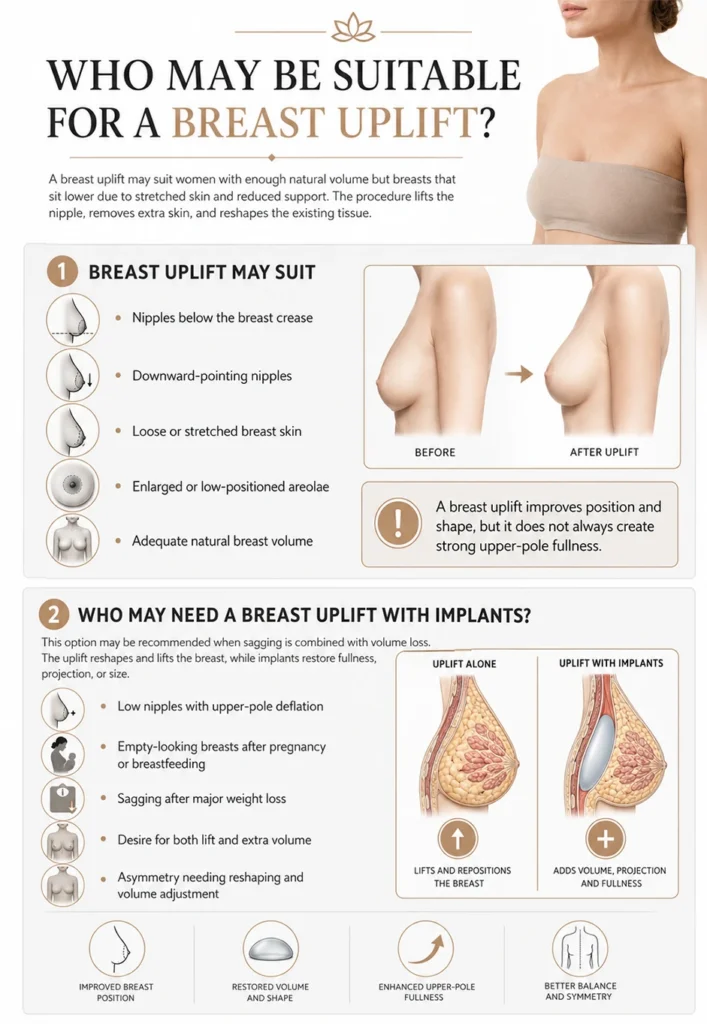
- Nipples sitting below the breast crease
- Nipples that point downwards
- Loose or visibly stretched breast skin
- Enlarged or low-positioned areolae
- Adequate natural breast volume
An uplift does not necessarily create pronounced upper-pole fullness because it works mainly with the patient’s own tissue. It is most suitable when breast position and shape are the principal concerns rather than a desire for substantially increased size.
Who May Need a Breast Uplift With Implants?
A breast uplift with implants may be recommended when there is both significant sagging and insufficient breast volume. The uplift raises and reshapes the breast, while the implant restores fullness, projection, or size.
- Low nipple position with upper-pole deflation
- Empty-looking breasts after pregnancy or breastfeeding
- Sagging after substantial weight loss
- Desire for both elevation and increased volume
- Asymmetry requiring reshaping and volume adjustment
Combined surgery is more complex because the uplift tightens the skin while the implant adds volume and weight. Careful implant selection is essential to protect healing tissues and reduce the risk of recurrent stretching.
What Are the Advantages of Breast Implants Alone?
The main advantage of breast implants alone is that they can increase volume and restore fullness through less extensive scars than a breast uplift. They are most effective when breast position is already acceptable and the principal goal is augmentation.
- Increased breast size and projection
- Improved upper-pole fullness
- Greater control over implant width and profile
- Shorter scars than uplift surgery
- Less complex than combined uplift and augmentation
Implants cannot remove loose skin or reliably lift a low nipple, so their benefits depend on appropriate patient selection. For the right patient, they can create a balanced result without unnecessary skin-removing surgery.
What Are the Advantages of a Breast Uplift?
A breast uplift directly corrects sagging by reshaping the existing tissue and removing excess skin. It can improve breast position without introducing an implant, which may appeal to patients who are satisfied with their natural volume.
- Raises low nipples and areolae
- Removes excess and stretched skin
- Reshapes natural breast tissue
- Can reduce enlarged areolae
- Avoids implant-related complications
An uplift is particularly useful when breast shape and position are the main concerns rather than size. Its main limitation is that it may not create the upper-pole fullness some patients associate with implants.
What Are the Advantages of a Breast Uplift With Implants?
A breast uplift with implants can correct low breast position, loose skin, and volume loss within the same treatment plan. It offers the most comprehensive reshaping when neither an uplift nor implants alone would achieve the desired result.
- Corrects sagging and deflation together
- Raises the nipple and tightens the skin envelope
- Restores upper-pole fullness
- Allows greater control over final breast size
- Can improve complex asymmetry
Combined surgery can produce a balanced improvement when its additional complexity is justified by the anatomy. The implant should remain proportionate to the reshaped breast to protect healing and long-term stability.
What Are the Disadvantages of Breast Implants Alone?
The main limitation of implants alone is that they add volume without removing excess skin or reliably correcting a low nipple. In patients with true ptosis, the breast tissue may continue to hang below the implant and create an unnatural contour.
- Cannot reliably correct moderate or severe sagging
- Do not remove loose or stretched skin
- May worsen a low or heavy breast position
- Carry risks such as rupture or capsular contracture
- May require further surgery in the future
Implants are not lifetime devices, although they do not always require replacement at a fixed interval. Their smaller scars are appealing, but scar length should not take priority over anatomical suitability.
What Are the Disadvantages of a Breast Uplift?
A breast uplift requires visible scars because excess skin must be removed to raise and reshape the breast. The extent of scarring depends on the degree of sagging and may involve a periareolar, vertical, or anchor-shaped pattern.
- More extensive scars than implants alone
- Limited increase in upper-pole fullness
- Possible changes in nipple sensation
- Risk of delayed healing or asymmetry
- Potential for recurrent sagging over time
A lift may make the breasts appear slightly smaller because the tissue is compacted into a higher shape. The procedure offers direct correction of sagging, but patients must accept permanent scars and normal surgical risks.
What Are the Disadvantages of a Breast Uplift With Implants?
A breast uplift with implants is more complex than either operation performed alone because it combines tissue reshaping with implant placement. It therefore carries the risks of both mastopexy and augmentation and may involve a more demanding recovery.
- Longer and more technically complex surgery
- More extensive scarring
- Implant-related and uplift-related risks
- Greater potential for wound-healing problems
- Possible need for staged or revision surgery
Very large implants can place excessive tension on the healing skin and increase the likelihood of recurrent drooping. Combined surgery should only be recommended when the expected benefit justifies the additional complexity.
How Does Recovery Compare Between Breast Implants, a Breast Uplift, and Combined Surgery?
Recovery varies according to the procedure performed, the extent of surgery, implant placement, and individual healing. Breast implants alone may involve more early tightness, while uplift surgery places greater emphasis on incision care and protecting the reshaped tissues.
- Breast implants alone: Pressure, tightness, swelling, and muscle discomfort are common during the first week
- Breast uplift: Soreness, swelling, and sensitivity around the incisions may be more noticeable than chest tightness
- Uplift with implants: Recovery combines implant-related pressure with the wound care required after mastopexy
- Return to desk work: Often possible after one to two weeks, depending on comfort and job demands
- Return to exercise: Usually gradual over four to six weeks or longer after combined surgery
Patients should expect the breasts to sit high, feel firm, or appear uneven during early healing. The final shape develops gradually as swelling settles, scars mature, and the tissues relax.
What Is the Typical Recovery Timeline?
Most patients can manage light daily activities within several days, but complete healing takes considerably longer. The timeline should be treated as a guide because recovery differs according to health, surgical technique, and the physical demands of work.
- First week: Rest, gentle walking, prescribed pain relief, and support bra use are usually required
- Weeks one to two: Many patients return to desk-based work if discomfort is controlled
- Weeks three to six: Activity increases gradually, but heavy lifting and strenuous exercise remain restricted
- Two to three months: Swelling reduces and the breast shape becomes more settled
- Six to eighteen months: Scars continue to soften, flatten, and fade
Driving should only resume when the patient can perform an emergency stop comfortably and is no longer taking strong pain medication. Miss Anca Breahna provides personalised advice about work, exercise, sleeping position, wound care, and support garments.
Which Procedure Has the Longest-Lasting Result?
Breast implants, breast uplift surgery, and combined surgery can all provide long-lasting improvement, but none can stop natural ageing or future breast change. Longevity depends on skin quality, implant weight, pregnancy, weight fluctuation, genetics, and the strength of the breast tissues.
- Breast implants are not considered lifetime devices
- Uplift results may change gradually because of gravity and tissue ageing
- Larger implants can place more strain on the breast envelope
- Pregnancy and major weight changes may alter any surgical result
- Stable weight and supportive bras may help preserve breast shape
An uplift can provide a durable improvement in nipple position and contour, but some recurrent sagging may develop over time. Patients with implants may also require future assessment or surgery because of rupture, capsular contracture, displacement, or changing preferences.
Download Miss Anca Breahna Breast Uplift Guide
How Do the Costs Compare?
The cost of breast implants, breast uplift surgery, and combined surgery varies because each operation differs in complexity, theatre time, materials, and aftercare requirements. A personalised quotation should be provided after consultation once the recommended procedure and surgical plan have been established.
- Breast implants alone: Includes implant costs, surgeon’s fees, anaesthetic fees, hospital charges, and follow-up
- Breast uplift: Reflects the complexity of skin removal, tissue reshaping, scar pattern, and theatre time
- Uplift with implants: Usually costs more because it combines mastopexy with implant surgery
- Additional factors: Asymmetry correction, implant type, hospital choice, and operative duration may affect pricing
- Future costs: Implant monitoring, revision surgery, or replacement may be required later
Patients should ask exactly what is included in the quotation and whether postoperative appointments, garments, and complication care are covered. Price should be considered alongside surgeon qualifications, hospital standards, continuity of care, and the safety of the treatment plan.
What Does Miss Anca Breahna Recommend?
Miss Anca Breahna recommends choosing the procedure that corrects the true anatomical problem rather than the option with the fewest scars or the largest potential size increase. The decision should be based on nipple position, skin quality, breast volume, chest dimensions, tissue strength, and long-term stability.
- Implants alone: Usually best when volume loss is the main concern and nipple position remains satisfactory
- Breast uplift: Usually best when sagging, stretched skin, or a low nipple is the dominant concern
- Uplift with implants: Usually best when both drooping and insufficient fullness require correction
- Breast reduction: May be more suitable when the breasts are heavy as well as sagging
- Staged surgery: May be advised when combining procedures would place excessive tension on the tissues
Using an oversized implant to avoid an uplift can create an unstable or unnatural result and may worsen future drooping. A proportionate plan usually offers a safer balance between breast shape, scar burden, implant size, and long-term tissue support.
Breast Uplift Before and After Photos

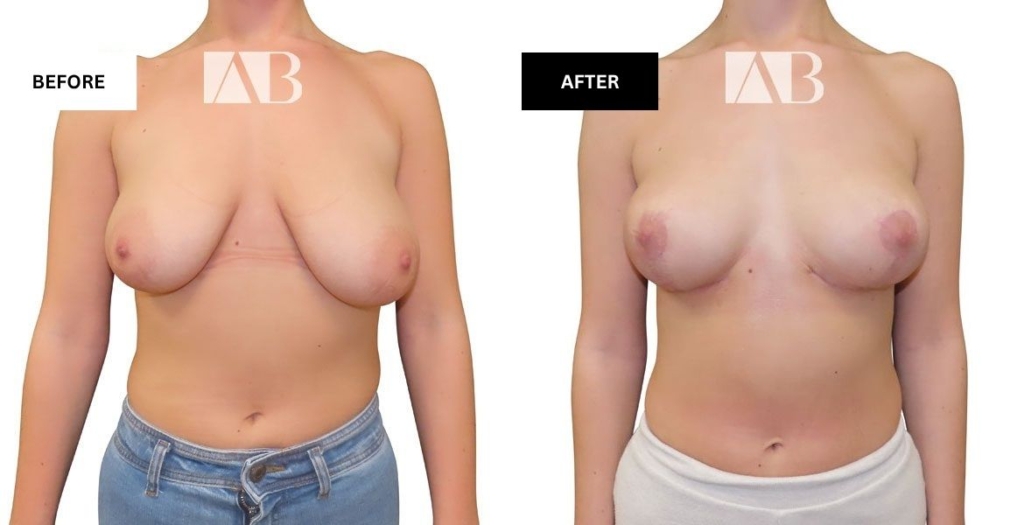
Why Is a Personal Consultation Important?
A personal consultation is essential because breast sagging cannot be assessed accurately from size, cup measurement, or photographs alone. Clinical examination allows the surgeon to evaluate the skin envelope, nipple position, tissue thickness, chest wall, asymmetry, and the patient’s priorities.
- Medical history and general health are reviewed
- Breast measurements and clinical photographs may be taken
- Implant size and profile can be discussed where relevant
- Scar patterns, risks, recovery, and alternatives are explained
- The likely result and limitations are considered in detail
The consultation should help the patient understand why one procedure is recommended over another. It also provides time to consider the proposed operation without feeling pressured to proceed.
Breast Uplift or Implants: A Simple Decision Guide
The simplest way to approach the decision is to identify whether the main concern is volume, position, or both. Implants restore fullness, an uplift corrects drooping, and combined surgery addresses both problems when this can be done safely.
- Choose implants alone when the nipples are well positioned and the main concern is deflation
- Choose an uplift when loose skin and low nipple position are the main issues
- Consider combined surgery when both sagging and volume loss are present
- Avoid choosing implant size solely to escape uplift scars
- Accept that the safest recommendation may differ from the procedure initially expected
The right operation should create a proportionate improvement while respecting the limitations of the tissues. Miss Breahna’s recommendation is guided by anatomy, safety, realistic expectations, and the patient’s preferred balance between fullness and scarring.
Book a Breast Surgery Consultation with Miss Anca Breahna
Choosing between breast implants, a breast uplift, or a combination of both begins with understanding your individual anatomy and aesthetic goals. A consultation with Miss Anca Breahna provides a comprehensive assessment and personalised recommendation based on your breast shape, skin quality, tissue characteristics, and the results you wish to achieve.
- Receive a detailed clinical assessment of your breast shape and degree of sagging
- Discuss whether breast implants, a breast uplift, or combined surgery is the most suitable option
- Explore implant sizes, shapes, and surgical techniques where appropriate
- Gain a clear understanding of the expected results, recovery, potential risks, and scarring
- Ask questions in a relaxed, confidential, and patient-centred environment
Every treatment plan is tailored to the individual because no two patients have the same anatomy or expectations. To arrange a consultation with Miss Anca Breahna at her Chester clinic and receive expert advice on the most appropriate approach for your needs, contact the practice today. Her clinic’s online Contact Page and Complimentary Photo Assessment feature can help you get started with enquiries and setting appointments. Miss Anca Breahna can assess whether you are best suited to a breast uplift, implants, or a combined plan, then guide you through realistic outcomes, scars, recovery, and long-term considerations so you feel confident in your decision.
Frequently Asked Questions About Breast Uplift vs Breast Implants

Can breast implants lift mildly sagging breasts without a breast uplift?
Breast implants can improve the appearance of very mild sagging by restoring lost volume, but they cannot reliably raise a low nipple or remove excess skin. If the nipple sits below the breast crease, a breast uplift is usually needed to achieve a balanced and natural-looking result.
How can I tell whether my nipples are too low for breast implants alone?
The position of the nipple in relation to the breast crease is one of the most important factors when deciding between implants and a breast uplift. Miss Anca Breahna will assess your breast measurements, skin quality, and overall anatomy during consultation to determine which procedure is most appropriate.
Will choosing larger breast implants allow me to avoid a breast uplift?
Using larger implants to fill loose skin is rarely a reliable alternative to a breast uplift because the additional weight may stretch the tissues even further. In some patients, oversized implants can make breast sagging more noticeable over time rather than correcting it.
Can breast implants make existing breast sagging look worse?
Yes, breast implants may accentuate existing sagging if the underlying problem is excess skin or a low nipple position rather than loss of breast volume. Careful patient assessment helps avoid choosing augmentation alone when an uplift would provide a more stable and proportionate result.
Do I need a breast uplift if my breasts look empty after pregnancy or breastfeeding?
Pregnancy and breastfeeding can cause both loss of breast volume and stretching of the skin, so the most suitable procedure depends on the changes that have occurred. Some patients benefit from implants alone, while others require a breast uplift or a combined uplift with implants to restore both shape and fullness.
Can a breast uplift restore upper-pole fullness without breast implants?
A breast uplift reshapes and redistributes the existing breast tissue, which may create some improvement in upper-pole fullness. However, patients wanting a noticeably fuller upper breast may require implants because an uplift alone does not increase breast volume.
Is it better to have a breast uplift and implants together or as separate procedures?
Many patients can safely undergo both procedures during the same operation, although staged surgery may occasionally provide a safer or more predictable outcome. The decision depends on tissue quality, implant size, healing capacity, and the complexity of the breast reshaping required.
What type of scars should I expect from a breast uplift compared with breast implants?
Breast implants alone usually involve a single incision placed in the breast crease, around the areola, or occasionally in the armpit, whereas a breast uplift requires more extensive scars to remove excess skin. The final scar pattern depends on the degree of sagging and the amount of correction required.
How could future pregnancy affect the results of breast implants or a breast uplift?
Pregnancy, breastfeeding, and significant weight changes can alter breast shape regardless of which procedure has been performed. Although surgery provides long-lasting improvement, future body changes may reduce the longevity of the result or occasionally lead to further surgery.
Can fat transfer replace breast implants when a breast uplift is also required?
Fat transfer can provide a modest increase in breast volume for selected patients, but it cannot replace a breast uplift when significant sagging is present. Patients seeking a substantial increase in breast size usually achieve more predictable volume enhancement with breast implants.
Medical References
- A Systematic Review of Single-Stage Augmentation-Mastopexy / Plastic and Reconstructive Surgery – https://journals.lww.com/plasreconsurg/Abstract/2014/11000/A_Systematic_Review_of_Single_Stage.13.aspx
- Breast Lift with and without Implant: A Synopsis and Primer for the Plastic Surgeon / Plastic and Reconstructive Surgery – Global Open – https://pmc.ncbi.nlm.nih.gov/articles/PMC7647657/
- Long-term results measured by BREAST-Q reveal higher patient satisfaction after “autoimplant-mastopexy” than augmentation-mastopexy / Gland Surgery – https://pmc.ncbi.nlm.nih.gov/articles/PMC6842755/
Further Reading
- Read Miss Anca Breahna’s Blog about Breast Uplift and the Pencil Test for Breasts
- Read Miss Anca Breahna’s Blog about Recovery Timeline After Breast Uplift Surgery
- Read Miss Anca Breahna’s Blog about Benefits of a Breast Lift with Implants
About Anca Breahna – Consultant Plastic Surgeon
 Miss Anca Breahna, PhD, MSc, FEBOPRAS, FRCS (Plast), is a Consultant Plastic, Reconstructive and Aesthetic Surgeon in Chester with extensive experience in cosmetic and reconstructive breast surgery. Her training is especially relevant to mastopexy, where reshaping the breast requires careful judgement of skin excess, breast tissue, nipple position and symmetry rather than simply reducing or increasing volume.
Miss Breahna performs breast uplift surgery in Chester for women affected by breast sagging following pregnancy, breastfeeding, weight change or ageing. Depending on the degree of ptosis, she may recommend a crescent, peri-areolar, vertical or anchor-pattern lift, with treatment planned around the amount of reshaping required and the position of the nipple and areola. As an experienced plastic surgeon in Chester, she also considers whether an uplift alone is appropriate or whether another breast procedure may better address the patient’s goals, while discussing scarring, recovery and realistic long-term expectations in detail.
Back to blog