- Introduction
- How Can You Make Your Breasts Look Perkier?
- What Does Having Perky Breasts Mean?
- What Is Upper Pole Fullness?
- Why Do Breasts Lose Firmness and Begin to Sag?
- ✓ How Does Ageing Affect Breast Position?
- ✓ How Do Pregnancy and Breastfeeding Affect Breast Shape?
- ✓ How Do Weight Changes Affect Breast Firmness?
- Can You Make Your Breasts Perkier Naturally?
- ✓ Can Exercise Lift Sagging Breasts?
- ✓ Which Exercises May Improve Chest Appearance?
- ✓ Can Wearing the Right Bra Make Breasts Look Perkier?
- ✓ Can Creams or Skincare Products Firm the Breasts?
- ✓ Can Better Posture Make the Breasts Look More Lifted?
- ✓ Does Weight Loss Make Breasts Perkier?
- Can Breast Implants Make Breasts Perkier?
- ✓ When Are Breast Implants Alone Appropriate?
- What Is a Breast Uplift?
- ✓ What Can a Breast Uplift Improve?
- ✓ What Types of Breast Uplift Scars Are Possible?
- ✓ Can a Breast Uplift Be Combined With Implants?
- Can Fat Transfer Make the Breasts Look Perkier?
- Breast Uplift Before and After Photos
- What Happens During a Breast Surgery Consultation?
- What Are the Risks of Breast Uplift Surgery?
- ✓ What Additional Risks Apply When Implants Are Used?
- ✓ Can Breast Uplift Surgery Affect Breastfeeding?
- What Is Recovery Like After a Breast Uplift?
- ✓ When Can Patients Return to Work?
- ✓ When Can Patients Exercise Again?
- ✓ When Will the Final Result Be Visible?
- What Are the Alternatives to Breast Uplift Surgery?
- ✓ Are Non-Surgical Breast Lifts Effective?
- Who Is Suitable for a Breast Uplift?
- ✓ Who May Not Be Suitable?
- How Much Does a Breast Uplift Cost?
- ✓ What Long-Term Costs Should Patients Consider?
- Summary
- FAQs About Achieving Perky Breasts
- Arrange a Breast Uplift Consultation With Miss Anca Breahna
- Download Anca Breahna's Breast Uplift Guide
- Further Reading
- About Anca Breahna – Consultant Plastic Surgeon
Introduction
Miss Anca Breahna, PhD, MSc, FEBOPRAS, FRCS (Plast), Consultant Plastic, Reconstructive and Aesthetic Surgeon in Chester, explains that there is no single method that can make every breast appear permanently firmer or more lifted. Mild changes in appearance may be achieved through supportive bras, posture, exercise, and weight stability, but significant breast sagging usually requires surgery to reposition the breast tissue and nipple.
Breasts may lose firmness because of ageing, pregnancy, breastfeeding, weight changes, genetics, gravity, and reduced skin elasticity. The most suitable treatment depends on whether the main concern is loose skin, loss of volume, low nipple position, asymmetry, or a combination of these changes.
Some patients benefit from breast uplift surgery alone, while others may require implants, fat transfer, or a combination of breast procedures to address both shape and volume. A personalised consultation is essential because the safest and most effective option depends on the patient’s anatomy, tissue quality, lifestyle, and expectations.
How Can You Make Your Breasts Look Perkier?
Breasts can sometimes be made to look perkier through better support, improved posture, and careful clothing choices, but these measures do not permanently reposition breast tissue. Where the skin has stretched or the nipples have descended, surgery is usually the only way to create a meaningful and lasting lift.
Options that may improve breast appearance include:
- Wearing a professionally fitted supportive bra
- Strengthening the chest and upper back muscles
- Maintaining a stable and healthy weight
- Using breast uplift surgery to remove excess skin
- Combining uplift surgery with implants where volume has also been lost
Non-surgical measures may improve presentation and support, particularly when breast sagging is mild. They cannot remove loose skin, raise a low nipple, or reshape significantly stretched breast tissue.
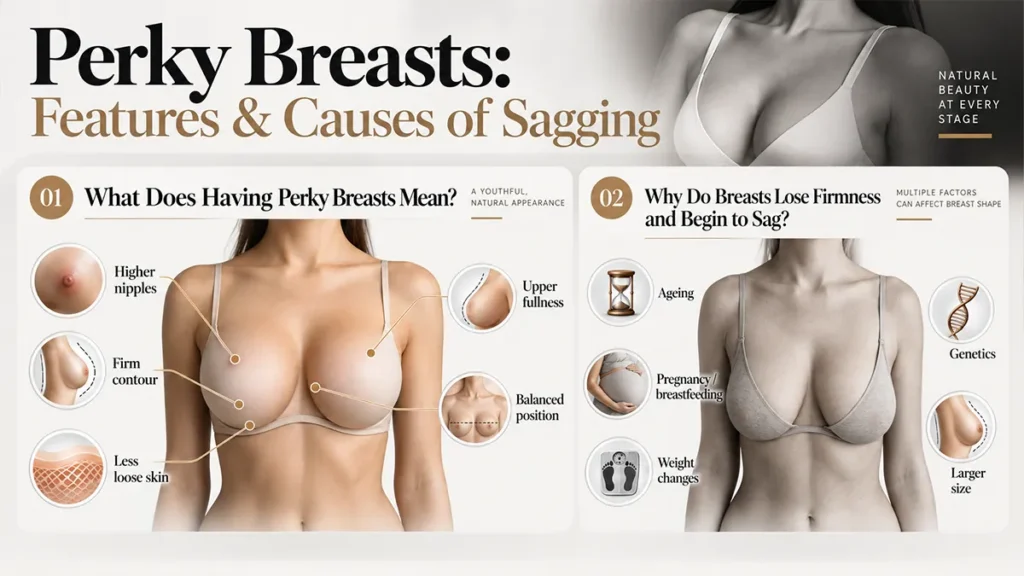
What Does Having Perky Breasts Mean?
The term “perky breasts” usually refers to breasts that sit relatively high on the chest, have a defined shape, and have nipples that face forwards rather than downwards. There is no fixed medical definition because natural breast position and shape vary considerably between individuals.
Features commonly associated with a perkier appearance include:
- Nipples positioned above or level with the breast crease
- A firmer lower breast contour
- Limited loose or hanging skin
- Some fullness in the upper breast
- Balanced position between both breasts
Not every naturally attractive breast has a high, rounded, or youthful appearance. The aim of treatment should be to improve proportion and shape while respecting the patient’s natural anatomy.
What Is Upper Pole Fullness?
Upper pole fullness refers to the amount of volume in the upper part of the breast above the nipple. Some breasts naturally have more fullness in this area, while others have a gentler slope from the upper chest to the nipple.
Upper pole fullness can decrease with ageing, pregnancy, breastfeeding, weight loss or changes in breast volume. A breast uplift can raise and reshape existing tissue, but it does not necessarily create substantial upper-pole volume. Breast implants or, in selected cases, fat transfer may be considered when additional fullness is also desired.
Why Do Breasts Lose Firmness and Begin to Sag?
Breasts lose firmness when the skin and supporting tissues gradually stretch and become less able to hold the breast in its previous position. This process, known as breast ptosis, may happen slowly with age or more noticeably after pregnancy, weight change, or significant loss of breast volume.
Common causes of breast sagging include:
- Ageing and reduced skin elasticity
- Pregnancy and breastfeeding-related volume changes
- Weight gain and weight loss
- Genetics and natural tissue quality
- Larger or heavier breast size
These factors often work together rather than acting alone. The degree of sagging depends on skin strength, breast weight, hormonal change, lifestyle, and the patient’s individual anatomy.
✓ How Does Ageing Affect Breast Position?
Ageing gradually reduces the amount of collagen and elastin in the skin, making the breast envelope less firm and less resistant to stretching. Breast tissue may also become softer or lose volume, which can make the breast appear lower or emptier.
Age-related breast changes may include:
- Thinner and less elastic skin
- Reduced upper breast fullness
- Stretching of internal supporting tissues
- Lower nipple position
- Increased softness of the breast tissue
These changes are a normal part of ageing and vary greatly between patients. Surgery can improve breast shape and position, but it cannot stop the natural ageing process completely.
✓ How Do Pregnancy and Breastfeeding Affect Breast Shape?
Pregnancy causes the breasts to enlarge as glandular tissue develops and the skin stretches to accommodate the increased volume. After pregnancy or breastfeeding, the breast may reduce in size without the skin returning fully to its previous tightness.
Possible changes include:
- Loss of upper breast fullness
- Stretched breast skin
- Lower breast position
- Changes in nipple height
- Increased asymmetry
Pregnancy itself is an important cause of breast change, whether or not the patient breastfeeds. The final effect depends on breast size, skin quality, weight change, genetics, and the number of pregnancies.
✓ How Do Weight Changes Affect Breast Firmness?
Weight gain can increase breast volume and place additional pressure on the skin and supporting tissues. Weight loss may then reduce breast fat, leaving the skin loose and the breast looking flatter or lower.
Weight-related changes may include:
- Increased breast size during weight gain
- Loss of fullness after weight reduction
- Loose or stretched skin
- Reduced upper pole volume
- Greater breast asymmetry
Repeated weight fluctuation can make these changes more noticeable over time. Patients considering surgery are usually advised to reach a stable weight before treatment so that the result is more predictable.
Can You Make Your Breasts Perkier Naturally?
Natural methods may improve the way the breasts are supported or presented, but they cannot physically remove excess skin or reposition breast tissue. Their effect is usually modest and depends on the degree of breast sagging.
Helpful measures may include:
- Maintaining a stable weight
- Wearing supportive bras
- Improving posture
- Avoiding smoking
- Protecting the skin from excessive sun exposure
These measures may help preserve skin quality and reduce additional strain on the breasts. They should not be expected to produce the same structural change as breast uplift surgery.
✓ Can Exercise Lift Sagging Breasts?
Exercise can strengthen the pectoral muscles beneath the breasts and improve posture, which may make the chest appear firmer or more lifted. It cannot directly tighten stretched breast skin or move a low nipple because the breast itself is not made of muscle.
Exercises that may improve chest appearance include:
- Press-ups
- Chest presses
- Chest fly exercises
- Plank variations
- Upper back and shoulder exercises
Improved muscle tone may enhance the contour beneath the breast and support better posture. However, exercise cannot correct moderate or severe breast ptosis.
✓ Which Exercises May Improve Chest Appearance?
Exercises that strengthen the chest, shoulders, upper back, and core may improve the overall presentation of the upper body. They can be particularly helpful when rounded shoulders or weak posture make the breasts appear lower.
Useful exercises may include:
- Incline or standard press-ups
- Dumbbell chest presses
- Resistance-band chest fly exercises
- Rows and reverse fly exercises
- Planks and core-strengthening movements
These exercises can improve posture and muscle definition when performed consistently. They do not replace surgery where loose skin and breast descent are the main concerns.
✓ Can Wearing the Right Bra Make Breasts Look Perkier?
A correctly fitted bra can lift and support the breasts while it is being worn, creating a firmer and more balanced appearance under clothing. It may also reduce discomfort by distributing breast weight more effectively across the shoulders and chest.
A supportive bra should provide:
- A firm but comfortable underband
- Cups that fully contain the breast tissue
- Straps that do not dig into the shoulders
- Appropriate support for the breast size
- Additional control during exercise
A bra does not permanently tighten the skin or reposition the breast tissue. Its effect is temporary, but it can significantly improve comfort, shape, and appearance in clothing.
✓ Can Creams or Skincare Products Firm the Breasts?
Moisturisers and skincare products can improve skin hydration, softness, and surface texture, but they cannot create a true breast lift. Creams cannot remove excess skin, raise the nipple, or reshape the underlying breast tissue.
Skincare may help with:
- Improving skin hydration
- Supporting a smoother skin texture
- Reducing dryness
- Protecting the skin barrier
- Improving the appearance of superficial skin quality
Products marketed as non-surgical breast lifts often make claims that exceed what topical treatment can realistically achieve. Patients should be cautious of creams that promise permanent lifting or major structural change.
✓ Can Better Posture Make the Breasts Look More Lifted?
Better posture can make the chest appear more open and the breasts appear higher by reducing rounded shoulders and forward slumping. This improves presentation rather than changing the actual position of the breast tissue.
Postural improvement may involve:
- Strengthening the upper back
- Stretching the chest muscles
- Improving shoulder alignment
- Strengthening the core
- Adjusting sitting and standing habits
Posture work can complement exercise and supportive clothing. It cannot correct stretched skin, low nipples, or significant breast sagging.
✓ Does Weight Loss Make Breasts Perkier?
Weight loss does not reliably make breasts perkier because the breasts may lose volume as body fat decreases. In some patients, this creates a smaller breast with more loose skin and a lower position.
The effect of weight loss depends on:
- The amount of weight lost
- Age and skin elasticity
- Original breast size
- Speed of weight reduction
- Previous pregnancy or weight fluctuation
Patients planning substantial weight loss should usually complete it before considering breast surgery. A stable weight allows the surgeon to assess the true degree of skin excess and volume loss.
Can Breast Implants Make Breasts Perkier?
Breast implants can restore lost volume and improve upper breast fullness, particularly where the breasts appear deflated rather than significantly droopy. They do not reliably correct moderate or severe sagging when the nipple sits low or the skin envelope is excessively stretched.
Implants may help by:
- Restoring breast volume
- Increasing upper pole fullness
- Improving projection
- Enhancing mild asymmetry
- Supporting shape in selected patients
Using an implant that is too large to fill loose skin may place additional strain on the tissues and worsen future drooping. Where significant ptosis is present, a breast uplift may be needed with or without an implant.
✓ When Are Breast Implants Alone Appropriate?
Implants alone may be suitable when the main concern is volume loss and the nipple remains at or above the breast crease. They are less suitable when there is substantial excess skin or a clearly low nipple position.
Implants alone may be considered when there is:
- Mild breast deflation
- Good skin quality
- Limited breast sagging
- A desire for greater fullness
- A nipple in a relatively good position
A detailed examination is needed to determine whether implants alone can achieve the desired result. Choosing augmentation without uplift when significant sagging is present may lead to disappointment or an unbalanced appearance.
What Is a Breast Uplift?
A breast uplift, also called mastopexy, is an operation that raises and reshapes sagging breasts by removing excess skin and repositioning the breast tissue. The nipple and areola may also be moved to a higher position to create a more balanced contour.
A breast uplift may involve:
- Removing stretched or excess skin
- Reshaping the existing breast tissue
- Repositioning the nipple and areola
- Reducing an enlarged areola where appropriate
- Improving differences between the breasts
A breast uplift changes breast position and shape rather than simply increasing size. It can create a firmer appearance, but it does not stop future changes caused by ageing, pregnancy, or weight fluctuation.
✓ What Can a Breast Uplift Improve?
A breast uplift can improve breasts that sit lower on the chest, appear deflated, or have nipples that point downwards. It may also improve asymmetry when one breast or nipple sits lower than the other.
The procedure may address:
- Low breast position
- Downward-facing nipples
- Loose or stretched skin
- Enlarged areolas
- Uneven breast shape
The degree of improvement depends on the patient’s anatomy, skin quality, and the amount of lifting required. Perfect symmetry cannot be guaranteed because natural differences in the chest and breast tissues remain.
✓ What Types of Breast Uplift Scars Are Possible?
The scar pattern used during breast uplift surgery depends on the amount of loose skin and the degree of breast descent. More extensive sagging usually requires a longer scar to remove enough skin and reshape the breast safely.
Possible scar patterns include:
- A scar around the areola
- A scar around the areola with a vertical line
- An anchor-shaped or inverted-T scar
- A scar hidden within the breast crease
- Different patterns between breasts where asymmetry is significant
Breast uplift scars are permanent, although they usually fade and soften over time. The final appearance of the scars depends on healing, skin type, aftercare, and individual scar behaviour.
✓ Can a Breast Uplift Be Combined With Implants?
A breast uplift can be combined with implants when the patient has both sagging and loss of breast volume. The uplift raises the breast while the implant adds fullness, projection, or upper pole volume.
Combined surgery may help to:
- Restore volume lost after pregnancy
- Improve upper breast fullness
- Raise low breast tissue
- Correct moderate asymmetry
- Create a fuller breast shape
Combining procedures can be more complex than performing an uplift alone. Some patients may be advised to have surgery in stages if this offers better control or reduces risk.
Can Fat Transfer Make the Breasts Look Perkier?
Fat transfer can add modest volume to the breasts by using fat taken from another area of the body. It may improve mild deflation, but it does not remove loose skin or create the same lift as mastopexy.
Fat transfer may offer:
- A subtle increase in breast volume
- Use of the patient’s own tissue
- Improvement in selected asymmetries
- Additional shaping after uplift surgery
- Liposuction of a suitable donor area
Some transferred fat is naturally reabsorbed, so the final volume may be less than the amount initially injected. More than one treatment may be needed, particularly when a larger increase is desired.
Breast Uplift Before and After Photos


What Happens During a Breast Surgery Consultation?
A breast surgery consultation allows the surgeon to assess the cause and degree of sagging and discuss the patient’s preferred result. It also provides an opportunity to compare uplift, implants, fat transfer, and combined procedures.
The consultation may include:
- Review of medical history and medication
- Assessment of skin and tissue quality
- Measurement of breast and nipple position
- Discussion of scars and surgical options
- Explanation of risks and recovery
The consultation should establish what is realistically achievable and whether surgery is appropriate. Patients should leave with a clear understanding of the proposed treatment, limitations, and long-term considerations.
What Are the Risks of Breast Uplift Surgery?
Breast uplift surgery carries risks even when it is performed by an appropriately qualified plastic surgeon. Complications are uncommon in many patients, but they can affect healing, appearance, sensation, or the need for further treatment.
Possible risks include:
- Bleeding, infection, or delayed healing
- Unfavourable or widened scars
- Changes in nipple or breast sensation
- Breast asymmetry
- Need for revision surgery
Some complications are temporary, while others may require additional treatment or surgery. The surgeon should explain individual risk factors before the patient decides whether to proceed.
✓ What Additional Risks Apply When Implants Are Used?
Breast implants introduce risks that do not apply to uplift surgery alone. These risks may occur soon after surgery or develop several years later.
Implant-related risks include:
- Capsular contracture
- Implant rupture or leakage
- Implant displacement
- Rippling or implant visibility
- Future implant replacement
Implants are not lifetime devices and may require monitoring or further surgery. Patients should understand these long-term responsibilities before choosing combined uplift and augmentation.
✓ Can Breast Uplift Surgery Affect Breastfeeding?
Some patients can breastfeed after breast uplift surgery, but the ability to do so cannot be guaranteed. The effect depends on the surgical technique and how much glandular tissue, nipple tissue, and milk duct connection are preserved.
Factors that may affect breastfeeding include:
- The degree of nipple repositioning
- The amount of tissue reshaping
- Previous breast surgery
- Natural milk production
- Future pregnancy-related changes
Patients who hope to breastfeed should discuss this before surgery. Future pregnancy may also alter the surgical result by stretching the skin and changing breast volume again.
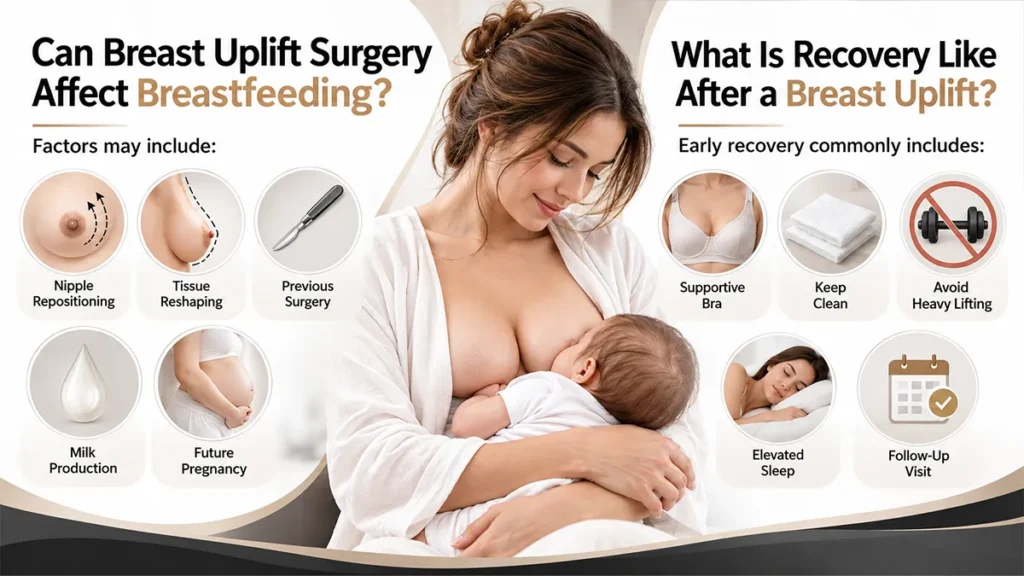
What Is Recovery Like After a Breast Uplift?
Recovery after breast uplift surgery usually involves swelling, bruising, tightness, and mild to moderate discomfort during the early period. The breasts gradually soften and settle as healing progresses.
Early recovery commonly includes:
- Wearing a supportive surgical bra
- Keeping dressings and wounds clean
- Avoiding heavy lifting
- Sleeping in a comfortable elevated position
- Attending follow-up appointments
Most patients can manage light daily activities before they are ready for strenuous exercise. Final breast shape and scar appearance continue to change over several months.
✓ When Can Patients Return to Work?
Return to work depends on the extent of surgery, the patient’s recovery, and the physical demands of the job. Desk-based work is usually easier to resume than work involving lifting, reaching, or repetitive upper-body movement.
Return-to-work planning should consider:
- Pain and movement
- Tiredness
- Commuting
- Physical job duties
- Wound healing
Patients should not return simply because discomfort has improved if their work could strain the healing tissues. Individual advice from the surgical team should guide the timing.
✓ When Can Patients Exercise Again?
Gentle walking is usually encouraged early to support circulation and mobility. More demanding exercise must be reintroduced gradually to avoid placing pressure on wounds and internal healing.
Exercise restrictions may apply to:
- Heavy lifting
- Running or high-impact activity
- Swimming
- Upper-body training
- Chest exercises
The exact timeline varies between patients and procedures. Full exercise after breast lift should resume only when the surgeon confirms that healing is progressing appropriately.
✓ When Will the Final Result Be Visible?
The breasts may initially look swollen, firm, or higher than expected after surgery. Their position and shape usually become more natural as swelling reduces and the tissues settle.
Changes during healing may include:
- Reduction in swelling
- Softening of the breasts
- Gradual settling of shape
- Fading of bruising
- Maturation of scars
The result may continue to develop for several months. Ageing, pregnancy, gravity, and weight changes can still alter breast shape in the future.
What Are the Alternatives to Breast Uplift Surgery?
Alternatives to breast uplift surgery may improve support, volume, or appearance without removing excess skin. Their effectiveness depends on whether the main concern is mild deflation, posture, breast size, or significant sagging.
Possible alternatives include:
- Supportive or padded bras
- Chest and posture exercises
- Breast implants for mild deflation
- Fat transfer for modest volume
- Choosing no surgical treatment
These options may be suitable when the patient does not want surgery or when sagging is limited. They do not reproduce the structural change achieved by removing skin and repositioning breast tissue.
✓ Are Non-Surgical Breast Lifts Effective?
Treatments marketed as non-surgical breast lifts may use radiofrequency, ultrasound, threads, or skin-tightening technology. Their results are generally modest and are not equivalent to breast uplift surgery.
Limitations may include:
- Minimal change in nipple position
- Limited effect on loose skin
- Temporary results
- Need for repeated treatment
- Variable clinical evidence
Non-surgical treatments may improve skin texture in selected patients, but they cannot reliably correct significant breast ptosis. Patients should be cautious of claims that promise a surgical-level lift without surgery.
Who Is Suitable for a Breast Uplift?
Suitable patients are generally healthy adults with sagging, loose skin, or low nipple position who understand the benefits and limitations of surgery. They should also be at a stable weight and willing to follow recovery advice.
Potential candidates may have:
- Breasts that sit lower than desired
- Downward-facing nipples
- Loose skin after pregnancy
- Deflation after weight loss
- Realistic expectations
Suitability can only be confirmed after examination and medical assessment. The operation should be chosen for personal reasons rather than in response to pressure from another person.
✓ Who May Not Be Suitable?
Breast uplift surgery may need to be delayed or avoided when health, lifestyle, or future plans could increase risk or reduce the durability of the result. Some patients may require further assessment or a different treatment plan.
Reasons to delay or avoid surgery may include:
- Pregnancy or breastfeeding
- Planned major weight loss
- Uncontrolled medical conditions
- Active smoking
- Unrealistic expectations
Patients must also be able to accept permanent scars and the possibility of future revision. Declining or postponing surgery may be the safest decision when risks outweigh likely benefits.
How Much Does a Breast Uplift Cost?
The cost of breast uplift surgery varies according to the hospital, anaesthetic, surgical complexity, and whether implants or fat transfer are included. A fixed quotation should only be provided after consultation and examination.
The total fee may include:
- Surgeon’s fees
- Hospital and theatre charges
- Anaesthetic fees
- Support garments
- Follow-up appointments
Patients should confirm exactly what is included and whether future revision would involve additional fees. Price should be considered alongside surgeon qualifications, hospital standards, safety, and continuity of care.
✓ What Long-Term Costs Should Patients Consider?
Breast uplift surgery may involve future costs if the breasts change or further treatment becomes necessary. These costs are more likely when implants are used or when pregnancy, ageing, or weight change alters the result.
Possible long-term costs include:
- Revision surgery
- Scar treatment
- Implant replacement
- Medical assessment
- Further reshaping after pregnancy
Patients should consider both the initial fee and the possibility of future treatment. Breast surgery should be viewed as a long-term commitment rather than a one-off cosmetic purchase.
Summary
Breasts may look perkier with supportive bras, posture, exercise, and stable weight, but these measures cannot remove loose skin or significantly raise low breast tissue. Breast uplift surgery, with or without implants or fat transfer, offers the most effective structural correction when sagging is moderate or severe.
FAQs About Achieving Perky Breasts

Can sleeping position affect how perky my breasts stay over time?
Yes, consistently sleeping on your stomach or side can contribute to breast tissue displacement and reduced skin elasticity over time. While not the sole cause of sagging, back sleeping with good support is often recommended to help maintain perkiness longer.
Is it true that running without a sports bra can make breasts droop faster?
Absolutely. High-impact activities like running create repeated strain on Cooper’s ligaments, which support breast structure. Without proper support, this can accelerate stretching and sagging.
Can breastfeeding make my breasts less perky even if I don’t lose volume?
Pregnancy causes breast enlargement and skin stretching, and breast shape may change as volume reduces afterwards. Breastfeeding itself is not necessarily the main cause of sagging; pregnancy, breast size, skin quality, weight change and individual anatomy all contribute.
Is there such a thing as too much perkiness?
Overcorrection during surgery or high-profile implants can create an overly lifted or artificial look, where the breasts sit unnaturally high. A skilled surgeon like Miss Anca Breahna aims for balanced, proportionate results that reflect your natural anatomy.
Can losing weight make my breasts perkier?
Not usually. While fat loss may reduce breast size, it can also lead to deflation and sagging if the skin doesn’t retract. In some cases, weight loss highlights the need for surgical lifting to restore firmness.
Do smaller breasts naturally stay perkier for longer?
In general, yes. Smaller breasts experience less gravitational pull and stretching over time. However, genetics and skin quality also play a significant role regardless of size.
Can targeted chest workouts make breasts look perkier immediately?
Chest workouts won’t lift the breasts themselves, but can build the pectoral muscles underneath, giving the illusion of a slightly higher position. Consistency over time helps improve the overall firmness of the upper chest.
Is nipple position the most important factor in whether breasts look perky?
Nipple position plays a key role, especially in surgical planning, but it’s not the only factor. Skin tightness, breast volume distribution, and upper-pole fullness also significantly influence perceived perkiness.
Could wearing a bra all the time prevent sagging?
There’s no conclusive evidence that wearing a bra constantly prevents sagging. However, properly fitted bras can reduce strain during daily activity and exercise, which helps slow down natural changes over time.
Can I have a lift without implants and still get perky results?
Yes. A breast uplift (mastopexy) without implants can effectively elevate and reshape your natural tissue for a perky, youthful contour. It’s ideal for those satisfied with their volume but seeking better shape and position.
Medical References
- Longevity of ptosis correction in mastopexy and reduction mammaplasty: A systematic review of techniques / JPRAS Open / https://www.jprasopen.com/article/S2352-5878%2822%2900033-X/fulltext
- Systematic review of outcomes and complications in nonimplant-based mastopexy surgery / Journal of Plastic, Reconstructive & Aesthetic Surgery / https://pubmed.ncbi.nlm.nih.gov/30527707/
- Modified double space technique for augmentation mastopexy / Brazilian Journal of Plastic Surgery / https://www.rbcp.org.br/details/3081/en-US/modified-double-space-technique-for-augmentation-mastopexy
Arrange a Breast Uplift Consultation With Miss Anca Breahna
If you’ve been wondering how to get perky breasts and feel more confident in your body, now is the time to explore your options. Whether you’re looking for a lift, subtle volume, or a full transformation, Miss Anca Breahna offers safe, refined, and natural-looking solutions that reflect your individuality.
As one of the few female Consultant Plastic & Reconstructive Surgeons in Chester, she understands both the technical and emotional aspects of your decision. Her consultations are always collaborative, allowing you to express your goals and explore the best approach together.
Exploring Miss Breahna’s website pages gives you an overview of your aesthetic improvement options. Visit the contact page and complimentary photo assessment page are easy to navigate for you to start booking a consultation and begin your journey toward lifted, perky, and natural-looking breasts. Achieve balance, beauty, and confidence with expert care that puts you first.
Download Anca Breahna’s Breast Uplift Guide
Further Reading
- Read Miss Anca Breahna’s Procedure Page on Breast Reduction
- Read Miss Anca Breahna’s Procedure Page on Breast Asymmetry Surgery
- Read Miss Anca Breahna’s Procedure Page on Breast Implant Removal and Uplift
- Read Miss Anca Breahna’s Patient Guide to Preparing for Your Surgery
- Read Miss Anca Breahna’s Blog about How to Get Firmer Breasts
- Read Miss Anca Breahna’s Blog about Breasts After Weight Loss
- Read Miss Anca Breahna’s Blog about How to Fix Asymmetrical Breasts
About Anca Breahna – Consultant Plastic Surgeon
 Miss Anca Breahna, PhD, MSc, FEBOPRAS, FRCS (Plast), is a Consultant Plastic, Reconstructive and Aesthetic Surgeon in Chester with extensive experience in cosmetic and reconstructive breast surgery. Her training is especially relevant to mastopexy, where reshaping the breast requires careful judgement of skin excess, breast tissue, nipple position and symmetry rather than simply reducing or increasing volume.
Miss Breahna performs breast uplift surgery in Chester for women affected by breast sagging following pregnancy, breastfeeding, weight change or ageing. Depending on the degree of ptosis, she may recommend a crescent, peri-areolar, vertical or anchor-pattern lift, with treatment planned around the amount of reshaping required and the position of the nipple and areola. As an experienced plastic surgeon in Chester, she also considers whether an uplift alone is appropriate or whether another breast procedure may better address the patient’s goals, while discussing scarring, recovery and realistic long-term expectations in detail.
Back to blog