- Key Takeaways
- Is It Normal for Bras Never to Fit Properly?
- What Bra Fit Problems Are Usually Normal?
- What Bra Fit Problems Are Not Normal?
- What Causes Bras to Fit Poorly?
- ✓ Is the Band Size the Most Important Part of Bra Fit?
- ✓ How Does Breast Shape Affect Bra Fit?
- ✓ Can Breast Asymmetry Cause Bra Fit Problems?
- ✓ Does Breast Drooping Affect Bra Fit?
- ✓ Can Pregnancy, Weight Loss, and Ageing Change Bra Fit?
- How Can You Tell Whether the Problem Is Bra Size or Breast Shape?
- What Should You Try Before Considering Breast Surgery?
- ✓ Can a Professional Bra Fitting Help?
- ✓ Which Bra Styles May Improve Comfort?
- When Might Breast Surgery Improve Bra Fit?
- ✓ Can Breast Reduction Make Bras Fit Better?
- ✓ Can a Breast Uplift Improve Bra Fit?
- ✓ Can Breast Augmentation Solve Bra Fit Problems?
- ✓ Can Breast Asymmetry Be Corrected Surgically?
- ✓ Can Fat Transfer Help With Bra Fit?
- Download the Breast Augmentation Guide
- What Is Recovery Like After Breast Surgery?
- When Should You Contact Your Surgeon After Breast Surgery?
- Breast Augmentation Before and After Photos
- What Happens During a Consultation With Miss Anca Breahna?
- Conclusion
- Proper Bra Fit and Surgical Solution FAQs
- Next Step: Discuss Persistent Bra-Fit Problems With Miss Breahna
- Further Reading
Miss Anca Breahna, PhD, MSc, FEBOPRAS, FRCS (Plast), Consultant Plastic & Reconstructive Surgeon in Chester, explains that bras often fit poorly because breast shape is just as important as bra size. While many bra fitting problems can be solved with better sizing or different styles, some are caused by breast anatomy and may be improved through carefully planned breast surgery.
- Poor bra fit affects women of all ages and breast sizes.
- Breast shape changes naturally after pregnancy, weight loss, ageing, and menopause.
- Commercial bra sizing cannot accommodate every breast shape.
- Most bra discomfort can be improved without surgery.
- Surgery is only appropriate when anatomy is the underlying cause of persistent problems.
Feeling uncomfortable in your bra should not simply be accepted as normal. Understanding why bras fit poorly is the first step towards finding a solution that improves both comfort and confidence.
Key Takeaways
- Bra size is only one factor affecting comfort
- Breast shape influences how every bra fits
- Most fitting problems improve with professional fitting
- Some anatomical concerns cannot be corrected by changing bras alone
- A surgical consultation can help determine whether surgery is appropriate
Many people assume they simply have not found the right bra yet. In reality, persistent fitting problems are often the result of a mismatch between breast anatomy and the way bras are manufactured.
Is It Normal for Bras Never to Fit Properly?
Yes, it is very common to struggle with bra fit because commercially produced bras are designed around standard measurements rather than the wide variety of natural breast shapes. Many women experience recurring problems despite wearing what appears to be the correct bra size.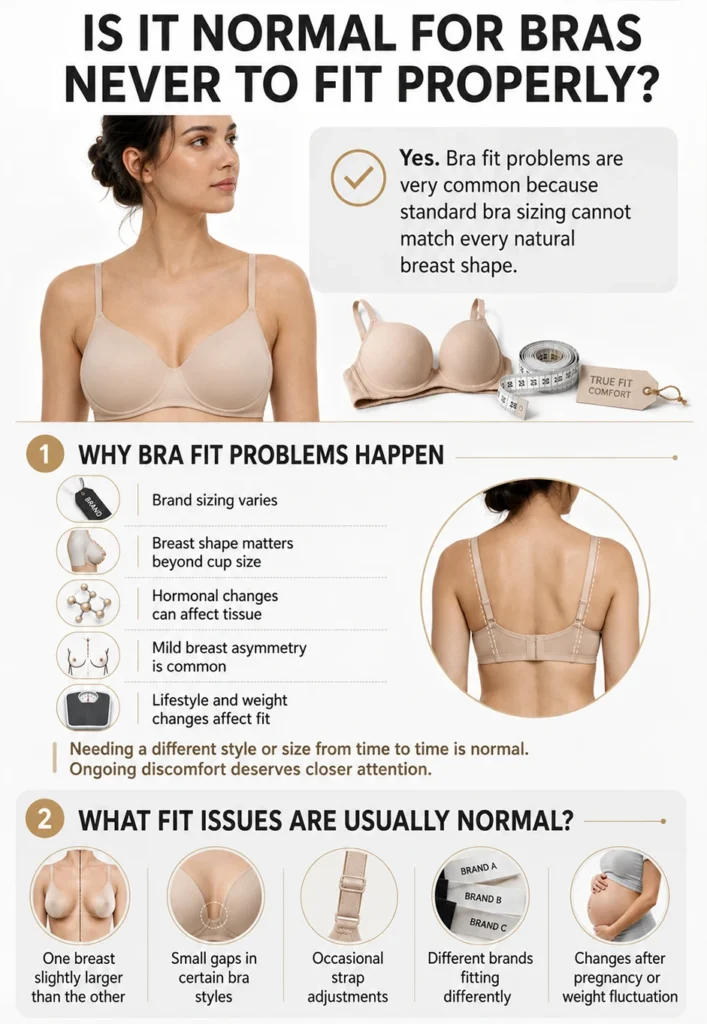
- Different brands use different sizing systems
- Breast shape varies far more than cup size suggests
- Hormonal changes alter breast tissue over time
- Small differences between the breasts are extremely common
- Lifestyle changes frequently affect bra fit
Occasionally needing a different bra style or size is perfectly normal. Persistent discomfort, however, deserves closer attention because it often has an identifiable cause.
What Bra Fit Problems Are Usually Normal?
Minor bra fitting issues are common and usually reflect the natural variation in breast anatomy rather than a medical problem. Many of these concerns can be improved by choosing a different style rather than changing cup size.
- One breast being slightly larger than the other
- Small gaps at the top of certain bra styles
- Needing occasional strap adjustments
- Different brands fitting differently
- Changes after pregnancy or weight fluctuations
These normal variations explain why one bra may fit beautifully while another of the same size feels uncomfortable. Understanding your breast shape is often more helpful than focusing only on the label inside the bra.
What Bra Fit Problems Are Not Normal?
Persistent pain or significant discomfort should not be accepted as part of wearing a bra every day. Ongoing problems may indicate that your bra is unsuitable for your anatomy or that your breast shape would benefit from specialist assessment.
- Constant underwire pain
- Deep shoulder grooves from straps
- Skin irritation beneath the breasts
- Bras that never feel supportive regardless of style
- Significant asymmetry causing persistent fitting difficulties
Daily discomfort can affect posture, physical activity, clothing choices, and quality of life. If bra fitting problems continue despite professional fitting, it may be worthwhile discussing the underlying causes with a specialist.
New or unexplained breast changes, such as a new lump, persistent one-sided swelling, nipple discharge, skin dimpling, nipple inversion or a sudden change in breast size or shape, should be assessed by a GP or breast specialist rather than attributed solely to bra fit.
What Causes Bras to Fit Poorly?
Bras fit poorly for many different reasons, and the problem is often far more complex than simply choosing the wrong cup size. Breast anatomy, tissue quality, body shape, and bra design all influence how supportive and comfortable a bra feels.
- Incorrect band size
- Breast shape mismatch
- Natural breast asymmetry
- Breast drooping (ptosis)
- Changes following pregnancy, ageing, or weight loss
Understanding the true cause makes it much easier to find an effective solution. Rather than continually buying new bras, identifying the underlying issue often saves both time and frustration.
✓ Is the Band Size the Most Important Part of Bra Fit?
Yes, the band provides most of the support in a well-fitting bra and plays a much greater role than many people realise. When the band is too loose, the shoulders and straps are forced to carry more weight than they were designed to support.
- Bands should sit level around the body
- A loose band rides upwards at the back
- Tight straps often compensate for inadequate band support
- Underwires may shift when the band is unstable
- Poor band support increases shoulder discomfort
Many women instinctively tighten their straps when their bra feels unsupportive. In reality, improving band fit often solves the problem far more effectively than adjusting the straps.
✓ How Does Breast Shape Affect Bra Fit?
Breast shape has a major influence on bra fit because two women with the same bra size may have completely different breast proportions. Factors such as breast projection, width, and tissue distribution all affect how a bra sits against the body.
- Projected breasts require deeper cups
- Shallow breasts often suit lower-profile cup designs
- Wide breast roots need broader underwires
- Close-set breasts may require lower centre gores
- Softer breast tissue behaves differently from firmer tissue
Cup size alone cannot account for these anatomical differences. This explains why one bra style may feel perfect while another of the same labelled size feels entirely unsuitable.
✓ Can Breast Asymmetry Cause Bra Fit Problems?
Yes, breast asymmetry is one of the most common reasons bras never seem to fit properly because bras are manufactured symmetrically while breasts rarely are. Even relatively small differences in breast size or shape can make finding a comfortable bra more challenging.
- One cup may fit while the other gaps
- Underwires may sit differently on each side
- Straps often require unequal adjustment
- Clothing may sit unevenly across the chest
- Professional fitting often focuses on the larger breast
Almost everyone has some degree of breast asymmetry. Recognising that this is normal often reassures patients who believe they are simply choosing the wrong bras.
✓ Does Breast Drooping Affect Bra Fit?
Yes, breast drooping, known medically as ptosis, can significantly affect how bras fit because breast tissue sits lower on the chest than many bra designs are intended to accommodate. As the position of the breast changes, the relationship between the breast, underwire, and cup shape also changes.
- Upper cups may gape
- Lower cups may feel overly full
- Underwires may slide onto breast tissue
- Straps may slip more frequently
- Support often feels inconsistent throughout the day
Although supportive bras can improve comfort, they cannot reposition breast tissue permanently. When ptosis is the main anatomical concern and bra fitting remains difficult despite appropriate support, breast uplift surgery may be considered following an individual surgical assessment.
✓ Can Pregnancy, Weight Loss, and Ageing Change Bra Fit?
Yes, breast tissue changes naturally throughout life, meaning a bra that fitted perfectly a few years ago may no longer provide the same comfort or support. Hormonal changes, pregnancy, breastfeeding, menopause, and weight fluctuations all influence breast size, shape, and skin elasticity.
- Pregnancy often increases breast volume
- Breastfeeding can alter breast shape
- Weight loss may reduce breast fullness
- Menopause changes tissue composition
- Ageing gradually reduces skin elasticity
Bra fitting should be viewed as something that evolves alongside your body rather than remaining fixed for life. Reassessing your size and preferred bra style after major life changes can significantly improve comfort.
How Can You Tell Whether the Problem Is Bra Size or Breast Shape?
You can often identify whether the main problem is bra size or breast shape by looking at where the bra fails to support or contain the breast. Repeated problems across several brands and sizes usually suggest a shape mismatch rather than a simple sizing error.
- A band that rides up is usually too loose
- Straps that dig in often indicate poor band support
- Gaping across several styles may suggest a cup-shape mismatch
- Side spillage can mean the wire is too narrow
- A centre gore that lifts may indicate insufficient cup depth or unsuitable spacing
A professional fitting can help distinguish between a size problem and an anatomical mismatch. This is often the most useful step before considering any surgical option.
What Should You Try Before Considering Breast Surgery?
Most persistent bra fit problems should first be addressed with professional fitting, different bra styles, and a careful reassessment of support needs. Surgery is rarely the first solution when discomfort may b e improved through better garment selection.
- Arrange a professional bra fitting
- Try different cup shapes rather than only changing size
- Replace bras that have stretched or lost support
- Test firmer bands, wider straps, or side-support styles
- Consider wire-free options if underwires repeatedly cause pain
These practical changes resolve many fit concerns without surgery. If discomfort continues despite several well-fitted options, a clinical assessment may help identify whether breast anatomy is the underlying cause.
✓ Can a Professional Bra Fitting Help?
Yes, a professional fitting can often reveal problems that are difficult to identify when measuring yourself at home. An experienced fitter will assess not only band and cup size but also breast shape, tissue distribution, and how the bra behaves during movement.
- The fitter can check whether the band is level
- They can identify underwire pressure on breast tissue
- They can compare different cup depths and shapes
- They can assess whether straps are carrying too much weight
- They can suggest styles suited to asymmetry or ptosis
A good fitting is often more valuable than buying several bras in different sizes without guidance. It can also clarify whether the limitation lies with the garment or with a persistent anatomical concern.
✓ Which Bra Styles May Improve Comfort?
Different bra styles suit different breast shapes, and changing the cup design may be more effective than changing the labelled size. The most suitable option depends on breast width, projection, tissue softness, and the level of support required.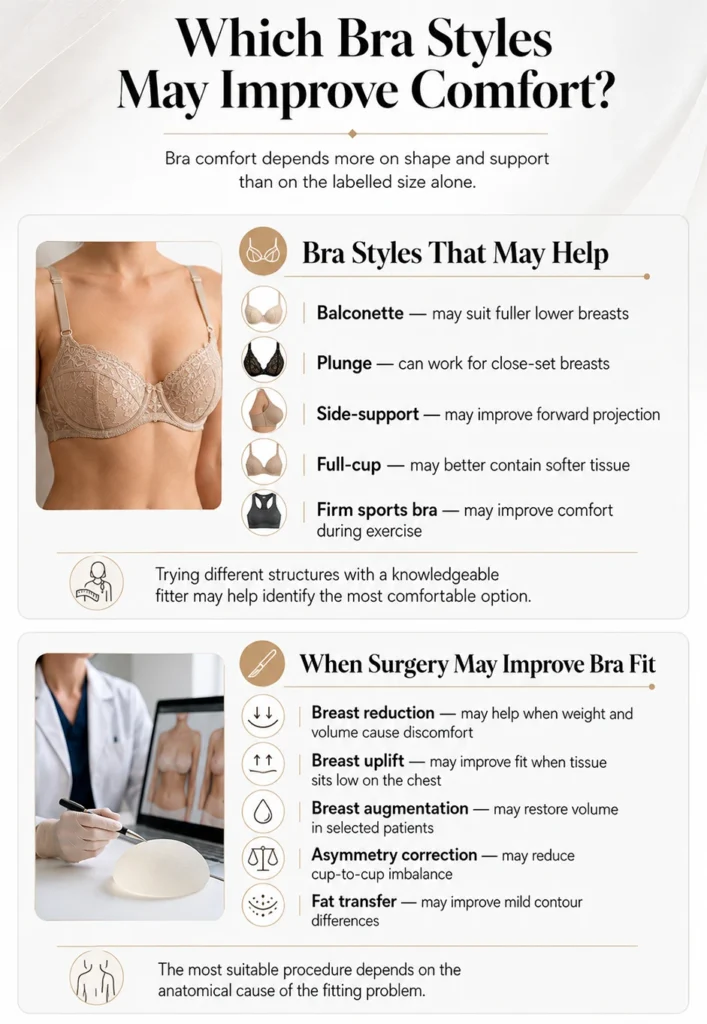
- Balconette bras may suit fuller lower breasts
- Plunge bras can work well for close-set breasts
- Side-support bras may improve forward projection
- Full-cup bras can better contain softer tissue
- Firm sports bras may improve comfort during exercise
No single style is best for everyone. Trying several structures with a knowledgeable fitter can help identify the designs that support your anatomy most comfortably.
When Might Breast Surgery Improve Bra Fit?
Breast surgery may improve bra fit when discomfort is primarily caused by breast size, drooping, asymmetry, or tissue distribution rather than poor sizing alone. The correct procedure depends on which anatomical feature is creating the repeated fitting problem.
-
- Breast reduction may help when weight and volume cause discomfort
- Breast uplift may improve fit when tissue sits low on the chest
- Breast augmentation may restore volume in selected patients
- Asymmetry correction may reduce cup-to-cup imbalance
Surgery should address a specific anatomical concern rather than a general dislike of bra shopping. A careful consultation is essential to determine whether the likely improvement justifies the scars, recovery, and surgical risks.
✓ Can Breast Reduction Make Bras Fit Better?
Breast reduction can make bras easier to fit when large or heavy breasts cause strain, skin irritation, shoulder grooves, or difficulty finding adequate support. The procedure removes excess breast tissue and skin while reshaping the breast to a smaller, more proportionate size.
- Reduces breast weight
- May relieve shoulder and neck discomfort
- Can improve band and strap comfort
- May increase the range of suitable bra styles
- Can make exercise and clothing choices easier
Many patients find that bra fitting becomes more straightforward after breast reduction, although sizing still varies between brands. The procedure also involves permanent scars and a recovery period that should be considered carefully.
✓ Can a Breast Uplift Improve Bra Fit?
A breast uplift can improve bra fit when drooping breast tissue creates upper-cup gaping, lower-cup pressure, or repeated problems with support. The operation reshapes and raises the breast tissue and usually repositions the nipple to a more balanced level.
- Improves breast position
- Reduces excess skin
- Redistributes tissue within the breast
- May improve upper-cup filling
- Can create a more predictable breast footprint
A breast uplift does not primarily increase breast size. It is most appropriate when breast position and shape, rather than lack of volume alone, are the main causes of poor fit.
✓ Can Breast Augmentation Solve Bra Fit Problems?
Breast augmentation may help selected patients whose bras gape because of volume loss after pregnancy, breastfeeding, ageing, or weight loss. It is less suitable when significant drooping is present because implants add volume but do not reliably reposition low breast tissue.
- Restores lost breast volume
- Can improve upper-pole fullness
- May improve cup filling
- Can help selected cases of mild asymmetry
- May be combined with an uplift when ptosis is present
Implants should not be used simply to force loose skin to look full. If the breast sits too low, a lift may be needed to achieve a stable and natural result.
✓ Can Breast Asymmetry Be Corrected Surgically?
Breast asymmetry can be improved surgically when the difference is significant enough to affect comfort, clothing fit, or confidence. Treatment may involve reducing one breast, augmenting the other, lifting one or both sides, or combining techniques.
- Different implant sizes may be used
- One breast may be reduced
- One or both breasts may be uplifted
- Fat transfer may refine smaller differences
- Nipple position may be adjusted where appropriate
Perfect symmetry cannot be guaranteed because the chest wall and soft tissues are naturally different on each side. The goal is to achieve better balance and easier fitting rather than exact mirror-image breasts.
✓ Can Fat Transfer Help With Bra Fit?
Fat transfer to breasts may help patients with mild volume loss, subtle asymmetry, or contour irregularity who want a modest change without implants. Fat is removed from another area of the body and carefully injected into the breast to improve shape.
- Suitable for modest volume enhancement
- May improve mild asymmetry
- Uses the patient’s own tissue
- Can soften contour irregularities
- Does not reliably correct significant drooping
Not all transferred fat survives permanently, so the final increase in volume can be less predictable than with implants. Fat transfer is also not a substitute for breast uplift surgery when low tissue position is the main concern.
Download the Breast Augmentation Guide
What Is Recovery Like After Breast Surgery?
Recovery after breast surgery depends on the procedure performed, but swelling, bruising, tenderness, and temporary changes in breast shape are common during the early weeks. A supportive postoperative bra is often recommended while the tissues heal and settle.
- Support bras are usually worn during early recovery.
- Swelling may make sizing unreliable at first.
- Heavy lifting and strenuous exercise are temporarily restricted.
- Scars gradually mature over several months.
- Final breast shape may take several months to stabilise.
It is usually sensible to delay buying expensive new bras until your surgeon confirms that swelling has reduced sufficiently. Early postoperative fit is temporary and should not be used to judge the final result.
When Should You Contact Your Surgeon After Breast Surgery?
You should contact your surgeon if symptoms become more severe rather than gradually improving, or if you develop signs that may suggest a complication. Prompt advice is particularly important when changes are sudden, one-sided, or accompanied by fever or wound problems.
- Increasing redness or warmth.
- Severe or worsening pain.
- Sudden swelling of one breast.
- Bleeding or discharge from the wound.
- Fever, breathlessness, or feeling acutely unwell.
Some asymmetry and swelling are normal during early healing, but unexpected changes should always be discussed. It is better to seek reassurance early than to wait when you are concerned.
Breast Augmentation Before and After Photos


What Happens During a Consultation With Miss Anca Breahna?
A consultation with Miss Anca Breahna can assess whether breast anatomy – including volume, shape, asymmetry, skin quality and nipple position – may be contributing to persistent bra-fit problems and whether surgery may be appropriate.
- Your symptoms and fitting difficulties will be discussed.
- Breast measurements and proportions will be assessed.
- Suitable surgical and non-surgical options will be explained.
- Scars, recovery, risks, and limitations will be reviewed.
- A personalised treatment plan will be developed where appropriate.
Bringing one or two problematic bras can help demonstrate exactly where the fit breaks down. This practical information can make it easier to identify whether the issue is support, shape, breast position, or a combination of factors.
Conclusion
Bras often fit poorly because standard sizing systems cannot fully account for breast shape, asymmetry, tissue quality, and changes over time. Most problems improve with professional fitting and better style selection, but surgery may help selected patients when anatomy remains the main cause of discomfort.
- Shape can matter as much as size.
- Mild asymmetry is normal.
- Professional fitting should usually come first.
- Surgery can improve comfort in carefully selected cases.
- The most suitable procedure depends on the underlying cause.
A consultation with Miss Anca Breahna can help clarify whether a better bra strategy is likely to be enough or whether breast surgery may offer a more lasting improvement. The aim should be an appropriately planned treatment that reflects the patient’s anatomy, goals, surgical risks and realistic expectations.
Proper Bra Fit and Surgical Solution FAQs

Why does a bra feel perfect in the fitting room, then feel wrong at home the same day?
Small changes in posture, movement, swelling, and strap adjustment can reveal a shape mismatch that is not obvious when you are standing still. Some bras also “settle” as the band warms and stretches slightly, which can change support. If the band starts to ride up or the wires shift onto tissue, it is often a support architecture issue rather than you choosing the wrong number.
Why do cups gape when I lean forward, but feel tight when I stand tall?
That pattern can happen when the cup shape does not match how your tissue distributes with movement. Some breasts are more mobile and change shape with posture, especially if tissue is softer or there is ptosis. In that case, a different cup cut or wire shape may solve the issue without changing size.
Why do my bras fit one breast but not the other, even after a professional fitting?
Asymmetry is common, and a single bra is built symmetrically. The “best” fit often aims for the larger side, then uses style choice or a small insert for the smaller side if needed. If the asymmetry is significant and emotionally or physically bothersome, surgical balancing can be discussed, but it is not required for most people.
Why do underwires always stab the same spot, no matter what brand I buy?
That often suggests the wire shape is consistently wrong for your breast root and chest wall. If the wire sits on breast tissue rather than around it, the same pain point repeats across bras. A fitter can test whether a different wire width, a different cup depth, or a wire-free style is more compatible.
If I have “empty top cups,” is augmentation always the answer?
Not always. “Empty top cup” can reflect ptosis and tissue sitting lower, in which case a lift may be the most direct solution. If you want more volume as well, augmentation can be considered, but implants do not automatically correct droop in significant ptosis, so the plan is individual.
Is it a warning sign if I need the tightest hook on a brand-new bra to feel supported?
Often, yes. Most people need room to tighten as the band relaxes with wear. If you start on the tightest hook, the band may be too loose, or the material may be too stretchy for your support needs, which then shifts the load to the straps and causes discomfort.
Can breast surgery make bra shopping simpler even if my main goal is comfort, not aesthetics?
It can, for the right patient. Reduction may reduce weight and make support easier, while a lift can reposition tissue so cups sit more predictably. The decision should be based on symptoms, anatomy, scar tolerance, and realistic outcomes, discussed in a surgeon-led consultation.
Medical References
- Optimising breast support in female patients through correct bra fit. A cross-sectional study – https://www.sciencedirect.com/science/article/abs/pii/S1440244010000745
- The impact of breast support garments on fit, support and posture of larger-breasted women – https://www.sciencedirect.com/science/article/abs/pii/S0003687022000242
- Comparative Morphological Evaluation of Young Women’s Breast-Bra Reshaping by Different Bra Cups – https://pmc.ncbi.nlm.nih.gov/articles/PMC10002063/
Next Step: Discuss Persistent Bra-Fit Problems With Miss Breahna
If you feel like bras never fit properly, the most likely explanation is not that you are “hard to fit.” It is that bra sizing systems are limited, breast shapes vary widely, and factors like asymmetry and ptosis create repeated compromises. Research supports that poor bra fit is common and that professional fitting criteria can identify a better fit than traditional approaches.
If your bras never fit, the breast shape problem is persistent, or if you suspect symptoms like heaviness, discomfort, or droop are driving the issue, it may be worth exploring a clinical assessment. In Chester, UK, you can book a consultation with Miss Anca Breahna, Consultant Plastic & Reconstructive Surgeon or send your photos for assessment, and bring your most problematic bras so the fit issues can be assessed in a practical, real-world way. Miss Anca Breahna can then advise whether an improved bra strategy is likely to solve the issue, or whether breast surgery may be appropriate for your anatomy, symptoms and goals.
Further Reading
- Read Miss Anca Breahna’s Blog about How to Fix Asymmetrical Breasts
- Read Miss Anca Breahna’s Blog about Solutions for Heavy Breasts
- Read Miss Anca Breahna’s Blog about How to Fix Droopy/Sagging Breasts
- Read Miss Anca Breahna’s Blog about Understanding Bra Cup Sizes and Breast Implant Sizes
- Read Miss Anca Breahna’s Blog about Do I Need a Post-Op Bra After Breast Surgery?
- Read Miss Anca Breahna’s Procedure Page on Tuberous Breast Correction
- Read Miss Anca Breahna’s Procedure Page on Mastopexy Augmentation – Uplift with Implants