- Take our Plastic Surgery Quiz to find out if you'd be a good candidate for cosmetic surgery.
- Understanding Breast Anatomy: The Foundation of Shape
- Download Anca's Breast Augmentation Guide
- What Does “Type” Really Mean?
- Common Breast Shapes: A Visual Spectrum
- Round breasts
- Teardrop (or pear-shaped) breasts
- Bell-shaped breasts
- Side-set breasts
- Asymmetrical breasts
- Athletic breasts
- Relaxed or ptotic breasts
- Tuberous breasts
- Why Breast Shapes Vary
- Genetics
- Age
- Pregnancy and breastfeeding
- Weight fluctuations
- Hormonal factors
- Lifestyle and posture
- Developmental conditions
- When Does Breast Type Matter?
- Aesthetic concerns
- Physical discomfort
- Post-pregnancy changes
- Correcting developmental differences
- Surgical Options Based on Breast Type
- Breast augmentation
- Breast lift (mastopexy)
- Breast reduction
- Tuberous breast correction
- Fat transfer
- Breast Augmentation Before and After Photo
- Embracing Your Breast Type: Confidence Through Understanding
- FAQs About Breast Types
- Take the Next Step with Confidence
- To book a consultation: 📞 07538 012918 📧 contact@ancabreahna.com 🌐 www.ancabreahna.com
- Further Reading
- About Anca Breahna – Consultant Plastic Surgeon
Breasts come in many shapes and sizes, and while this variety is completely natural, many women still find themselves questioning whether their breasts are normal. Some may feel self-conscious about asymmetry or shape, while others might be considering surgical options to feel more confident in their bodies. Understanding the different types of breasts is the first step to self-acceptance and, where needed, making informed decisions about possible treatments.
Miss Anca Breahna is a Consultant Plastic & Reconstructive Surgeon based in Chester, UK. With extensive experience and a patient-focused approach, she works with women who are looking for clarity, reassurance, and options related to their breast appearance and health. In this article, Miss Breahna explores the natural diversity of breast types, explains the anatomy behind breast shapes, and offers insight into when and why patients might consider consulting a specialist.
Take our Plastic Surgery Quiz to find out if you’d be a good candidate for cosmetic surgery.
Understanding Breast Anatomy: The Foundation of Shape
To understand why breasts look the way they do, it helps to first understand their anatomy. Breasts are not made up of muscle, but rather a complex combination of tissues that work together to form their structure.
There are three main types of tissue within the breast:
- Glandular tissue: This includes the milk ducts and lobules, which are responsible for milk production. This tissue gives the breast its functional capability.
- Fatty tissue (adipose tissue): This determines the volume and softness of the breast. The ratio of fat to glandular tissue varies from person to person, influencing size and feel.
- Connective tissue: This includes fibrous bands known as Cooper’s ligaments that help support and shape the breast. Over time, these ligaments can stretch, contributing to sagging or a change in breast position.
The skin covering the breast also plays a vital role in shaping and supporting the tissue underneath. Skin elasticity varies based on age, genetics, pregnancy, and weight changes, all of which can influence breast appearance over time.
Another factor in breast shape is how the breast sits on the chest wall. The placement is influenced by the ribcage, underlying muscles, and the natural width between the breasts. These anatomical features contribute to variations such as breast spacing, projection, and height.
Download Anca’s Breast Augmentation Guide

What Does “Type” Really Mean?
When we refer to a breast “type,” we are really speaking about a combination of characteristics. This includes the overall shape, the way volume is distributed, the position of the nipple, the size, and the symmetry between the two breasts.
No two breasts are exactly the same, even on the same body. Minor differences in size or shape are very common and are usually not a cause for concern. Some women may notice a significant difference between their breasts, while others may be more symmetrical but still have questions about their shape or volume.
In her Chester practice, Miss Anca Breahna often hears from patients who are surprised to learn that their breast shape is completely normal. Many women have spent years thinking something was wrong, only to find out that variations are not just common, they are expected.
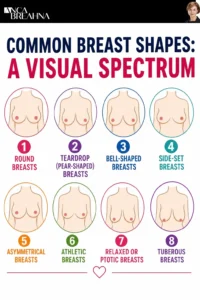
Common Breast Shapes: A Visual Spectrum
There are several commonly observed breast shapes, each defined by how the tissue is distributed and how the breast sits on the chest. Here are some of the most frequent types:
-
Round breasts
These are full at both the top and bottom, giving a balanced, circular appearance. They tend to look symmetrical and are often associated with a youthful contour. Many women naturally have round breasts, while others may achieve this look through augmentation.
-
Teardrop (or pear-shaped) breasts
These are slightly less full at the top and more voluminous at the bottom, resembling a teardrop shape. This shape is very common and is often seen as a natural, graceful contour.
-
Bell-shaped breasts
Wider at the base and narrower at the top, bell-shaped breasts often appear longer and may have a heavier feel. This shape is more common in women with larger breasts and can sometimes contribute to discomfort due to weight.
-
Side-set breasts
Also called “east-west” breasts, this type features a wider space between the breasts with nipples that may point outward slightly. This is a normal anatomical variation and not necessarily a sign of asymmetry.
-
Asymmetrical breasts
Most women have one breast that is slightly different in size or shape than the other. For some, the difference is minimal and hardly noticeable. For others, the variation may be more pronounced, sometimes leading to concerns about clothing fit or self-image.
-
Athletic breasts
Often found in women with a lower body fat percentage or strong chest muscles, athletic breasts tend to be smaller, firmer, and less rounded. They may sit higher on the chest and appear flatter in profile.
-
Relaxed or ptotic breasts
These are breasts where the skin and ligaments have stretched, often due to aging, weight changes, or pregnancy. The result is a downward shift of tissue and sometimes the nipple. This is a natural change and not necessarily a sign of a problem.
-
Tuberous breasts
This is a congenital condition where the breast base is constricted, leading to a narrow shape, larger areolas, and sometimes significant asymmetry. This type of breast may cause emotional distress but can often be corrected surgically.
In her Chester clinic, Miss Anca Breahna works with many patients who experience one or more of these breast types. Some women are simply curious to learn more about their shape, while others are seeking change through cosmetic or reconstructive surgery.
Why Breast Shapes Vary
Breast shape and size are influenced by a number of factors, many of which are outside of our control. Here are the main reasons for natural variation:
-
Genetics
Your DNA largely determines how your breasts develop during puberty and how they change over time. The volume, density, and spacing of your breasts are all inherited traits.
-
Age
As the body ages, changes in collagen, elastin, and hormone levels lead to natural shifts in skin firmness and tissue support. Breasts may become less full, more relaxed, or change position over time.
-
Pregnancy and breastfeeding
Hormonal changes during pregnancy prepare the breast for milk production, often causing temporary increases in volume. After breastfeeding, some women experience a reduction in size or loss of firmness.
-
Weight fluctuations
Because breasts contain fatty tissue, gaining or losing weight can affect their volume and shape. Rapid weight changes may also impact skin elasticity.
-
Hormonal factors
Breast tissue is sensitive to hormone levels, particularly estrogen and progesterone. These fluctuations can affect size and tenderness, particularly during menstrual cycles or menopause.
-
Lifestyle and posture
Wearing an unsupportive bra, poor posture, or repetitive movements can subtly affect how the breasts appear over time. Exercise and chest muscle development can also influence shape and projection.
-
Developmental conditions
Certain medical conditions such as tuberous breast deformity or Poland syndrome can affect how one or both breasts develop. These are usually identifiable during adolescence and may require specialist consultation.
When Does Breast Type Matter?
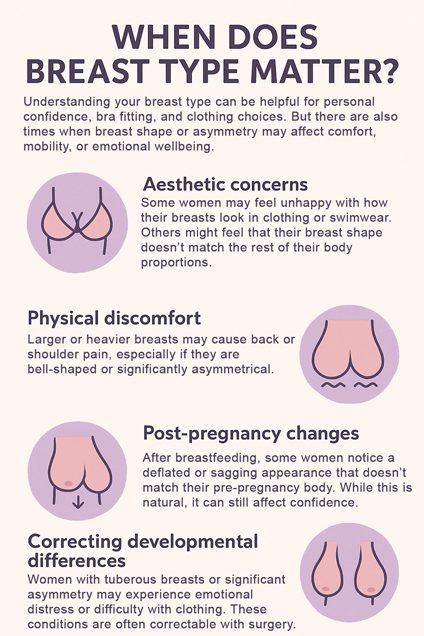
Understanding your breast type can be helpful for personal confidence, bra fitting, and clothing choices. But there are also times when breast shape or asymmetry may affect comfort, mobility, or emotional wellbeing.
-
Aesthetic concerns

Some women may feel unhappy with how their breasts look in clothing or swimwear. Others might feel that their breast shape doesn’t match the rest of their body proportions. In many of these cases, patients seek reassurance or explore options for enhancement or reshaping.
-
Physical discomfort
Larger or heavier breasts may cause back or shoulder pain, especially if they are bell-shaped or significantly asymmetrical. Breasts that have lost firmness can also lead to skin irritation under the fold or difficulty finding supportive clothing.
-
Post-pregnancy changes
After breastfeeding, some women notice a deflated or sagging appearance that doesn’t match their pre-pregnancy body. While this is natural, it can still affect confidence.
-
Correcting developmental differences
Women with tuberous breasts or significant asymmetry may experience emotional distress or difficulty with clothing. These conditions are often correctable with surgery.
In Chester and Liverpool (ASET Hospital), Miss Anca Breahna sees patients for a wide range of reasons. Many are not seeking dramatic change, but rather a return to balance or a solution to a specific concern.
Surgical Options Based on Breast Type
For patients who wish to alter the shape, size, or symmetry of their breasts, several surgical options are available. These are always tailored to the individual, based on anatomy, goals, and lifestyle.
-
Breast augmentation
This procedure involves the placement of implants to enhance volume and shape. It is often suitable for women with flat, athletic, or underdeveloped breasts, or those seeking more upper-pole fullness.
-
Breast lift (mastopexy)
This is designed to elevate and reshape sagging breasts. It may be performed with or without implants, depending on the desired volume and shape. It is commonly requested after pregnancy or weight loss.
-
Breast reduction
For women with large, heavy breasts, reduction surgery can relieve discomfort and improve body proportion. This is particularly helpful for bell-shaped or pendulous breasts.
-
Tuberous breast correction
This involves reshaping the breast base, adjusting the areola, and in some cases using implants to restore symmetry and volume.
-
Fat transfer
This technique uses fat from another area of the body to subtly enhance breast volume or correct asymmetry. It is often used in combination with other procedures.
Miss Anca Breahna, Consultant Plastic Surgeon in Chester, takes a highly individualised approach to all breast surgeries. Her goal is not to create a standard look, but to support each patient in achieving natural, balanced results that feel right for them.
Breast Augmentation Before and After Photo


Embracing Your Breast Type: Confidence Through Understanding
One of the most powerful outcomes of learning about breast types is the realisation that variation is entirely normal. Just because your breasts don’t look like a magazine image doesn’t mean there’s anything wrong.
Self-acceptance is often the first step toward confidence. For some women, that comes from understanding and appreciating their natural shape. For others, it may mean making a change that helps them feel more comfortable in their skin.
At her private practices in Chester (Nuffield Health) and Liverpool (ASET Hospital), Miss Anca Breahna offers supportive consultations to help patients explore their options in a respectful, honest, and informative setting. There is no pressure, only clarity and care.

FAQs About Breast Types
Can sleeping position affect the shape of my breasts over time?
Yes, over time, regularly sleeping on your side or stomach may contribute to slight changes in skin tension or ligament stretching. While not a major cause of sagging, supportive sleepwear or sleeping on your back may help maintain natural shape.
Why do my breasts feel different temperatures?
This is usually related to blood flow or fat distribution. It is generally harmless, but if you notice persistent coldness, discolouration, or discomfort in one breast, it is worth discussing with a specialist.
Can exercise change my breast shape even if I don’t lose weight?
Yes, building the pectoral muscles underneath the breast can slightly lift or firm the appearance. However, the breast tissue itself does not become more toned from exercise.
Why do my nipples point in different directions?
It is a common anatomical variation related to underlying tissue and skin tension. Unless it is a sudden change, it is completely normal and not usually a cause for concern.
Can breastfeeding cause one breast to stay larger than the other?
Yes, some women notice lasting asymmetry if one breast was used more during nursing. This can be corrected if desired, but it is medically harmless.
Do bras actually prevent breasts from sagging?
Wearing a supportive bra may reduce ligament strain during high-impact activity, but it does not prevent natural changes due to age or gravity. Consistent support helps with comfort more than structural preservation.
My breasts have always felt lumpy. Is that a “type”?
Lumpy or dense breast tissue is a common trait, not a specific type. It is important to stay aware of changes and speak with your GP or surgeon if anything feels different over time.
Is it possible to have two different breast shapes at once?
Yes, some women have a combination of shapes like a teardrop on one side and a rounder breast on the other. This is more common than people think and may be corrected if it impacts confidence.
Do breast types differ by ethnicity?
Yes, breast shape, density, and skin elasticity can vary across ethnicities due to genetic differences. These variations are natural and considered during surgical planning for optimal outcomes.
Can I have a breast lift without looking like I have had surgery?
Absolutely. In many cases, Miss Anca Breahna uses advanced techniques to create subtle, natural-looking lifts with minimal scarring, tailored to each patient’s anatomy.
Medical References
- Anatomy and physiology of the breast – a surgically‑relevant outline (Surgery Journal) – https://www.sciencedirect.com/science/article/pii/S0263931924001637 surgeryjournal.co.uk+1
- Biomechanical Behaviour of Female Breast – A Review (MDPI) – https://www.mdpi.com/2673-8430/5/1/5 MDPI
- Breast Biomechanics: What Do We Really Know? (American Journal of Physiology) – https://journals.physiology.org/doi/pdf/10.1152/physiol.00024.2019 journals.physiology.org
Take the Next Step with Confidence
If you are curious about your breast shape, or considering a change, a conversation with a specialist can be invaluable. Miss Anca Breahna, Consultant Plastic & Reconstructive Surgeon in Chester, is here to provide expert insight and guide you through your options.
Appointments are available at:
- Nuffield Health The Grosvenor Hospital, Chester
- ASET Hospital, Liverpool
To book a consultation:
📞 07538 012918
📧 contact@ancabreahna.com
🌐 www.ancabreahna.com
Further Reading
- Read Dr Breahna’s Blog About Types of Breast Implants
- Read Dr Breahna’s Blog About Breast Augmentation Size Chart – Implant Sizes and UK Bra Cup Sizes
- Read Dr Breahna’s Blog About All about Perfect Breasts and How to Get Them
- Read Dr Breahna’s Blog About What’s the Difference – DD Cup vs D Cup?
About Anca Breahna – Consultant Plastic Surgeon
 Miss Anca Breahna, PhD, MSc, FEBOPRAS, FRCS (Plast), is a Consultant Plastic, Reconstructive and Aesthetic Surgeon in Chester with extensive experience in breast surgery. Her reconstructive and aesthetic background gives her a detailed understanding of breast shape, volume, symmetry and tissue characteristics, all of which are important when planning breast enlargement. She assesses each patient’s chest width, existing breast tissue, skin quality and overall proportions before discussing whether augmentation is appropriate.
Miss Breahna performs breast augmentation in Chester for women seeking greater breast volume, improved symmetry or restoration of fullness following pregnancy, breastfeeding or weight loss. Treatment planning includes careful discussion of implant size, shape and placement, as well as incision position, expected scarring and long-term considerations. As an experienced plastic surgeon in Chester, Miss Breahna focuses on selecting an implant and surgical approach that suits the patient’s individual anatomy and goals, while ensuring that expectations, risks and recovery are clearly understood before surgery.
Back to blog