- Introduction
- Quick Answer: How Can You Reduce Breast Size?
- Can Breast Size Be Reduced Naturally?
- Why Do Breasts Become Enlarged?
- When Should You Consider Breast Reduction?
- Do Non-Surgical Methods Reduce Breast Size?
- Does Weight Loss Reduce Breast Size?
- Can Exercise Make Breasts Smaller?
- Can Hormonal Treatment Reduce Breast Size?
- Do Breast Reduction Creams or Devices Work?
- How Does Breast Reduction Surgery Work?
- Which Breast Reduction Techniques Are Available?
- ✓ What Is the Anchor Breast Reduction Technique?
- ✓ What Is the Vertical or Lollipop Technique?
- ✓ Can Liposuction Reduce Breast Size?
- What Results Can You Expect From Breast Reduction?
- How Are Symmetry, Shape, and Nipple Position Improved?
- What Are the Risks of Breast Reduction Surgery?
- What Temporary Effects Are Common After Breast Reduction?
- Can Breast Reduction Affect Nipple Sensation?
- Can Breast Reduction Affect Breastfeeding?
- When Should You Contact Your Surgeon?
- What Is Recovery Like After Breast Reduction?
- ✓ What Happens During the First 48 Hours?
- ✓ What Happens During the First Week?
- ✓ When Can You Return to Work?
- ✓ When Can You Drive?
- ✓ When Can You Exercise Again?
- How Should Breast Reduction Scars Be Cared For?
- Breast Reduction Before and After Photos
- What Alternatives Are Available to Breast Reduction Surgery?
- Can Supportive Bras Help?
- Can Physiotherapy Help?
- Can Weight Management Replace Surgery?
- Who Is Suitable for Breast Reduction Surgery?
- Who May Need to Delay Surgery?
- How Much Does Breast Reduction Cost?
- What Additional Costs Should Patients Consider?
- What Is the Main Message About Reducing Breast Size?
- Breast Size Reduction FAQs
- How Can Patients Arrange a Breast Reduction Consultation With Miss Anca Breahna?
- Download Anca Breahna's Breast Reduction Guide
- Further Reading
- About Anca Breahna – Consultant Plastic Surgeon
Introduction
Miss Anca Breahna, PhD, MSc, FEBOPRAS, FRCS (Plast), is a Consultant Plastic, Reconstructive and Aesthetic Surgeon with extensive experience in breast surgery. Breast size may reduce with weight loss when the breasts contain a significant amount of fatty tissue, but excess glandular tissue and stretched skin usually require breast reduction surgery for a substantial and lasting change. The most appropriate treatment depends on breast composition, symptoms, anatomy, and personal goals.
Overly large breasts can affect far more than appearance. They may contribute to neck, shoulder, and back discomfort, bra-strap grooves, skin irritation, difficulty exercising, problems finding suitable clothing, and unwanted attention. These concerns can influence daily comfort, mobility, confidence, and overall quality of life.
This guide explains the available surgical and non-surgical ways to reduce breast size. It covers natural approaches, breast reduction techniques, expected results, risks, recovery, alternatives, suitability, costs, and frequently asked questions. The aim is to help patients understand what each option can realistically achieve before deciding whether to seek treatment.
Quick Answer: How Can You Reduce Breast Size?
Breast size may reduce through weight loss when a substantial proportion of the breast is made of fatty tissue. When the main concern is excess glandular tissue, loose skin, or significant breast weight, reduction mammaplasty is usually the most effective option.
Possible approaches include:
- Weight management
- Regular cardiovascular exercise
- Supportive bras and physiotherapy
- Liposuction in selected patients
- Surgical breast reduction
Non-surgical methods may improve comfort or reduce fatty volume, but they cannot reliably remove glandular tissue or significant loose skin. A clinical assessment is needed to determine which option is most appropriate.
Can Breast Size Be Reduced Naturally?
Breast size can sometimes decrease naturally when overall body fat is reduced, but the effect varies between patients. Natural methods are more likely to help when the breasts contain a high proportion of fatty tissue rather than dense glandular tissue.
Factors that influence natural reduction include:
- Body fat percentage
- Breast tissue composition
- Genetics
- Hormonal influences
- Skin elasticity
Weight loss may make the breasts smaller without necessarily improving drooping or loose skin. Patients should therefore distinguish between reducing breast volume and improving breast shape.
Why Do Breasts Become Enlarged?
Breasts may become enlarged because of genetics, hormones, pregnancy, weight gain, or natural tissue development. In many patients, several factors contribute at the same time.
Common causes include:
- Family history and genetics
- Puberty and hormonal development
- Pregnancy and breastfeeding
- Weight gain
- Menopause or other hormonal change
Breast size may also change over time even when body weight remains relatively stable. Understanding the likely cause helps determine whether weight loss, medical review, or surgery is most appropriate.
When Should You Consider Breast Reduction?
Breast reduction may be worth considering when breast size interferes with comfort, mobility, clothing, exercise, or emotional wellbeing. The decision should be based on symptoms and quality of life rather than cup size alone.
Common reasons include:
- Neck, shoulder, or back pain
- Deep bra-strap grooves
- Recurrent skin irritation beneath the breasts
- Difficulty exercising
- Problems finding supportive clothing
Some patients also experience self-consciousness, unwanted attention, or frustration with how their body feels in daily life. A consultation can help establish whether these concerns are likely to improve through surgery.
Do Non-Surgical Methods Reduce Breast Size?
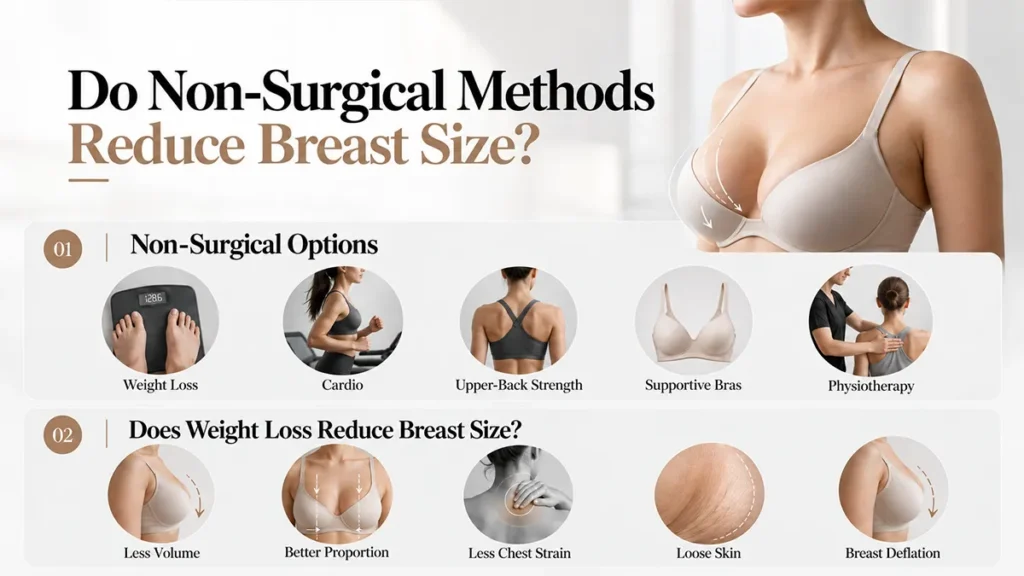
Non-surgical methods may reduce fatty volume or improve support, posture, and comfort, but they cannot reliably remove glandular tissue. Their usefulness depends on the reason the breasts are enlarged and the amount of structural change required.
Non-surgical options may include:
- Weight loss
- Cardiovascular exercise
- Chest and upper-back strengthening
- Supportive bras
- Physiotherapy
These measures may be worthwhile before considering surgery, particularly when weight is still changing. They should not be expected to produce the same reduction or lifting effect as breast reduction surgery.
Does Weight Loss Reduce Breast Size?
Weight loss may reduce breast size when the breasts contain a significant amount of fat. The extent of change is unpredictable because glandular tissue does not respond in the same way.
Weight loss may lead to:
- Reduced breast volume
- Improved body proportion
- Less strain on the chest
- Increased loose skin
- Greater breast deflation
Patients planning breast reduction are usually advised to reach a stable weight first. This allows the surgeon to assess the final amount of breast tissue and skin that may need treatment.
Can Exercise Make Breasts Smaller?
Exercise can reduce overall body fat and improve the strength of the chest, shoulders, and back. It cannot directly remove glandular breast tissue or tighten significantly stretched breast skin.
Exercise may help by:
- Supporting weight loss
- Improving posture
- Strengthening the upper body
- Making physical activity easier
- Reducing musculoskeletal strain
Chest exercises may improve the foundation beneath the breasts but do not substantially shrink the breasts themselves. Exercise remains valuable for general health even when surgery is still required.
Can Hormonal Treatment Reduce Breast Size?
Hormonal treatment may affect breast volume in selected patients when enlargement is related to an identifiable medical or hormonal condition. It is not a routine treatment for naturally large breasts.
Medical assessment may consider:
- Hormonal symptoms
- Medication-related changes
- Pregnancy-related changes
- Menstrual or menopausal factors
- Sudden or unexplained enlargement
Hormonal medicines should never be used solely to reduce breast size without appropriate medical advice. Most patients with longstanding breast enlargement will not achieve a major reduction through medication.
Do Breast Reduction Creams or Devices Work?
Creams, supplements, massage devices, and non-invasive products are commonly advertised as ways to reduce breast size. There is no clinical evidence that these methods can remove glandular tissue or produce a meaningful structural reduction.
Products may claim to:
- Burn localised fat
- Tighten breast skin
- Reduce breast volume
- Improve firmness
- Create a lifted contour
These claims should be treated cautiously because topical products cannot selectively remove breast tissue. Patients seeking a significant reduction should rely on evidence-based assessment rather than commercial promises.
How Does Breast Reduction Surgery Work?
Breast reduction surgery, also called reduction mammaplasty, removes excess breast tissue, fat, and skin to create a smaller and lighter breast. The remaining tissue is reshaped, and the nipple is usually repositioned to suit the new breast contour.
The operation may involve:
- Removing excess glandular tissue
- Reducing fatty tissue
- Excising stretched skin
- Repositioning the nipple and areola
- Reshaping the breast mound
The goal is to reduce physical burden while creating a breast shape that remains proportionate to the patient’s frame. The amount removed and the final size depend on anatomy, symptoms, blood supply, and the patient’s goals.
Which Breast Reduction Techniques Are Available?
Different surgical techniques are used according to breast size, skin excess, nipple position, and the degree of reshaping required. No single approach is appropriate for every patient.
Common techniques include:
- Anchor or inverted-T reduction
- Vertical or lollipop reduction
- Liposuction-assisted reduction
- Different internal pedicle techniques
- Combined skin and tissue reshaping
The selected method determines the scar pattern, amount of tissue that can be removed, and the degree of lifting possible. Surgical planning should balance symptom relief, shape, blood supply, sensation, and scar placement.
✓ What Is the Anchor Breast Reduction Technique?
The anchor or inverted-T technique uses an incision around the areola, vertically down the breast, and along the breast crease. It is often considered when a substantial reduction and significant skin removal are required.
This technique may be useful for:
- Large breast reductions
- Significant drooping
- Extensive loose skin
- Major nipple repositioning
- Detailed reshaping
The anchor method provides wide access for tissue removal and contouring. Its main limitation is the longer scar, which should be discussed clearly before surgery.
✓ What Is the Vertical or Lollipop Technique?
The vertical technique uses an incision around the areola and a vertical scar extending towards the breast crease. It may suit selected patients who need a moderate reduction and reshaping without a long horizontal scar.
Potential features include:
- Moderate tissue reduction
- Breast lifting
- Central reshaping
- Reduced scar length
- Suitability for selected anatomy
This approach is not appropriate for every large or severely drooping breast. The surgeon must decide whether enough skin and tissue can be removed safely through the vertical pattern.
✓ Can Liposuction Reduce Breast Size?
Liposuction may reduce breast volume in carefully selected patients when the enlargement is mainly caused by fat and the skin is likely to retract well. It cannot provide the same degree of lifting, nipple repositioning, or skin removal as a full breast reduction.
Liposuction may be considered when there is:
- Good skin elasticity
- Limited breast drooping
- Predominantly fatty breast tissue
- A modest reduction goal
- No need for major reshaping
The technique usually leaves smaller scars but offers more limited control over final shape. It may not be suitable when excess skin, glandular tissue, or low nipple position is the main concern.
What Results Can You Expect From Breast Reduction?
Breast reduction can create smaller, lighter, and more proportionate breasts while reducing symptoms linked to excess breast weight. The operation also lifts and reshapes the breasts rather than simply removing volume.
Possible improvements include:
- Reduced neck, shoulder, and back discomfort
- Easier exercise and movement
- Improved clothing fit
- Less skin irritation
- A more balanced body contour
Natural asymmetry may remain, and scars are permanent even though they usually fade over time. Ageing, pregnancy, hormonal change, and weight fluctuation can also affect the breasts after surgery.
How Are Symmetry, Shape, and Nipple Position Improved?
Breast reduction usually involves reshaping the breast mound and moving the nipple to a higher position. The areola may also be reduced when this improves proportion with the smaller breast.
Surgical planning may address:
- Unequal breast volume
- Different nipple levels
- Enlarged areolas
- Low breast position
- Differences in breast shape
Perfect symmetry cannot be guaranteed because natural differences in the chest wall and breast tissues remain. The realistic goal is improved balance, comfort, and proportion.
What Are the Risks of Breast Reduction Surgery?
Breast reduction is a major operation and carries both general surgical risks and complications specific to breast reshaping. Understanding these risks is essential because even carefully planned surgery cannot guarantee perfect healing, symmetry, sensation, or scar quality.
Possible risks include:
- Bleeding, infection, or delayed wound healing
- Wound separation or fat necrosis
- Changes in nipple or breast sensation
- Breast asymmetry or contour irregularity
- Prominent scarring or need for revision surgery
Some complications are temporary, while others may require further treatment or another operation. The individual risk depends on health, smoking status, breast size, surgical technique, and the extent of tissue removal.
What Temporary Effects Are Common After Breast Reduction?
Swelling, bruising, soreness, tightness, and temporary numbness are common during the early recovery period. These effects usually improve gradually as the tissues settle and the incisions heal.
Common temporary changes include:
- Breast swelling
- Bruising
- Tenderness
- Scar redness
- Temporary altered sensation
The breasts may also look uneven or higher than expected during early healing. These changes should not be judged as the final result because settling can continue for several months.
Can Breast Reduction Affect Nipple Sensation?
Breast reduction can temporarily or permanently alter nipple and breast sensation because nerves may be stretched, divided, or affected during tissue removal and reshaping. The degree of change varies according to the surgical technique, amount of reduction, and individual healing.
Possible outcomes include:
- Temporary numbness
- Increased sensitivity
- Reduced sensation
- Uneven sensation between the breasts
- Rare permanent sensory change
Sensation often improves over time, but full recovery cannot be guaranteed. Patients should discuss this risk before surgery, particularly when a large reduction is planned.
Can Breast Reduction Affect Breastfeeding?
Some patients can breastfeed after breast reduction, but the ability to do so cannot be guaranteed. Surgery may affect milk ducts, glandular tissue, nipple position, and the connections required for milk production and flow.
Factors that may influence breastfeeding include:
- The pedicle technique used
- The amount of glandular tissue removed
- The degree of nipple repositioning
- Previous breast surgery
- Individual milk production
Patients who hope to breastfeed in the future should raise this during consultation. Pregnancy and breastfeeding may also alter the long-term shape and size of the breasts after surgery.
When Should You Contact Your Surgeon?
Some discomfort, swelling, and bruising are expected, but symptoms that are severe or worsening should be assessed promptly. Early review can help distinguish normal healing from a complication.
Contact the surgical team for:
- Increasing pain or swelling
- Heavy bleeding
- Fever or spreading redness
- Wound opening
- Offensive discharge
Sudden shortness of breath, chest pain, or calf swelling requires urgent medical attention. Patients should use the emergency contact instructions provided by the hospital or clinic.
What Is Recovery Like After Breast Reduction?
Recovery is gradual and usually involves swelling, bruising, tiredness, and restricted upper-body movement during the early weeks. Patients are commonly advised to wear a supportive postoperative bra and avoid lifting, stretching, or strenuous exercise while the tissues heal.
Early recovery may include:
- Prescribed pain relief
- Dressings and wound checks
- Support-bra use
- Gentle walking
- Follow-up appointments
The pace of recovery varies between patients and should not be compared too closely with someone else’s experience. The surgeon’s individual guidance should take priority over general timelines.
✓ What Happens During the First 48 Hours?
The first two days are usually focused on rest, pain control, hydration, and gentle movement. The breasts may feel tight, swollen, tender, and higher than expected.
Patients may be advised to:
- Rest with the upper body supported
- Take prescribed medication
- Wear the recommended bra
- Walk gently around the home
- Avoid lifting or reaching
Some drainage or light spotting on dressings may occur, depending on the operation. Heavy bleeding, rapidly increasing swelling, or severe pain should be reported immediately.
✓ What Happens During the First Week?
Swelling and bruising usually remain noticeable during the first week, although discomfort often begins to improve. Patients may attend a wound review and receive updated advice about dressings, showering, and activity.
During this stage, patients should usually avoid:
- Heavy lifting
- Driving
- Strenuous housework
- Overhead reaching
- Sleeping directly on the breasts
Light daily activity is often encouraged, provided it does not strain the wounds. Returning to normal routines too quickly can increase swelling and place tension on the incisions.
✓ When Can You Return to Work?
Return to work depends on the type of job, the extent of surgery, and the patient’s recovery. Desk-based roles may be resumed sooner than employment involving lifting, reaching, prolonged standing, or physical activity.
Work planning should consider:
- Commuting
- Fatigue
- Arm movement
- Manual handling
- Workplace dress requirements
Patients should not return solely because pain has improved. Wound healing, movement, and the risk of strain should also be considered.
✓ When Can You Drive?
Driving should wait until the patient is no longer taking sedating pain medication and can control the vehicle safely. The seat belt must be tolerated comfortably, and the patient should be able to perform an emergency stop without hesitation.
Driving readiness depends on:
- Clear concentration
- Comfortable arm movement
- Safe seat-belt use
- No sedating medication
- Adequate reaction time
Insurance requirements may also apply. Patients should follow their surgeon’s advice rather than relying on a fixed number of days.
✓ When Can You Exercise Again?
Gentle walking is usually encouraged early, but strenuous exercise must be reintroduced gradually. Activities that involve bouncing, lifting, chest strain, or upper-body impact may need to be delayed for longer.
Restricted activities may include:
- Running
- Heavy lifting
- Swimming
- Upper-body weight training
- High-impact exercise
Exercise should resume only when wounds are healed and the surgeon confirms that the tissues can tolerate increased activity. A supportive sports bra may be recommended when returning to exercise.
How Should Breast Reduction Scars Be Cared For?
Breast reduction scars are permanent, although they usually fade and soften over time. Scar care should begin only after the wounds have healed and the surgical team confirms that treatment is appropriate.
Scar care may include:
- Silicone gel or sheets
- Sun protection
- Gentle massage when advised
- Supportive bras
- Regular follow-up
Early scars may appear red, firm, raised, or sensitive. Final scar maturation can take many months, and the appearance cannot be guaranteed.
Breast Reduction Before and After Photos


What Alternatives Are Available to Breast Reduction Surgery?
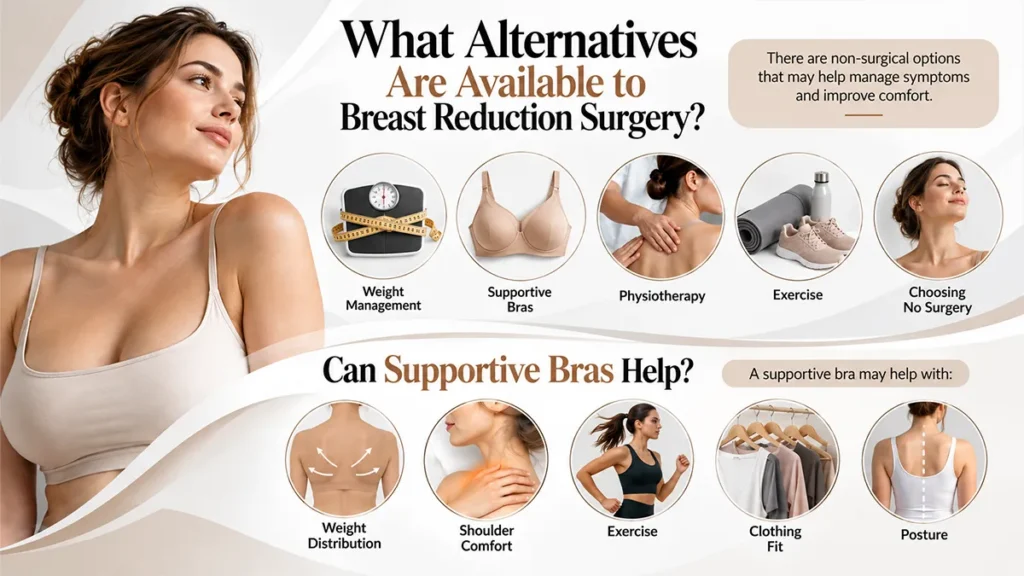
Alternatives may improve comfort, posture, support, or fatty breast volume, but they do not remove excess glandular tissue and skin in the same way as surgery. Their value depends on the cause of breast enlargement and the severity of the patient’s symptoms.
Possible alternatives include:
- Weight management
- Supportive bras
- Physiotherapy
- Exercise
- Choosing no surgery
These options may be appropriate for patients who are not ready for surgery or whose symptoms are mild. They are less likely to provide a substantial reduction when the breasts are mainly glandular or significantly drooping.
Can Supportive Bras Help?
A properly fitted bra can improve support, reduce strain, and make physical activity more comfortable. It does not permanently reduce breast volume or remove excess skin.
A supportive bra may help with:
- Weight distribution
- Shoulder comfort
- Exercise
- Clothing fit
- Posture
Professional fitting can be useful when standard sizes do not provide adequate support. This may improve daily comfort even when surgery is still being considered.
Can Physiotherapy Help?
Physiotherapy may improve posture, muscle strength, and pain management, particularly when breast weight contributes to neck, shoulder, or upper-back strain. It cannot reduce breast tissue itself.
Physiotherapy may focus on:
- Upper-back strength
- Shoulder stability
- Posture
- Mobility
- Pain-management strategies
Some patients benefit from trying physiotherapy before surgery. Persistent symptoms despite appropriate conservative treatment may support consideration of breast reduction.
Can Weight Management Replace Surgery?
Weight management may reduce breast size when fatty tissue contributes significantly to enlargement. It cannot reliably reduce glandular tissue or tighten stretched skin.
Weight management may be useful for:
- Improving general health
- Reducing fatty breast volume
- Supporting safer anaesthesia
- Stabilising body proportions
- Improving long-term results
Patients planning substantial weight loss are often advised to complete it before surgery. A stable weight makes the eventual surgical plan more predictable.
Who Is Suitable for Breast Reduction Surgery?
Suitable patients are generally healthy adults whose breast size causes persistent physical, functional, or emotional difficulty. They should understand the likely scars, recovery, risks, and possibility of residual asymmetry.
Potential candidates may have:
- Chronic neck, back, or shoulder discomfort
- Recurrent skin irritation
- Exercise limitations
- Stable body weight
- Realistic expectations
Suitability depends on medical history, breast anatomy, smoking status, skin quality, and personal goals. An in-person consultation is required to determine whether surgery is appropriate.
Who May Need to Delay Surgery?
Some patients may need to postpone surgery until health, weight, or lifestyle factors are better controlled. Delaying treatment can reduce complications and improve the stability of the result.
Reasons to delay may include:
- Pregnancy or breastfeeding
- Active smoking or nicotine use
- Uncontrolled diabetes
- Active infection
- Ongoing major weight loss
Patients should also delay surgery if they are unable to accept permanent scars or have unrealistic expectations. The decision should be made carefully and without pressure.
How Much Does Breast Reduction Cost?
The cost of breast reduction varies according to the hospital, anaesthetic, surgical complexity, and follow-up arrangements. A personalised quotation should be provided after consultation because the amount of tissue removal and reshaping differs between patients.
The fee may include:
- Surgeon’s fee
- Anaesthetist’s fee
- Hospital and theatre charges
- Support garments
- Follow-up appointments
Patients should ask what is included and whether revision surgery or treatment of complications would involve further charges. Price should be considered alongside qualifications, hospital standards, aftercare, and continuity of care.
What Additional Costs Should Patients Consider?
The full cost of treatment may include more than the operation itself. Recovery can also create practical expenses that should be planned in advance.
Additional costs may include:
- Time away from work
- Travel to appointments
- Extra support bras
- Scar-care products
- Childcare or household help
Patients should avoid choosing a surgeon based on the lowest price alone. Safe facilities, specialist expertise, and accessible postoperative care are equally important.
What Is the Main Message About Reducing Breast Size?
Breast size may reduce through weight loss when fatty tissue contributes significantly, but exercise and lifestyle measures cannot remove excess glandular tissue or loose skin. Breast reduction surgery remains the most reliable option for patients seeking a substantial reduction, reshaping, and relief from symptoms linked to breast weight.
The key points are:
- Breast composition affects non-surgical results
- Surgery removes tissue, fat, and skin
- Scars are permanent
- Recovery takes time
- Individual assessment is essential
The best treatment plan balances symptom relief, proportion, safety, and realistic expectations. Patients should understand the benefits, limitations, and risks before deciding to proceed.
Breast Size Reduction FAQs

Can I get a breast reduction even if I haven’t had children yet?
Yes, breast reduction is possible before pregnancy, and many women opt for it to improve their quality of life. However, future pregnancies and breastfeeding may alter the results, so timing is a consideration during consultation.
Do breasts grow back after reduction surgery?
It’s uncommon, but some tissue regrowth can occur due to weight gain, hormonal changes, or pregnancy. Miss Breahna tailors each reduction to reduce this risk, but long-term changes in the body can affect the final result.
Will reducing my breast size change the sound of my voice or breathing?
Although rare, patients sometimes report easier breathing and posture improvements after surgery. However, it doesn’t alter the voice itself, but reduced chest strain can subtly enhance vocal comfort for some.
Is it possible to combine breast reduction with other body contouring procedures?
Yes, many patients choose to combine reduction with abdominoplasty or liposuction for a more holistic transformation. This is something Miss Breahna discusses during a comprehensive surgical planning session.
Can I still wear push-up bras after a breast reduction?
Absolutely. Once healed, patients can enjoy a wide range of lingerie styles with greater comfort. Many find they no longer need extra support or padding to feel confident.
Will my breast tattoos or piercings be affected by reduction surgery?
If tattoos or piercings are near the surgical area, they may be altered or need removal during surgery. Miss Breahna will discuss this during the consultation and help you understand how incisions will be planned.
Can a breast reduction be reversed if I change my mind later?
Breast tissue that’s removed cannot be restored naturally, but volume can be added with implants or fat transfer if desired. However, reversals are rare, as patients typically experience relief and satisfaction after surgery.
Will I be short of breath or less mobile right after the reduction?
No, many patients actually feel freer in their breathing and posture after healing begins. While initial soreness may restrict movement temporarily, most feel physically lighter soon after recovery starts.
Do smaller breasts mean less risk of sagging in the future?
Generally, yes. With less weight and improved skin support, smaller breasts tend to maintain shape longer. That said, gravity, age, and genetics still play a role in long-term changes.
Can breast reduction help me feel more confident in professional settings?
Definitely. Many women report greater confidence, reduced self-consciousness, and improved posture, which positively impacts how they present themselves in work and social environments.
Medical References
- Longevity of ptosis correction in mastopexy and reduction mammaplasty: A systematic review of techniques / JPRAS Open / https://www.sciencedirect.com/science/article/pii/S235258782200033X
- Comparison of Clinical Associations and Outcomes Between Superomedial and Inferior Pedicle Breast Reduction Surgery: A Retrospective Study / Aesthetic Plastic Surgery / https://link.springer.com/article/10.1007/s00266-025-05041-1
- A 12-year review of patient-reported outcomes after reduction mammoplasty in patients with high body mass index / Medicine / https://journals.lww.com/md-journal/fulltext/2019/06210/a_12_year_review_of_patient_reported_outcomes.26.aspx
- Reduction mammaplasty improves levels of anxiety, depression and body image satisfaction in patients with symptomatic macromastia in the short and long term / Journal of Psychosomatic Obstetrics & Gynecology / https://www.tandfonline.com/doi/full/10.1080/0167482X.2016.1270936?scroll=top&needAccess=true
How Can Patients Arrange a Breast Reduction Consultation With Miss Anca Breahna?
If breast size is causing persistent discomfort, limiting physical activity or affecting daily life, a consultation can help determine whether breast reduction surgery or another approach may be appropriate.
Miss Anca Breahna can assess breast size and shape, symptoms, medical history and individual goals. During consultation, she can also explain the likely scars, recovery, risks, limitations and expected outcomes of breast reduction surgery.
You can contact Anca’s team to arrange a consultation in Chester or request further information.
Download Anca Breahna’s Breast Reduction Guide
Further Reading
- Read Miss Anca Breahna’s Info Page on Breast Reduction Recovery
- Read Miss Anca Breahna’s Blog on Breast Reduction Scars
- Read Miss Anca Breahna’s Info Page on Breast Reduction Cost
- Read Miss Anca Breahna’s Blog on Breast Reduction and Athletic Performance
- Read Miss Anca Breahna’s Blog on Back, Shoulder and Neck Pain Caused by Large Breasts
- Read Miss Anca Breahna’s Blog about Causes and Treatment of Overly Large Breasts – Macromastia
- Read Miss Anca Breahna’s Blog about Breast Reduction Surgery and Age: Considerations for Different Life Stages
- Read Miss Anca Breahna’s Blog about Causes and Solutions for Huge Breasts (Gigantomastia)
About Anca Breahna – Consultant Plastic Surgeon
 Miss Anca Breahna, PhD, MSc, FEBOPRAS, FRCS (Plast), is a Consultant Plastic, Reconstructive and Aesthetic Surgeon in Chester with extensive experience in breast surgery. Her background in both reconstructive and aesthetic procedures is particularly relevant to breast reduction, where successful planning requires careful consideration of breast volume, shape, skin quality, nipple position and overall body proportions. She also takes into account the physical symptoms that can accompany larger breasts, including discomfort affecting the neck, shoulders and back.
Miss Breahna performs breast reduction surgery in Chester for women seeking to reduce breast size while improving shape and proportion. During consultation, she assesses the amount of tissue to be removed, existing asymmetry, nipple and areola position, scar pattern and the patient’s individual goals before recommending a suitable surgical plan. As an experienced plastic surgeon in Chester, her approach aims to balance size reduction with a proportionate breast shape, while discussing scarring, recovery, sensation and realistic expectations clearly before surgery.
Back to blog