
- Introduction
- What Happens to Breast Implants During Menopause?
- Why Can the Breasts Look Lower Even When the Implants Have Not Moved?
- How Do Hormonal Changes Affect the Natural Tissue Around Breast Implants?
- How Can Weight Changes Affect Breast Implants During Menopause?
- Which Symptoms Should Be Checked Rather Than Attributed to Menopause?
- What Medical History Is Reviewed During a Breast Implant Consultation?
- Why Does the Timing and Pattern of Symptoms Matter?
- Why Are Clinical Photographs Taken?
- How Do Photographs Help Explain Breast Changes?
- What Breast Measurements Are Taken During Assessment?
- Why Is Tissue Thickness Important?
- What Is Discussed During a Breast Implant Consultation?
- How Is Normal Ageing Distinguished From an Implant Problem?
- When Is Breast Imaging Recommended?
- What Procedure Options May Be Considered?
- When Is Observation the Best Option?
- Can Better Breast Support Help?
- When May a Breast Uplift Be Recommended?
- When Is Implant Exchange Considered?
- Can Breast Implants Be Removed Without Replacement?
- How Can Fat Transfer Help?
- When Is Capsular Contracture Treatment Required?
- What Are the Risks of Breast Implant Revision Surgery?
- Breast Augmentation Before and After Photos
- What Is Recovery Like After Breast Implant Revision?
- How Long Do the Results Last?
- Download Miss Anca Breahna's Breast Augmentation Guide
- What Questions Should You Ask During Consultation?
- What Are the Next Steps After Assessment?
- Breast Implant Condition During Menopause FAQs
- Take our Plastic Surgery Quiz to find out if you'd be a good candidate for cosmetic surgery.
- Book A Consultation With Miss Anca Breahna In North West England
- Further Reading
- About Anca Breahna – Consultant Plastic Surgeon
Miss Anca Breahna, PhD, MSc, FEBOPRAS, FRCS (Plast), is a Consultant Plastic & Reconstructive Surgeon in North West England, UK. Menopause does not change the breast implant itself, but it can alter the natural tissues surrounding it and make the breasts look or feel different over time.
Hormonal changes may reduce breast density, soften glandular tissue, affect skin elasticity, alter fat distribution, and contribute to breast descent. The implant may remain intact and correctly positioned even though the breast appears lower, less full, more rippled, or different in proportion.
Introduction
Miss Anca Breahna, PhD, MSc, FEBOPRAS, FRCS (Plast), Consultant Plastic & Reconstructive Surgeon in North West England, explains that menopause affects the tissues around breast implants rather than the implants themselves. Breast implants do not undergo hormonal change, but the skin, fat, glandular tissue, and support structures surrounding them may alter during perimenopause and menopause.
Many women enter menopause several years after their original breast augmentation. An implant that appeared balanced in the thirties may look different in the forties, fifties, or sixties because the breast envelope has aged, softened, or changed in volume. This does not automatically mean that the implant has ruptured, moved, or become unsafe.
Perimenopause can also cause fluctuating breast tenderness, temporary fullness, and changes in sensitivity. Some women notice that their bras no longer fit properly, their cleavage looks different, or the implant edges are easier to feel. Others become concerned because one breast appears lower or firmer than the other.
A careful consultation is important because several issues can produce similar symptoms. Hormonal breast tenderness, age-related sagging, implant rippling, capsular contracture, rupture, weight change, and unrelated breast conditions may all affect how the breasts look or feel. Miss Anca Breahna assesses the whole clinical picture before recommending reassurance, imaging, monitoring, or treatment.
What Happens to Breast Implants During Menopause?
Menopause does not normally make silicone or saline implants swell, shrink, or deteriorate suddenly. Most visible changes occur because the skin and natural breast tissue surrounding the implant become softer, thinner, less elastic, or differently distributed.
Common changes include:
- A lower or less lifted breast shape
- Reduced fullness above the nipple
- A wider or lower-looking cleavage
- Increased visibility or palpability of implant edges
- Changes in bra fit, tenderness, or symmetry
The implant may therefore remain intact and stable while the breast envelope changes around it. Sudden swelling, rapid enlargement, a new lump, or persistent pain should not be assumed to be caused by menopause.
Why Can the Breasts Look Lower Even When the Implants Have Not Moved?
The breast can appear lower because ageing skin and connective tissues provide less support over time. Natural breast tissue may descend over a stable implant, changing the nipple position and the overall balance of the breast.
Signs of tissue descent may include:
- A lower nipple position
- A longer lower breast pole
- Reduced upper breast fullness
- More skin beneath the nipple
- A less lifted appearance in clothing
These changes usually reflect stretching of the breast envelope rather than true implant displacement. A clinical examination can determine whether the concern is primarily sagging, implant movement, or a combination of both.
How Do Hormonal Changes Affect the Natural Tissue Around Breast Implants?
Falling and fluctuating hormone levels can change the composition, sensitivity, and volume of the natural breast tissue. The implant does not respond to hormones, but the surrounding tissue may become softer, less dense, temporarily fuller, or more tender.
Hormonal influences may include:
- Reduced glandular breast tissue
- Increased fatty tissue within the breast
- Fluctuating tenderness during perimenopause
- Temporary fullness after starting or changing HRT
- Reduced collagen and skin elasticity
These changes vary considerably between women and may affect both breasts differently. Persistent, worsening, or one-sided symptoms should still be professionally assessed.
How Can Weight Changes Affect Breast Implants During Menopause?
Weight gain or weight loss can alter the amount of natural tissue covering an implant. Even when the implant itself remains unchanged, the breasts may look larger, smaller, heavier, or more visibly augmented.
Weight-related changes may cause:
- Increased natural breast volume
- Greater breast heaviness or descent
- Reduced tissue coverage after weight loss
- More visible implant edges or rippling
- Changes in body and breast proportions
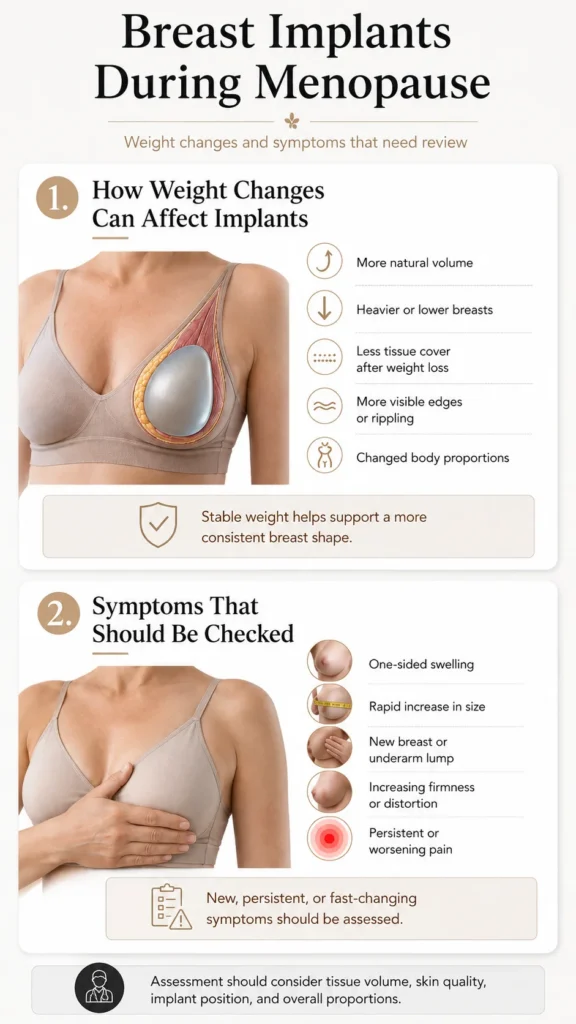 Stable weight generally supports more consistent long-term breast shape. Significant changes in appearance should be assessed in relation to tissue volume, skin quality, implant position, and the patient’s overall proportions.
Which Symptoms Should Be Checked Rather Than Attributed to Menopause?
Most menopause-related breast changes are gradual and benign, but some symptoms require assessment. New, persistent, one-sided, or rapidly progressing changes should not be dismissed as hormonal.
Seek medical review for:
- Persistent swelling in one breast
- A rapid increase in breast size
- A new breast or underarm lump
- Increasing firmness or visible distortion
- Persistent or worsening pain
These symptoms can have many possible causes, and most do not indicate a serious condition. Prompt assessment allows appropriate imaging, reassurance, or treatment when necessary.
What Medical History Is Reviewed During a Breast Implant Consultation?
A detailed medical history helps distinguish hormonal and age-related changes from possible implant complications. Miss Anca Breahna reviews the original surgery, current symptoms, general health, and any factors that may influence breast shape or recovery.
The consultation usually covers:
- The date and location of the original augmentation
- Implant type, size, manufacturer, surface, and placement
- Previous breast surgery or implant revision
- Pregnancy, breastfeeding, menopause, and weight history
- HRT, medications, smoking, and general medical health
Implant records are useful but are not essential for the consultation to proceed. Operation notes, implant cards, previous imaging, and clinic letters can provide helpful background when available.
Why Does the Timing and Pattern of Symptoms Matter?
The way symptoms develop can provide important clues about their likely cause. Intermittent tenderness affecting both breasts may be more consistent with hormonal change, while progressive one-sided firmness or swelling may require further investigation.
Useful details include:
- When the symptom first appeared
- Whether it affects one or both breasts
- Whether it fluctuates or remains constant
- Whether it is linked to HRT or hormonal changes
- Whether there is associated swelling, distortion, or a lump
Symptoms must always be considered alongside examination findings and implant history. The pattern does not establish a diagnosis by itself, but it helps guide the next steps.
Why Are Clinical Photographs Taken?
Standardised clinical photographs document breast shape, symmetry, skin quality, and implant position. They create an accurate visual record that supports assessment, treatment planning, and future comparison.
Photographs may show:
- Nipple height and breast position
- Differences between the left and right breast
- Skin laxity and lower breast descent
- Upper breast fullness and cleavage
- Visible rippling or contour changes
Images are usually taken from front, side, and oblique angles in consistent lighting. This allows subtle differences to be evaluated more reliably than through casual photographs or mirror inspection.
How Do Photographs Help Explain Breast Changes?
Clinical photographs can make it easier to separate tissue ageing from implant movement. They may show that the implant remains relatively stable while the natural breast and nipple sit lower than before.
Photographic comparison can help identify:
- Changes in breast symmetry
- Loss of upper breast fullness
- Increased lower breast skin
- Altered nipple position
- Progressive contour changes over time
This visual information supports a clearer discussion between patient and surgeon. All clinical images are stored confidentially as part of the medical record.
What Breast Measurements Are Taken During Assessment?
Breast measurements provide objective information about skin laxity, tissue descent, symmetry, and implant position. They help determine whether the main concern is ageing tissue, sagging, implant displacement, or a combination of issues.
Measurements may include:
- Breast width and chest-wall dimensions
- Nipple height and nipple-to-fold distance
- Degree of skin stretch and breast descent
- Tissue thickness over the implant
- Implant position in relation to the breast crease
These measurements help guide decisions about observation, breast uplift, implant exchange, implant removal, or combined surgery. They are always interpreted alongside symptoms, clinical photographs, implant history, and patient goals.
Why Is Tissue Thickness Important?
The thickness of the tissue covering the implant affects how visible or palpable the device may become. Reduced coverage can make rippling, edges, or contour irregularities more noticeable, particularly after weight loss or age-related tissue thinning.
Thin tissue coverage may influence:
- Whether implant rippling is visible
- Whether implant edges can be felt
- The suitability of fat transfer
- Implant size and profile choices
- Whether pocket adjustment may be helpful
Tissue thickness does not determine treatment on its own. Miss Anca Breahna considers it together with implant position, breast shape, skin quality, symptoms, and the patient’s preferred outcome.
What Is Discussed During a Breast Implant Consultation?
The consultation brings together your medical history, photographs, measurements, symptoms, and treatment goals. Miss Anca Breahna uses this information to explain whether the changes are likely to be hormonal, age-related, implant-related, or caused by several factors together.
The discussion usually includes:
- Whether the implants appear stable and appropriately positioned
- Whether ultrasound, mammography, or MRI may be helpful
- Whether the main concern is sagging, rippling, pain, or asymmetry
- Whether surgery is necessary or observation is reasonable
- What results, scars, recovery, and limitations to expect
The purpose of the consultation is not to push every patient towards surgery. Some women need reassurance and monitoring, while others may benefit from a carefully planned revision procedure.
How Is Normal Ageing Distinguished From an Implant Problem?
Normal ageing tends to produce gradual changes in both breasts, while implant complications may cause more localised, progressive, or one-sided symptoms. A diagnosis is based on examination, implant history, symptom pattern, and imaging when necessary.
Features more consistent with normal ageing may include:
- Gradual loss of upper breast fullness
- Increasing skin laxity in both breasts
- Mild changes in bra fit
- Progressive softening of natural breast tissue
- Symmetrical breast descent over time
Possible implant-related concerns may include increasing firmness, sudden swelling, visible distortion, or a rapidly developing asymmetry. Even so, no single symptom confirms a complication, which is why a formal assessment is important.
When Is Breast Imaging Recommended?
Breast imaging may be advised when there is concern about implant integrity, a new breast symptom, or an unclear examination finding. The most appropriate test depends on whether the aim is to assess natural breast tissue, the implant, or both.
Possible investigations include:
- Ultrasound for fluid, lumps, or implant concerns
- MRI for more detailed silicone implant assessment
- Mammography for routine or symptom-led breast screening
- Additional implant-displacement views during mammography
- Referral to a specialist breast clinic when appropriate
Breast cancer screening and implant-integrity assessment are not the same process. Patients should always tell the radiographer that they have implants so the examination can be adapted appropriately.
What Procedure Options May Be Considered?
Treatment depends on the cause of the change, the condition of the implants, the quality of the tissues, and the patient’s goals. Options range from observation and supportive measures to uplift, implant exchange, implant removal, or combined revision surgery.
Potential options include:
- Observation and long-term monitoring
- Professional bra fitting and lifestyle measures
- Breast uplift to address loose skin and lower nipples
- Implant exchange, removal, or pocket adjustment
- Fat transfer to improve tissue coverage or contour
No single procedure is suitable for every patient. Miss Anca Breahna develops a proportion-led plan that considers comfort, breast health, scarring, recovery, and the desired long-term shape.
When Is Observation the Best Option?
Observation may be appropriate when the implants appear stable and the changes are mild, expected, and not causing significant distress. Menopause alone is not a reason to replace or remove breast implants.
Observation may be suitable when:
- There are no concerning symptoms
- The implants appear stable on examination
- Changes are mainly related to normal tissue ageing
- The patient is comfortable with the breast appearance
- Imaging does not show a problem requiring treatment
Monitoring can include symptom awareness, routine breast screening, and review if a new change develops. Choosing not to have surgery is a valid option when there is no medical or personal reason to proceed.
Can Better Breast Support Help?
A correctly fitted bra can improve comfort and appearance when menopause-related changes are modest. It may reduce strain, improve support during exercise, and help patients understand whether the concern is mainly functional or structural.
Supportive measures may include:
- Professional bra fitting
- Wider straps and supportive underbands
- High-support sports bras
- Weight stabilisation
- Posture and upper-body conditioning
These measures cannot correct significant loose skin, implant displacement, or capsular contracture. However, they may provide meaningful relief when the implant is healthy and surgery is neither necessary nor desired.
When May a Breast Uplift Be Recommended?
A breast uplift may be recommended when the principal problem is loose skin, breast descent, or a low nipple position. The procedure reshapes the natural breast envelope and repositions the nipple without necessarily changing the implant.
A breast uplift may address:
- Sagging over a stable implant
- A low or downward-pointing nipple
- A long lower breast pole
- Loose or stretched skin
- Loss of a more lifted breast contour
An uplift may be performed with the existing implants, with implant exchange, or after implant removal. The recommended approach depends on implant condition, tissue quality, breast volume, and the desired outcome.
When Is Implant Exchange Considered?
Implant exchange may be appropriate when the existing device no longer suits the patient’s body, goals, or breast tissues. It may also be considered when there is confirmed rupture, significant implant malposition, capsular contracture, or a desire to change size.
Implant exchange can address:
- A change in preferred breast size
- Excessive implant weight or projection
- Rupture or suspected device failure
- Implant malposition or asymmetry
- A wish for a different shape or profile
Changing the implant alone may not correct loose skin or a low nipple position. In those cases, implant exchange may need to be combined with a breast uplift for a more balanced result.
Can Breast Implants Be Removed Without Replacement?
Yes, implants can be removed without inserting new ones. This option may appeal to women who no longer want implants, prefer a smaller breast shape, or wish to avoid future implant-related monitoring and surgery.
Implant removal may be considered when:
- The patient no longer wants augmented breasts
- There is discomfort, rupture, or capsular contracture
- The implants feel too large or heavy
- The patient prefers a more natural breast volume
- Future implant maintenance is no longer desirable
The breast may look smaller, softer, or emptier after removal, especially when the skin has stretched. A breast uplift or fat transfer may be discussed if additional reshaping or volume support is required.
How Can Fat Transfer Help?
Fat transfer to breasts may improve tissue coverage, contour irregularities, or visible implant rippling in selected patients. Fat is taken from another area of the body and carefully placed around the breast to soften transitions and improve coverage.
Fat transfer may help with:
- Visible or palpable implant rippling
- Thin tissue over implant edges
- Small contour irregularities
- Mild asymmetry
- Volume restoration after implant removal
Fat transfer is not suitable for every patient and cannot replace an uplift when substantial loose skin is present. Some transferred fat is naturally reabsorbed, so the final retained volume may be less than the amount initially placed.
When Is Capsular Contracture Treatment Required?
Capsular contracture occurs when the scar capsule around an implant tightens and changes the breast’s feel, shape, or comfort. Mild cases may be observed, while painful or visibly distorted breasts may require surgery.
Possible signs include:
- Increasing breast firmness
- A higher or rounder implant position
- Progressive distortion
- Tightness or pain
- New asymmetry between the breasts
Treatment may involve removal or modification of the capsule, implant exchange, pocket adjustment, or implant removal. The exact plan depends on the severity of the contracture, implant history, tissue condition, and patient preference.
What Are the Risks of Breast Implant Revision Surgery?
Breast implant revision surgery has many of the same general risks as primary breast surgery, with additional complexity from scar tissue and previous anatomical changes. Risks vary according to whether the operation involves an uplift, implant exchange, capsule surgery, fat transfer, or implant removal.
Possible risks include:
- Bleeding, infection, or delayed wound healing
- Changes in nipple or breast sensation
- Asymmetry, scarring, or contour irregularity
- Recurrent capsular contracture
- Need for additional surgery in the future
A careful consultation should include a clear discussion of both common and uncommon complications. Miss Anca Breahna explains how individual factors such as smoking, medical conditions, implant history, and tissue quality may affect risk.
Breast Augmentation Before and After Photos


What Is Recovery Like After Breast Implant Revision?
Recovery depends on the extent of surgery and whether an uplift, capsule procedure, or implant exchange is performed. Most patients experience swelling, tightness, bruising, and temporary discomfort during the early healing period.
A typical recovery may include:
- One to two weeks away from many routine work activities
- Support garments or a surgical bra
- Gradual return to light daily movement
- Avoidance of heavy lifting and strenuous exercise
- Several months for swelling and scars to settle
Recovery instructions are personalised because revision procedures vary considerably. Patients should follow their surgeon’s advice rather than relying on a standard timetable from a previous operation.
How Long Do the Results Last?
Revision surgery can provide long-lasting improvement, but it does not stop ageing, hormonal change, or future weight fluctuations. Implants are not lifetime devices, and the surrounding breast tissues will continue to change over time.
Longevity is influenced by:
- Implant type and condition
- Skin and tissue quality
- Weight stability
- Pregnancy and hormonal changes
- Smoking, health, and lifestyle factors
A stable weight and appropriate breast support may help preserve the result. Future monitoring remains important, particularly if silicone implants are retained or exchanged.
Download Miss Anca Breahna’s Breast Augmentation Guide
What Questions Should You Ask During Consultation?
Preparing questions in advance can help you make a more confident and informed decision. The most useful questions focus on diagnosis, treatment alternatives, expected outcomes, recovery, and long-term follow-up.
Consider asking:
- Are my changes caused by tissue ageing or an implant problem?
- Do I need ultrasound or MRI?
- Would an uplift be more suitable than implant exchange?
- What happens if I choose not to have surgery?
- What scars, recovery time, and future monitoring should I expect?
A good consultation should leave you with a clear understanding of your options and their limitations. You should not feel pressured to make a decision on the day.
What Are the Next Steps After Assessment?
The next step depends on whether the examination suggests normal ageing, a cosmetic concern, or a condition requiring investigation. Some patients leave with reassurance, while others may need imaging, follow-up, or a personalised surgical plan.
The usual patient pathway may involve:
- Bringing available implant records to consultation
- Completing clinical examination, photography, and measurements
- Arranging imaging when indicated
- Reviewing non-surgical and surgical options
- Allowing time to consider the recommendations
A second consultation may be appropriate before surgery so that questions can be revisited and consent confirmed. Treatment should proceed only when the patient feels informed, comfortable, and clear about the likely benefits and limitations.

Breast Implant Condition During Menopause FAQs
My breasts feel more tender during perimenopause. How do I know if it is hormonal or implant-related?
Hormonal tenderness often fluctuates and may affect both breasts, but any persistent, localised pain, new swelling, or a rapid shape change should be assessed. Screening does not evaluate implant integrity, so symptom-led assessment may involve different imaging.
Can menopause cause capsular contracture?
Menopause itself is not listed as a direct cause, but changes in tissue, inflammation, and overall health factors can influence how breasts feel over time. Research highlights modifiable risk factors like smoking, oversizing, and hematoma, which matter more than menopausal status alone.
Do implants make menopausal breast sagging worse?
Implants add volume and weight, and if tissue support reduces with age, breast sagging can become more noticeable. The key is whether the change is mainly tissue support, implant size choice, or both, which is best assessed in consultation.
If I start HRT and my breasts feel fuller, does that mean my implant size changed?
No. Implants do not swell with hormones, but your natural tissue can change in tenderness and fluid content. If symptoms are significant or unilateral, it is sensible to seek assessment rather than assume it is only HRT.
How do I safely do breast screening with implants in the UK?
Attend the screening as invited and tell the radiographer you have implants. UK guidance explains that additional views are taken and techniques are adapted to show as much tissue as possible.
Should I replace my implants at menopause as a routine step?
Routine replacement purely because of menopause is not recommended in the guidance. Monitoring and symptom awareness are emphasised, and implant decisions should be based on your implant age, symptoms, and goals, not a life stage alone.
What symptoms should make me seek urgent advice rather than waiting?
New persistent swelling, a new lump, rapid change in breast size, persistent pain, or new underarm swelling should be assessed promptly. UK regulator information on BIA-ALCL explains the importance of symptom awareness.
Medical References
- What You Should Know About Breast Implants If You’re Over 40 / Cleveland Clinic / – https://health.clevelandclinic.org/what-you-should-know-about-breast-implants-after-40
- Long-Term Follow-Up of Breast Capsule Contracture Rates in Cosmetic and Reconstructive Cases / Plastic and Reconstructive Surgery / – https://journals.lww.com/plasreconsurg/abstract/2010/09000/long_term_follow_up_of_breast_capsule_contracture.6.aspx
- Lump detection is enhanced in silicone breast models simulating postmenopausal breast tissue / Journal of General Internal Medicine / – https://pubmed.ncbi.nlm.nih.gov/8833020/
Take our Plastic Surgery Quiz to find out if you’d be a good candidate for cosmetic surgery.
Book A Consultation With Miss Anca Breahna In North West England
Breast implants do not go through menopause, but your breast tissue and skin do. During perimenopause and menopause, it is common to notice changes in shape, bra fit, tenderness, or tissue drape, and those changes can make implants look different even when the implant itself is fine. UK screening remains available with implants, but it uses adapted techniques and you should always tell the radiographer that you have implants.
If you are noticing changes in your breasts during menopause and want clear, expert guidance, book a consultation with Miss Anca Breahna in North West England. Send an online enquiry via our contact page, or a photo via the site’s Complimentary Photo Assessment feature to build your confidence as you schedule a consultation. During your consultation, you will:
- Understand what is normal vs what needs investigation
- Receive a personalised assessment
- Explore appropriate treatment options
- Build a long-term care plan
Miss Anca Breahna can help you understand what is normal, what needs checking, and what options actually help, from reassurance and monitoring to a tailored surgical plan when it is genuinely the best fit.
👉 Start here: Contact Anca Breahna Plastic Surgeon
Further Reading
- Read more about Breast Reduction
- Read more about Fat Transfer To Breasts / Lipofilling
- Read more about Motiva Preservé Breast Augmentation in Chester
- Read Miss Breahna’s Blog on Types of Breast Implants
- Read Miss Breahna’s Blog on Benefits Of A Preservation Breast Augmentation
- Read Miss Breahna’s Blog on How Breast Augmentation Can Affect Your Posture and Back
- Read Miss Breahna’s Blog on Risks and Complications of Breast Augmentation Surgery
About Anca Breahna – Consultant Plastic Surgeon
 Miss Anca Breahna, PhD, MSc, FEBOPRAS, FRCS (Plast), is a Consultant Plastic, Reconstructive and Aesthetic Surgeon in Chester with extensive experience in primary and revision breast surgery. Her reconstructive and aesthetic training is particularly important in breast implant removal and replacement, where previous surgery, existing scar tissue, implant position, breast tissue quality and changes in shape over time all need to be assessed carefully before deciding on the most appropriate approach.
Miss Breahna performs breast implant removal, replacement and capsulectomy in Chester for patients who wish to change their implants or who are experiencing concerns such as capsular contracture, rupture, malposition or changes in breast appearance. Treatment may involve implant removal alone, implant exchange, removal of the surrounding capsule where clinically appropriate, or additional revision of the breast pocket. During consultation, she considers the condition of the implants, the capsule, breast shape, skin quality and the patient’s current goals before recommending a tailored surgical plan. As an experienced plastic surgeon in Chester, she also discusses whether a breast uplift or other corrective procedure may be beneficial when implants are removed or exchanged.
Back to blog