
- Take our Plastic Surgery Quiz to find out if you'd be a good candidate for cosmetic surgery.
- What Is Gynaecomastia Surgery
- ✓ Why Men Choose Gynaecomastia Surgery
- ✓ How Gynaecomastia Surgery Is Performed
- What Is a Gynaecomastia Drain and Why Is It Used
- ✓ What a Drain Actually Is
- ✓ Why Surgeons Sometimes Use Drains
- Download Miss Anca Breahna's Gynaecomastia Surgery Guide
- Do I Really Need a Gynaecomastia Drain
- ✓ There Is No One Rule for Every Patient
- ✓ Factors That Influence the Decision
- When Drains Are More Likely to Be Recommended
- ✓ Higher Grade or Gland-Dominant Gynaecomastia
- ✓ Extensive Undermining or Skin Redundancy
- ✓ Specific Patient Risk Factors
- When Drains May Not Be Necessary
- ✓ Milder Gynaecomastia With Liposuction Dominant Treatment
- ✓ Use of Quilting Sutures and Compression
- Gynaecomastia Before and After Photos
- What to Expect if You Have a Drain After Gynaecomastia Surgery
- ✓ How Long Will the Drain Stay In
- ✓ Living With a Drain in the First Few Days
- ✓ Drain Removal
- Comfort, Scars, and Recovery With or Without Drains
- ✓ Does a Drain Change Pain or Recovery Time
- ✓ Scars From Drains and Incisions
- How Miss Anca Breahna Decides On Drains In Chester
- ✓ Personalised Planning for Each Chest
- ✓ Clear Explanations and Reassurance
- Taking The Next Step - Consultation And Enquiry
- Medical References
- Further Reading
- About Anca Breahna – Consultant Plastic Surgeon
Gynaecomastia surgery can be a life-changing step for men who feel self-conscious about a fuller or more feminine-looking chest. It is very common, however, to feel anxious about the details of the operation. One of the most frequent questions men ask is whether they will wake up with a drain and what that actually means for comfort and recovery.
At her private practice in Chester, UK, Miss Anca Breahna, a Consultant Plastic & Reconstructive Surgeon, regularly performs gynaecomastia surgery. She understands that the idea of a gynaecomastia drain can sound worrying and sometimes puts men off taking the next step. In reality, the decision to use a drain is a careful, individual choice based on your anatomy, the surgical technique, and your safety.
This article explains what drains are, when they are helpful, when they may not be needed, and how Miss Anca Breahna approaches this decision with her patients in Chester.
Take our Plastic Surgery Quiz to find out if you’d be a good candidate for cosmetic surgery.
What Is Gynaecomastia Surgery
✓ Why Men Choose Gynaecomastia Surgery
Gynaecomastia describes a buildup of glandular tissue and or fat behind and around the nipple area of the male chest. For some men, it is a mild fullness that only shows in certain clothes. For others, it creates a visible breast shape that can be very distressing. You may recognise yourself in situations such as avoiding fitted shirts, feeling uncomfortable at the gym, or keeping a T-shirt on at the pool or beach.
When exercise and weight control do not improve the chest shape, surgery becomes a sensible option. The aim of gynaecomastia surgery is to create a flatter, more masculine contour that sits naturally with the rest of your body and helps you feel more at ease in everyday life.
✓ How Gynaecomastia Surgery Is Performed
Most gynaecomastia procedures use a combination of liposuction and direct gland removal. Liposuction helps remove softer, fatty tissue around the chest, usually through small incisions hidden at the side of the chest or near the fold. Firm glandular tissue beneath the areola often needs to be removed through a small curved cut around the lower edge of the nipple.
The exact combination depends on how much of your gynaecomastia is fat versus gland, the quality of your skin, and the overall size and shape of your chest. At her Chester clinic, Miss Anca Breahna examines these factors carefully so that the plan is tailored to you rather than based on a fixed template.
What Is a Gynaecomastia Drain and Why Is It Used
✓ What a Drain Actually Is
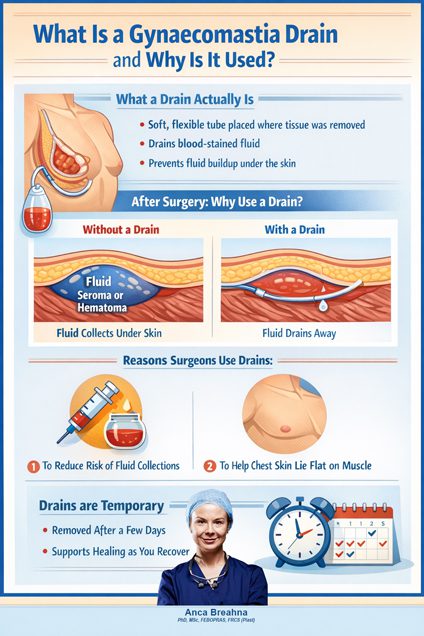
A surgical drain is a soft, flexible tube that sits in the space where tissue has been removed. The tube is connected to a small bottle or bulb that gently collects fluid. It is not a rigid device and does not pump anything into the body. Its job is to allow blood-stained fluid to leave the area instead of building up under the skin.
After gland and fat are removed from the chest, there is a temporary space between the skin and the underlying muscle. As your body heals, it naturally produces a small amount of fluid. If this fluid collects, it can form a seroma or, if blood accumulates, a hematoma. A gynaecomastia drain helps reduce this buildup in the first few days, while the tissues start to settle back down and stick together again.
✓ Why Surgeons Sometimes Use Drains
Surgeons use drains for two main reasons. First, to lower the risk of a significant fluid collection after surgery that might need to be drained with a needle. Second, to help the recontoured chest skin sit smoothly on the underlying muscle, rather than floating over a pool of fluid.
Drains are a short-term tool. They are usually removed within a few days once the output has dropped. The decision to use one is not a sign that something has gone wrong, but rather part of a strategy to support healing in certain situations.
Download Miss Anca Breahna’s Gynaecomastia Surgery Guide

Do I Really Need a Gynaecomastia Drain
✓ There Is No One Rule for Every Patient
There is no universal rule that says every man who has gynaecomastia surgery must have a drain, and equally, there is no rule that says drains are never needed. The decision is individual. It depends on how your operation is done, how much tissue is removed, and how your chest is closed.
During planning and again during the procedure, Miss Anca Breahna assesses whether the space under the skin is likely to close down easily with compression alone or whether a gynaecomastia drain would offer a clear benefit. Her aim is to avoid drains when it is safe to do so, but not to avoid them at the expense of your comfort or results.
✓ Factors That Influence the Decision
Several factors guide this decision, including:
- The volume of gland and fat removed, and how much dead space is left
- How widely the tissues have been separated or undermined during surgery
- Whether internal stitches, sometimes called quilting sutures, have been used to tack the skin down
- Your individual risk of bleeding or fluid buildup is based on health and medications
These factors can vary significantly from one patient to another, even when the chests look similar from the outside, which is why the decision about drains is never purely cosmetic.
When Drains Are More Likely to Be Recommended
✓ Higher Grade or Gland-Dominant Gynaecomastia
In men with more advanced or gland-heavy gynaecomastia, a larger solid mass of tissue often has to be removed from behind the nipple area. This can leave a more substantial space under the skin. While compression garments help, there may still be enough room for fluid to accumulate. In such cases, a gynaecomastia drain can be useful in the early days to keep that space collapsed while healing progresses.
If your gynaecomastia is firm, long-standing, and clearly made up of dense gland rather than softer fat, Miss Anca Breahna may explain that you are more likely to benefit from a drain, at least on the side where more tissue has been taken.
✓ Extensive Undermining or Skin Redundancy
Sometimes the skin over the chest has to be freed more widely so it can settle into a new position. This is more likely in men with significant excess volume, stretched skin, or mild skin laxity after weight loss. The larger the area that has been lifted away from the muscle, the more potential space there is where fluid could collect.
In these situations, a drain acts as an extra safeguard and can help the skin reattach more smoothly. It is part of a wider plan that also includes careful suturing and a properly fitted compression garment.
✓ Specific Patient Risk Factors
Certain medical factors increase the risk of postoperative fluid collections. These can include a tendency to bleed, the use of blood-thinning medication, higher body mass index, or conditions that affect healing. If these apply to you, Miss Anca Breahna may advise that a gynaecomastia drain is wise, even if the surgery itself is not extreme in scope.
This does not mean anything is wrong with you. It simply reflects a tailored approach that recognises how your body behaves and aims to reduce preventable problems.
When Drains May Not Be Necessary
✓ Milder Gynaecomastia With Liposuction Dominant Treatment
Not all gynaecomastia cases are severe. In milder forms where the main issue is excess fatty tissue with only a small central gland, the operation may be less extensive. Liposuction through very small incisions can remove much of the volume, and a limited gland excision can flatten the nipple area. The resulting space can be smaller and easier to manage with compression alone.
In these scenarios, the risk of a significant seroma or hematoma is lower. If, during surgery, the tissues sit back down nicely and there is only a modest potential space, Miss Anca Breahna may decide that a drain offers little extra advantage and can be safely avoided.
✓ Use of Quilting Sutures and Compression
Modern techniques allow surgeons to reduce the need for drains in some cases. Quilting sutures are internal stitches that fix the underside of the skin to the underlying chest wall at multiple points. This tacks the skin down, closes off pockets where fluid could accumulate, and helps the new contour hold its shape.
Combined with a well-fitted compression garment, this can significantly lower the risk of fluid buildup. When quilting has been used and the chest looks stable at the end of the operation, a gynaecomastia drain may not be required. As always, the choice is based on what is seen in your actual surgery rather than an assumption made in advance.
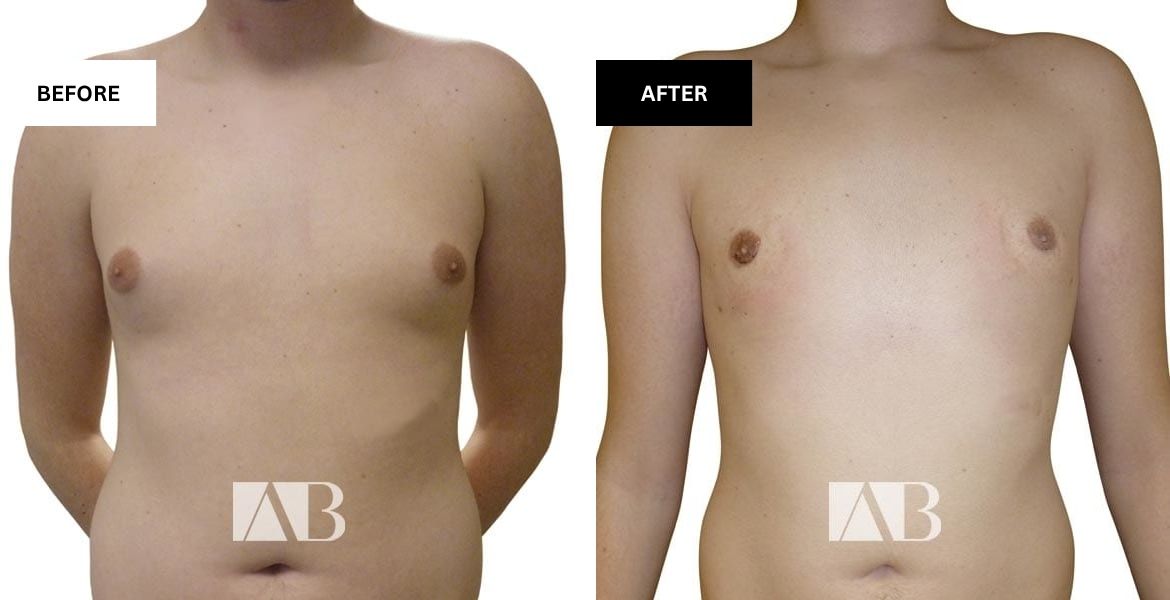
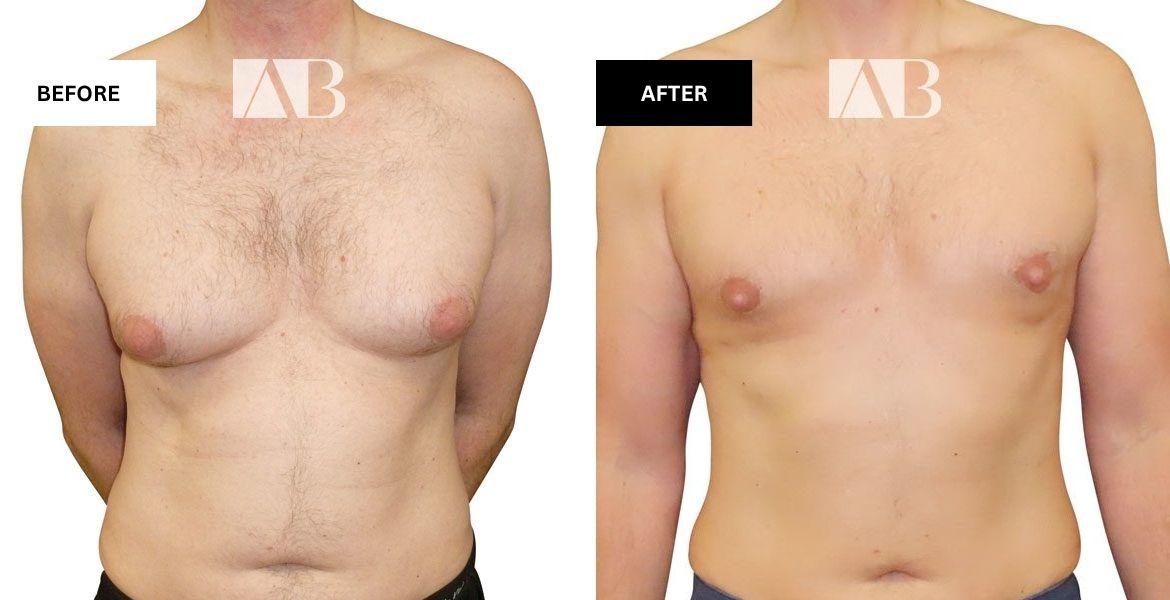
Gynaecomastia Before and After Photos
What to Expect if You Have a Drain After Gynaecomastia Surgery
✓ How Long Will the Drain Stay In
If a drain is used after your gynaecomastia surgery, it is usually a short-term measure. In many cases, it is removed within a few days, once the amount of fluid coming out has reduced to a low level. At your follow-up visit in Chester, Miss Anca Breahna will check the output and decide the right time to remove it.
The goal is to keep the drain for long enough to be helpful but not longer than necessary. You will be told how to care for it at home and how to record any measurements if needed.
✓ Living With a Drain in the First Few Days
Most men describe the drain as more of an annoyance than a major source of pain. You may feel a gentle pulling sensation at the exit site, especially when moving or adjusting clothing. The collection bottle or bulb is usually clipped to your garment or clothing so you can move around safely.
You will be shown how to keep the area clean and dry and how to handle the bottle. Activities such as showering can be adjusted for a few days until the drain is removed. The chest compression garment, which you would wear whether or not you have a drain, remains an important part of your support.
✓ Drain Removal
Drain removal is usually a quick and straightforward process. After cleaning the area, Miss Anca Breahna or a member of her team in Chester gently withdraws the tube and applies a small dressing. Patients often describe this as an odd, brief sensation rather than a painful experience.
The small drain site heals quickly and leaves a minor mark that is usually far less noticeable than the main incision around the areola. Over time, both types of scar tend to fade and blend with the surrounding skin.
Comfort, Scars, and Recovery With or Without Drains
✓ Does a Drain Change Pain or Recovery Time

Whether or not you have a gynaecomastia drain, you can expect some soreness and tightness across the chest after surgery. This is due to liposuction, gland removal, and natural tissue swelling. Pain relief is provided, and usually managed well. The presence of a drain may add a little local tenderness at the exit site, but it does not usually change the overall trajectory of recovery.
Your return to work and light activities will depend more on the extent of the operation and the nature of your job than on the use of drains. Many men with sedentary roles are back to work after one to two weeks, while those with more physical jobs may need longer before heavy lifting.
✓ Scars From Drains and Incisions
The main scars from gynaecomastia surgery are typically the small liposuction entry points and the curved incision at the edge of the areola used for gland removal. These are positioned to be as discreet as possible and generally fade significantly over time.
If a drain is used, its exit site is usually small and placed in a location that is hidden by normal clothing or even by the natural shadows of the chest. In the long term, it is rare for drain scars to be the main concern. The final chest shape and the overall contour tend to be far more important to patients looking back on their journey.
How Miss Anca Breahna Decides On Drains In Chester
✓ Personalised Planning for Each Chest
In Chester, UK, Miss Anca Breahna takes a personalised approach to every gynaecomastia case. During your consultation, she will examine your chest, assess the grade of gynaecomastia, evaluate how much is fat versus gland, and look at your skin quality. She will ask about your general health, medications, and any previous chest surgery.
Based on this, she will explain whether your surgery is likely to be more liposuction-focused or gland-focused, and how that affects the possible need for a gynaecomastia drain. You will have the chance to discuss your concerns about drains, scars, and recovery, and to receive clear, honest answers.
✓ Clear Explanations and Reassurance
If there is a reasonable chance that a drain will be beneficial, Miss Breahna will explain this in advance so it does not come as a surprise. She will also describe how long the drain is likely to stay in, how it will be managed, and how removal works.
Her priority is always your safety, your comfort, and your long-term chest contour. The use of a drain is simply one of the tools she can draw on to support those goals. It is never used routinely without thought and never avoided when it would clearly help.
Taking The Next Step – Consultation And Enquiry
If you are worried about gynaecomastia and unsure about the idea of a gynaecomastia drain, the most helpful step is to have a personal consultation where your own chest can be assessed and your questions answered.
You can reach Miss Anca Breahna, Consultant Plastic & Reconstructive Surgeon in Chester, UK, in several ways. Through her website, you can send an enquiry or use the complimentary photo assessment to receive an initial opinion about your case. This can be a discreet way to begin the conversation and understand what surgery and recovery might involve for you.
For direct contact or to arrange an in-person appointment:
Phone: 07538 012918
Email: contact@ancabreahna.com
CHESTER – MAIN CLINIC
Cheshire Cosmetic Surgery
Chester Wellness Centre
Wrexham Road
Chester CH4 9DE
NUFFIELD – THE GROSVENOR HOSPITAL
Nuffield Health
Wrexham Road
Chester CH4 7QP
With thoughtful planning and clear explanations, you can approach gynaecomastia surgery with confidence. Under the care of Miss Anca Breahna in Chester, decisions about drains, technique, and recovery are made carefully and individually, with your comfort, safety, and self-confidence at the centre of every step.
Medical References
- Unraveling the Efficacy of Internal Quilting Sutures Versus Doxycycline Instillation in Preventing Seroma Formation After Gynaecomastia Surgery / Aesthetic Surgery Journal Open Forum / https://academic.oup.com/asjopenforum/advance-article/doi/10.1093/asjof/ojae078/7754721
- Approach to Gynaecomastia and Pseudogynaecomastia: Surgical Techniques and Outcomes / Journal of Plastic, Reconstructive & Aesthetic Surgery / https://www.sciencedirect.com/science/article/abs/pii/S1748681522000791
- Efficacy Comparison of Subcutaneous Mastectomy Using Gasless and Gas-Insufflation Single-Port Transaxillary Approaches for Gynaecomastia / Frontiers in Surgery / https://www.frontiersin.org/journals/surgery/articles/10.3389/fsurg.2025.1562190/full
Further Reading
- Read Miss Anca Breahna’s Blog on Types of Gyno – Glandular vs. Fatty Tissue Gynaecomastia
- Read Miss Anca Breahna’s Blog on How to Get Rid of Man Boobs – Causes and Treatment Options
- Read Miss Anca Breahna’s Blog on Recovery after Gynaecomastia Surgery
- Read Miss Anca Breahna’s Blog on When Can I Exercise after Gynaecomastia
About Anca Breahna – Consultant Plastic Surgeon
 Miss Anca Breahna, PhD, MSc, FEBOPRAS, FRCS (Plast), is a Consultant Plastic, Reconstructive and Aesthetic Surgeon in Chester with experience in male chest contouring and reconstructive surgery. Her specialist background is particularly relevant to gynaecomastia correction, where treatment depends on identifying whether chest fullness is caused by excess fat, glandular tissue, loose skin or a combination of these factors.
Miss Breahna performs male breast reduction surgery in Chester for men affected by gynaecomastia, including enlargement affecting one or both sides of the chest. Depending on the individual anatomy, treatment may involve liposuction, excision of glandular tissue or a combination of techniques, with excess skin addressed where necessary. As an experienced plastic surgeon in Chester, she considers chest shape, skin quality, nipple position, symmetry and weight stability when planning surgery, with the aim of creating a flatter, more proportionate chest while discussing scarring, recovery and realistic expectations clearly before treatment.
Back to blog