
- Take our Plastic Surgery Quiz to find out if you'd be a good candidate for cosmetic surgery.
- What Happens to Your Body During a Mummy Makeover?
- The Critical First Two Weeks: Prioritising Rest and Gentle Movement
- Gaining Momentum: Increasing Movement and Supporting Mobility
- Download Miss Anca Breahna's Tummy Tuck Surgery Guide
- Building Strength Slowly and Safely
- Returning to Fitness With Confidence
- Healing the Mind Along With the Body
- Mummy Makeover Before and After Photos
- Avoiding the Common Pitfalls of Post-Surgical Exercise
- Supporting Long-Term Results With the Right Habits
- FAQs About Exercise After a Mummy Makeover
- Start Your Transformation With Expert Support
- Further Reading
- About Anca Breahna – Consultant Plastic Surgeon
Many women choose to undergo a Mummy Makeover to restore their body after the physical changes brought on by pregnancy and childbirth. This combination of surgical procedures often includes a tummy tuck, breast enhancement or uplift, and sometimes liposuction. The goal is not only to improve physical appearance but to support emotional wellbeing and self-confidence. However, while surgery initiates the transformation, a complete recovery journey also includes a careful return to exercise.
Miss Anca Breahna, Consultant Plastic & Reconstructive Surgeon based in Chester, provides expert guidance on how to approach exercise after a Mummy Makeover. With extensive experience in aesthetic and reconstructive surgery, she understands the physical and emotional considerations that shape this process. Her practices at Nuffield Health in Chester and ASET Hospital in Liverpool welcome women who are seeking not just surgical enhancement, but holistic, long-term health and body confidence.
In this article, Miss Breahna outlines a structured and safe approach to post-operative exercise, offering clear, evidence-informed advice to help women regain strength without compromising their surgical results. Every recovery journey is different, but the principles of gradual progression, body awareness, and individualised care remain the same.
Take our Plastic Surgery Quiz to find out if you’d be a good candidate for cosmetic surgery.
What Happens to Your Body During a Mummy Makeover?
Before diving into exercise routines, it is important to understand what the body undergoes during a Mummy Makeover. Most procedures involve some level of muscle repair, skin removal, and soft tissue manipulation. These are not minor interventions. A tummy tuck, for example, often includes the repair of stretched or separated abdominal muscles, which requires a significant healing period.
Every patient’s surgical journey is unique. Factors like surgical technique, body composition, healing capacity, and the number of combined procedures all influence recovery. Therefore, it is never appropriate to follow a generic timeline found online or compare one’s progress to others. Post-operative advice should always be based on guidance from your surgeon.
Miss Anca Breahna places great emphasis on tailored recovery plans. At her Chester and Liverpool clinics, she works closely with each patient to monitor healing, adjust timelines, and answer concerns. Her approach centres on protecting the body during early recovery while gradually introducing movement in a way that supports healing and restores strength.
The Critical First Two Weeks: Prioritising Rest and Gentle Movement
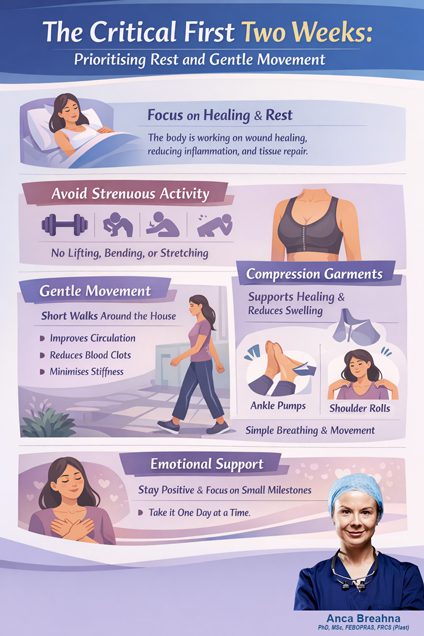
The first two weeks following surgery are critical. This is when the body focuses on wound healing, reducing inflammation, and beginning tissue repair. During this period, rest is not a luxury but a necessity.
Patients are advised to avoid all forms of strenuous activity, including lifting, stretching, or bending. However, complete immobility is not recommended either. Gentle walking around the house for a few minutes several times a day is encouraged. This type of movement supports healthy circulation, reduces the risk of blood clots, and can help minimise stiffness.
During this phase, patients will also be wearing compression garments. These garments support healing tissues, reduce swelling, and help the body adjust to its new contours. They should remain in place during rest and light movement.
Light breathing exercises and simple movements such as ankle pumps and shoulder rolls can also be introduced. These help maintain a sense of bodily control and connection without placing stress on healing areas.
This phase is also psychological. Patients often experience emotional shifts during the early stages of recovery. Fatigue, discomfort, and concern about their results are common. Miss Breahna encourages her patients to remain patient and focus on small milestones, such as being able to stand straighter or walk a little longer each day.
Gaining Momentum: Increasing Movement and Supporting Mobility
As the body begins to stabilise, patients can gently increase their level of movement. This does not mean returning to exercise as it was pre-surgery, but rather introducing more deliberate mobility to restore function.
Walking can be extended in duration and intensity. Outdoor walks on flat ground are ideal, as they promote cardiovascular health, support mental wellbeing, and enhance circulation without compromising healing tissues. At this stage, many patients begin to feel stronger and may be tempted to increase their activity levels too quickly. However, caution remains essential.
Low-impact movement such as gentle stretching (avoiding core engagement) or slow-paced standing exercises can be introduced if they do not cause discomfort. It is still too early for abdominal exercises, high-intensity cardio, or any form of weight training.
Patients should pay close attention to posture. Abdominal surgery, particularly when muscle repair is involved, can alter the way the body moves and stands. Restoring upright posture through awareness and gentle spinal mobility can be very beneficial.
Miss Breahna monitors her patients during this stage to ensure they are healing appropriately before advancing to more challenging movements. She also reminds them that swelling may still come and go, and that recovery is rarely linear. Listening to the body and reporting any concerns early is the best way to stay on track.
Download Miss Anca Breahna’s Tummy Tuck Surgery Guide
Building Strength Slowly and Safely
Around the six-week mark, and only after formal approval from the surgeon, patients can begin to explore basic strength training. This is a turning point in recovery, but it must be approached with structure and care.
At this stage, many patients are eager to regain their pre-surgery strength and fitness. However, the focus should still be on stability, mobility, and body awareness. Light resistance training can be introduced, using resistance bands or very light weights. Exercises should target the arms, legs, and glutes while avoiding strain on the abdominal wall.
Pelvic floor exercises and diaphragmatic breathing techniques can be reintroduced to gently begin core reactivation. It is still too soon for crunches, planks, or twisting movements. Instead, the goal is to establish a strong foundation of movement control and muscle engagement without risking damage to healing tissues.
Wearing compression garments may still be advised during activity to support internal tissues and reduce swelling. Hydration, rest, and proper nutrition also play important roles in maintaining energy and supporting continued healing.
Many women find this phase emotionally rewarding. As movement becomes easier and strength begins to return, confidence grows. Miss Breahna often observes her patients starting to reconnect with their bodies in a more positive way during this time.
Returning to Fitness With Confidence
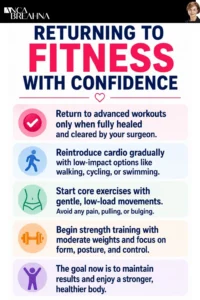
Once the body has sufficiently healed and patients have been cleared for more advanced activity, they can begin transitioning to a more robust fitness routine. This includes the gradual reintroduction of cardiovascular training, core engagement, and strength-based workouts.
It is important to note that not all women will reach this phase at the same time. Surgical complexity, individual health factors, and personal healing timelines will vary. Even when cleared, new routines should begin slowly and progress carefully.
Cardio options like brisk walking, cycling, or swimming (if incisions are healed) can be excellent choices. They support heart health and endurance without placing excessive strain on the core. High-impact activities such as running or jumping should only be resumed if the patient feels ready and shows no signs of discomfort or abdominal instability.
Core exercises should start with functional, low-load movements that focus on deep abdominal engagement. Examples include modified planks on the knees, supported bridges, and stability ball exercises. Any movement that causes bulging, pulling, or pain in the abdomen should be avoided and reported to the surgical team.
Strength training can now include moderate weights and machines, provided proper form is used. Sessions should prioritise posture, symmetry, and breath control to protect the surgical site and maintain results.
At this stage, the surgical transformation is largely complete. The goal shifts toward maintenance, longevity, and enjoyment of a stronger, healthier body.
Healing the Mind Along With the Body
Surgery is never just physical. The emotional journey of recovery is deeply personal and often overlooked. Many women report feeling vulnerable, frustrated, or impatient during the early stages of healing. These feelings are normal, and movement can play a powerful role in rebuilding mental resilience.
Even gentle walks or small victories in mobility can help women feel more in control of their bodies again. As strength returns, so does confidence. For many patients, exercise becomes a form of self-expression and empowerment. It reconnects them to a part of themselves that may have been lost during pregnancy, childbirth, or years of prioritising others.
Miss Anca Breahna’s approach to recovery embraces this emotional dimension. She encourages her patients to approach movement not as a means of perfection, but as a way to feel strong, stable, and self-assured. Physical transformation is often mirrored by an internal shift in self-image and wellbeing.
Mummy Makeover Before and After Photos


Avoiding the Common Pitfalls of Post-Surgical Exercise
Despite the best intentions, patients sometimes make choices that compromise their recovery. Common mistakes include:
- Starting exercise before receiving clearance from the surgeon
- Ignoring signs of discomfort, swelling, or fatigue
- Engaging in abdominal exercises too early
- Lifting heavy objects around the house
- Failing to wear compression garments as advised
- Comparing one’s progress to others
- Skipping follow-up appointments
Each of these can delay healing, affect surgical outcomes, or increase the risk of complications. Miss Breahna reminds her patients that consistency and patience will lead to better results than rushing or forcing the process.
Supporting Long-Term Results With the Right Habits
Surgical results can last many years, but they must be supported by a healthy lifestyle. A Mummy Makeover is not a substitute for exercise or nutrition. It is a foundation upon which long-term body confidence is built.
Miss Breahna encourages her patients in Chester and Liverpool to adopt sustainable fitness routines. This may include walking, low-impact cardio, resistance training, or yoga. The key is to find enjoyable forms of movement that support strength, flexibility, and emotional wellbeing.
Maintaining a stable weight, eating nutrient-rich foods, and managing stress also contribute to lasting results. Extreme dieting or intense training regimens are not necessary and can be counterproductive.
Follow-up consultations are important even after full recovery. These allow Miss Breahna to monitor healing over time, provide advice on scar management, and address any questions that may arise months or years later.
FAQs About Exercise After a Mummy Makeover
Can I wear shapewear instead of my compression garment when exercising?
No. Shapewear may seem similar, but it does not provide the same medical-grade compression or support needed after surgery. Compression garments are specifically designed to reduce swelling, support healing tissues, and protect your surgical results. Switching to shapewear too soon can compromise recovery.
Is it normal to feel muscle tightness in unexpected places, like the back or thighs?
Yes. After a Mummy Makeover, your posture may temporarily shift due to core weakness and healing incisions. This can lead to tension in areas like the lower back or hips. Gentle stretching and postural awareness can help relieve discomfort, but always consult your surgeon if pain is persistent.
Can I use electric muscle stimulation (EMS) to speed up core recovery?
EMS devices are not recommended in the early stages of recovery, especially when abdominal muscles have been repaired. They can cause unintentional strain and disrupt internal healing. Only consider EMS with approval from your surgeon, and never as a replacement for gradual, controlled exercise.
Why does walking feel harder than expected, even weeks after surgery?
Your core muscles play a major role in balance and gait. After surgery, they may be healing or temporarily disengaged, making simple movements feel more tiring. This improves with time as your strength and stability return.
Can swimming help reduce swelling post surgery?
Swimming can be beneficial once incisions are fully healed and your surgeon has approved water-based activity. The gentle resistance and buoyancy support joint movement and circulation. However, entering pools too soon increases the risk of infection and delayed healing.
Will sweating affect my scars or sutures during exercise?
Mild perspiration is normal and generally not harmful after incisions have closed. However, excessive sweating in the early stages can irritate the skin or disrupt healing if garments are tight or damp. Always wear breathable clothing and cleanse the skin gently after exercise.
Why does one side of my body feel more mobile or tight than the other during workouts?
It is common for one side to heal faster or feel different due to surgical technique, muscle balance, or body dominance. Asymmetry during early recovery is usually temporary. Incorporating balanced movements and focusing on form can help correct this over time.
Can I return to yoga or Pilates sooner if I avoid core focused poses?
Modified versions may be possible once your surgeon approves light movement. However, even gentle poses can unintentionally engage the abdominal wall. It is best to work with a qualified instructor who understands post surgical limitations.
Is it safe to do breathwork or meditation with physical movement post surgery?
Yes, breath-led movement like gentle yoga or guided meditations can be beneficial. Breathwork can reduce stress, aid in pain management, and reconnect you with your body. Just ensure that any movement linked to breath is slow, controlled, and cleared by your surgeon.
Why do I feel emotional or anxious when trying to exercise again?
Physical recovery often stirs emotional responses, especially after a transformative surgery. Many women feel pressure to bounce back or frustration at how limited they feel. These emotions are valid, and gradual movement, combined with self compassion, often helps patients feel grounded and empowered again.
Medical References
- “Safety of core muscle training immediately after abdominal surgery” — systematic review assessing the safety of abdominal wall muscle exercises early after surgery. OUP Academic
Link: https://academic.oup.com/bjsopen/article/7/6/zrad142/7477087 - “Effectiveness of Respiratory and Abdominal Strength Exercises in Abdominal Surgery” — physiotherapy‑oriented review of abdominal wall exercises post surgery. Jcdr
Link: https://jcdr.net/articles/PDF/16290/52574_CE%5BRa1%5D_F%28KR%29_PF1%28AG_SS%29_PFA%28AG_KM%29_PN%28KM%29.pdf - “Effects of postoperative physical exercise rehabilitation on cardiorespiratory fitness, functional capacity and quality of life …” — meta‑analysis across surgical patients (including breast, colorectal, prostate) of exercise interventions post‑surgery. SpringerLink+1
Link: https://link.springer.com/content/pdf/10.1007/s00432-024-06064-y.pdf
Start Your Transformation With Expert Support
Exercise after a Mummy Makeover is not just about regaining fitness. It is part of a wider journey toward confidence, energy, and body connection. By following a structured, thoughtful approach to movement, patients can support their recovery, protect their surgical investment, and embrace a more vibrant version of themselves.
Miss Anca Breahna, Consultant Plastic & Reconstructive Surgeon based in Chester, is committed to supporting her patients throughout every stage of the journey. Her experience, empathy, and personalised care ensure that each woman receives the guidance she needs to move forward with clarity and confidence.
To learn more about recovery after a Mummy Makeover, or to book a consultation at Nuffield Health in Chester or ASET Hospital in Liverpool, please contact Miss Anca Breahna’s clinic at contact@ancabreahna.com or call 07538 012918.
Your transformation deserves expert care. Let it begin with the right support.
Further Reading
- Read more about Mini Tummy Tuck
- Read more about Liposuction
- Read more about Arm Lift – Arm Reduction Surgery
- Read Miss Anca Breahna’s How to Reduce Swelling and Bruising After a Mummy Makeover Surgery
- Read Miss Anca Breahna’s What is a Mummy Makeover?
- Read Miss Anca Breahna’s What is a Menopause Makeover?
- Read Miss Anca Breahna’s Signs It’s Time to Replace Your Breast Implants
About Anca Breahna – Consultant Plastic Surgeon
 Miss Anca Breahna, PhD, MSc, FEBOPRAS, FRCS (Plast), is a Consultant Plastic, Reconstructive and Aesthetic Surgeon based in Chester with extensive experience in breast surgery, abdominal contouring and body reshaping. This broad surgical background is particularly relevant to a Mummy Makeover, where several areas may need to be assessed together to create a treatment plan that is balanced, safe and suited to the patient’s overall proportions.
Miss Breahna performs Mummy Makeover surgery in Chester for women seeking to address changes following pregnancy and breastfeeding, which may include loose abdominal skin, muscle separation, altered breast shape or volume, and localised fat deposits. Depending on individual needs, treatment may combine procedures such as abdominoplasty, breast uplift or augmentation, liposuction and, in selected cases, labiaplasty. As an experienced plastic surgeon in Chester, she considers anatomy, general health, scar placement, recovery, future pregnancy plans and realistic expectations before recommending a personalised combination of procedures.
Back to blog