- Take our Plastic Surgery Quiz to find out if you'd be a good candidate for cosmetic surgery.
- What Is a C-Section Belly
- ✓ How a C-Section Changes the Lower Abdomen
- ✓ The Typical C-Section Shelf or Pooch
- Why a C-Section Belly Happens
- ✓ Scar Tethering and the C-Section Shelf
- ✓ Diastasis Recti - Muscle Separation After Pregnancy
- ✓ Skin Stretching and Local Fat Deposits
- Download Miss Anca Breahna's Tummy Tuck Guide
- Non-Surgical Solutions for a C-Section Belly
- ✓ Time, Healing, and Early Postnatal Recovery
- ✓ Postnatal Physiotherapy and Core Rehabilitation
- ✓ Scar Massage, Mobility, and Posture
- ✓ Lifestyle, Weight Balance, and Expectations
- When Conservative Measures May Not Be Enough
- ✓ Recognising Structural Limits
- ✓ Emotional Impact And Self-Permission
- Surgical Options for a C-Section Belly
- ✓ Full Abdominoplasty (Tummy Tuck)
- ✓ Mini Abdominoplasty
- ✓ Liposuction With Scar Release or Revision
- ✓ Diastasis Recti Repair as Part of Surgery
- How Miss Anca Breahna Plans Treatment in Chester
- Consultation and Assessment
- Choosing the Right Solution for Your C-Section Belly
- Tummy Tuck Before and After Photos
- Recovery, Results, and Long-Term Expectations
- What to Expect After Surgery
- Longevity of Results and Future Pregnancies
- Taking The Next Step - Consultation or Photo Assessment With Miss Breahna
- Further Reading
- Medical References
- About Anca Breahna – Consultant Plastic Surgeon
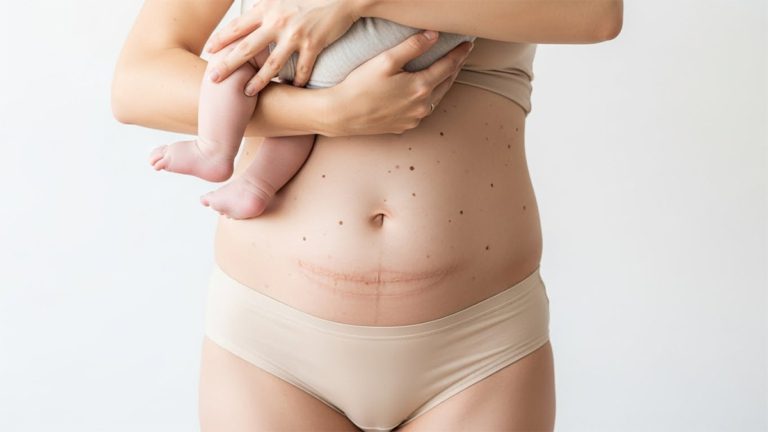
After a caesarean birth, many women find that their tummy does not return to how it looked or felt before pregnancy. Even with healthy eating and exercise, a stubborn overhang or “shelf” above the scar can remain. This is often called a C-section belly, and it can affect how you feel in clothes, on the beach, and in your own skin.
At her private clinic in Chester, UK, Miss Anca Breahna, a Consultant Plastic & Reconstructive Surgeon, sees many women who feel frustrated and confused about why their lower abdomen has changed so much. They wonder if they have done something wrong, or if doing more exercise will finally fix it. In reality, a C-section belly is usually the result of structural changes, not a lack of effort.
This guide explains why a C-section belly develops, what you can try without surgery, and when surgical options become the most realistic solution. The aim is to give you clear, honest information so you can make informed choices about your body after a C-section.
Take our Plastic Surgery Quiz to find out if you’d be a good candidate for cosmetic surgery.
What Is a C-Section Belly
✓ How a C-Section Changes the Lower Abdomen
A caesarean section is a major abdominal surgery. During the operation, the surgeon makes a horizontal cut low on the abdomen, then passes through layers of skin, fat and the strong tissue that supports the muscles. The uterus is opened to deliver your baby, and afterwards, all of these layers are repaired.
Even when everything heals well, the tissues do not always return to their pre-pregnancy state. The lower abdominal wall has been stretched by pregnancy and then interrupted by surgery. The scar itself is often placed where the skin of the lower tummy meets the groin area, which can create a natural point where tissues fold or crease.
✓ The Typical C-Section Shelf or Pooch
Many women describe a small ledge or “shelf” that sits just above the C-section scar. The skin and fat above the scar can seem to hang over a step or groove. The lower tummy can also look rounder or softer than before, even at a healthy weight. This pattern is what most people mean when they talk about a C-section belly.
Importantly, this is rarely just “extra weight“. It usually involves the scar, the skin, the underlying fat and sometimes the abdominal muscles themselves.
Why a C-Section Belly Happens
✓ Scar Tethering and the C-Section Shelf
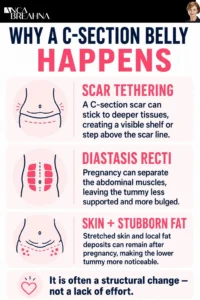
When a scar heals, it sometimes sticks down to the deeper tissues beneath it. In the case of a C-section, the lower scar can tether to the fascia and muscle layer. This tethered area does not move or stretch as freely as the skin and fat above it. As a result, the tissues above can drape over the fixed scar and create a visible step.
This is one of the reasons the overhang often seems to sit exactly at the scar line. Even if you lose weight, the underlying tethering can still make that step noticeable.
✓ Diastasis Recti – Muscle Separation After Pregnancy
During pregnancy, the growing uterus stretches the rectus abdominis muscles apart. The connective tissue between them thins and widens. For some women, this separation, called diastasis recti, improves after birth. For others, the gap remains.
When diastasis persists, the abdominal wall can lose some of its support and tension. The tummy may look gently domed or bulged, especially around the belly button, and this can make a C-section belly more noticeable. This is not a sign of weakness or lack of effort. It is a structural change in the tissue that sits between the muscles.
✓ Skin Stretching and Local Fat Deposits
Pregnancy stretches the abdominal skin to accommodate the baby. After birth, the skin gradually contracts, but it may not fully tighten, particularly after large babies, multiple pregnancies or if the skin was already slightly lax. Loose or crepe-like skin often settles over the lower abdomen and can fold at the scar line.
At the same time, hormones and genetics influence where your body tends to store fat. The lower abdominal area is a common place for fat to persist, even when the rest of the body has slimmed. This combination of skin changes and stubborn fat can keep the C-section belly visible despite your best lifestyle efforts.
Download Miss Anca Breahna’s Tummy Tuck Guide
Non-Surgical Solutions for a C-Section Belly
✓ Time, Healing, and Early Postnatal Recovery
In the first months after a C-section, your body is still healing. It is normal for the lower tummy to feel swollen, tight and numb. Simply caring for a newborn is a demanding job, and most women are not ready for intense exercise straight away.
During this period, your main goals are gentle movement, good nutrition, and rest where possible. Swelling often improves over the first three to six months. It can take up to a year for your body to settle into its “new normal”. A realistic time frame helps manage expectations and reduces pressure to “bounce back” too quickly.
✓ Postnatal Physiotherapy and Core Rehabilitation
A women’s health or pelvic floor physiotherapist can play a key role in improving a C-section belly without surgery. They assess your abdominal wall, diastasis recti, breathing pattern and pelvic floor function. From there, they create a tailored programme of exercises that target the deep core muscles in a safe and progressive way.
These exercises usually start with gentle breathing, engagement of the deep abdominal muscles and pelvic floor, and controlled movements that avoid straining the healing tissues. Over time, the programme can build towards more challenging activities such as planks or specific strength work, if appropriate. Many women notice improved posture, flatter appearance and better core strength with this approach, even if some structural laxity remains.
✓ Scar Massage, Mobility, and Posture
Once your scar has healed and your doctor or midwife confirms it is safe, gentle scar massage can help improve mobility. By lifting, stretching and moving the tissue around the scar in a controlled way, you may reduce tethering and improve the way the skin drapes over the lower abdomen. Physiotherapists often teach specific techniques for C-section scars and can guide you on pressure and frequency.
Posture also influences how your tummy looks. Rounded shoulders, a tipped pelvis and weak gluteal muscles can all make the abdomen protrude more. Working on posture, hip stability and glute strength alongside core exercises can enhance the effect of your rehabilitation and soften the appearance of a C-section belly.
✓ Lifestyle, Weight Balance, and Expectations
Maintaining a stable, healthy weight supports all of these measures. Overall fat loss can reduce the thickness of the fat layer over the lower abdomen, which may make the contour smoother. However, even with excellent habits, loose skin and strong scar tethering rarely disappear entirely. It is helpful to think of non surgical steps as a way to improve function, comfort and the way clothes fit, rather than a guaranteed way to erase all signs of pregnancy and surgery.
When Conservative Measures May Not Be Enough
✓ Recognising Structural Limits
If it has been a year or more since your last pregnancy, you have worked consistently on physiotherapy and lifestyle, and you are still troubled by a pronounced C-section belly, it may be time to consider whether structural issues are holding you back. Signs include a clear overhang of skin at the scar, visible wrinkling or folds that do not improve with weight loss, and a persistent muscle gap that causes bulging when you strain or sit up.
In these cases, no amount of exercise can remove extra skin or detach a deeply tethered scar. These are physical changes in the tissues that usually require surgery to correct.
✓ Emotional Impact And Self-Permission
For many women, this point is not only physical but emotional. You may feel grateful for your child or children, yet sad or frustrated about how your body has changed. You may feel guilty for even thinking about surgery. It is important to recognise that wanting to feel comfortable in your own body is not selfish.
At her clinic in Chester, Miss Anca Breahna often hears women say they “should” be happy with how they look because they are lucky to have a healthy baby. Her view as a Consultant Plastic & Reconstructive Surgeon is that both can be true. You can be deeply grateful and still want to address changes that affect your confidence, comfort and choice of clothing.
Surgical Options for a C-Section Belly
✓ Full Abdominoplasty (Tummy Tuck)
A full abdominoplasty is often the most comprehensive surgical solution for a significant C-section belly. During this procedure, an incision is made low across the abdomen, usually a little longer than the original C-section scar. A segment of skin and fat between this incision and the level of the belly button is lifted. The underlying rectus muscles are examined and, if separated, they are tightened with internal stitches to restore support and reduce bulging.

The skin is then pulled down, excess tissue is removed, and the belly button is brought out through a new opening in the tightened skin. The original C-section scar is usually removed as part of the tissue that is taken away, so it is effectively replaced by the new abdominoplasty scar.
This procedure is best suited to women who have a clear overhang, loose skin above and below the belly button, and a noticeable muscle separation. It addresses skin, fat, scar and muscles in one operation.
✓ Mini Abdominoplasty
A mini abdominoplasty focuses on the area below the belly button. The incision is shorter than in a full tummy tuck, and there is little or no repositioning of the belly button. A smaller segment of skin and fat is removed, and in some cases, the lower part of the rectus muscles can be tightened.
This can be a good option for women whose main issue is a small lower “pouch” and C-section shelf, with relatively firm skin in the upper abdomen and only mild diastasis. It is less extensive than a full tummy tuck, but also more limited in how much it can change.
✓ Liposuction With Scar Release or Revision
In selected cases where the skin is still reasonably firm but there is localised fat over the lower abdomen and a sharply tethered scar, a combination of liposuction and scar revision may help. Liposuction can reduce the fatty layer, while careful release of scar adhesions can smooth the step at the C-section line.
This approach is more conservative than abdominoplasty and does not tighten skin or correct significant muscle separation. It is usually reserved for women with relatively minor contour issues and good tissue quality.
✓ Diastasis Recti Repair as Part of Surgery
When diastasis recti is moderate to severe and has been present for a long time, stitching the muscles back towards the midline (plication) during an abdominoplasty is often the only reliable way to restore tension. This repair can improve core strength, posture and the way the tummy looks.
During consultation, Miss Anca Breahna will assess your muscle separation and explain whether surgical repair is likely to offer a meaningful benefit in your case.
How Miss Anca Breahna Plans Treatment in Chester
Consultation and Assessment
At a consultation in Chester, UK, Miss Anca Breahna will listen to your concerns and ask about your pregnancies, C-section history, weight changes and any previous abdominal surgery. She will examine your abdomen while you stand and lie down, assess the quality and position of your scar, check for diastasis recti, and evaluate your skin and fat distribution.
She will then explain which elements of your C-section belly are likely to respond to further physiotherapy and lifestyle changes, and which are structural. Together, you can decide whether it makes sense to continue with non-surgical measures, move towards surgery, or combine both.
Choosing the Right Solution for Your C-Section Belly
Not every woman needs, or wants, a full tummy tuck. Some will benefit from a mini abdominoplasty, others from liposuction and scar work, and some may decide that targeted physiotherapy and time are sufficient for their goals.
As a Consultant Plastic & Reconstructive Surgeon, Miss Anca Breahna will outline the pros, limitations and recovery demands of each option. The final plan is tailored to your anatomy, your family plans, your lifestyle and your feelings about scars, downtime and change.
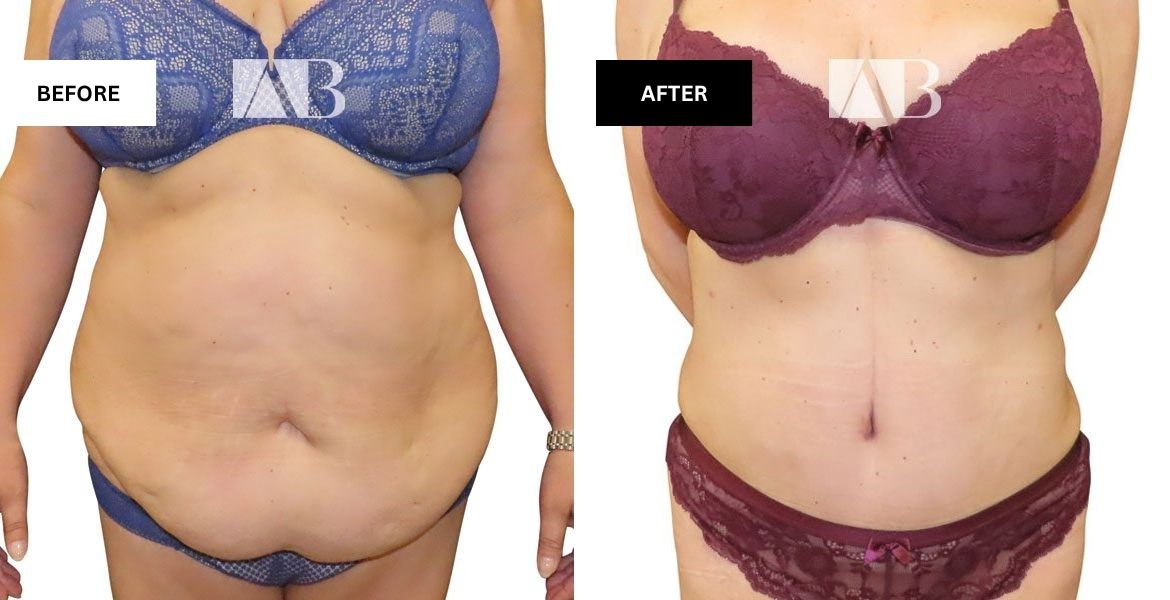
Tummy Tuck Before and After Photos

Recovery, Results, and Long-Term Expectations
What to Expect After Surgery
Abdominoplasty and related procedures are major operations that require planning and support. After surgery, you can expect tightness, swelling and some discomfort across the abdomen. A supportive garment is usually worn for several weeks, and you will be encouraged to walk gently soon after the operation to reduce the risk of clots.
Most women need at least two weeks away from desk-based work, and longer if their job involves lifting or physical activity. Full exercise, especially high impact or heavy lifting, is reintroduced gradually over several months. Miss Anca Breahna and her team in Chester will give detailed instructions and see you for follow-up appointments to monitor healing.
Longevity of Results and Future Pregnancies
The improvements from surgery are generally long-lasting when weight remains stable, and core strength is maintained. Skin that has been removed does not grow back, and tightened muscles usually stay in their new position unless they are stretched again.
If you are planning more pregnancies, it is wise to discuss this with Miss Anca Breahna. Future pregnancies can stretch the tissues again and may reduce the benefits of surgery. Many women choose to have surgery once their family is complete, but personal circumstances vary, and this is something to decide together after a clear discussion.
Taking The Next Step – Consultation or Photo Assessment With Miss Breahna
If you are struggling with a C-section belly and unsure what can realistically be improved, the most helpful step is a personalised assessment. What you see in the mirror is the result of a unique combination of scar, skin, fat and muscle, and the best solution is rarely found in generic advice.
You can contact Miss Anca Breahna, Consultant Plastic & Reconstructive Surgeon in Chester, UK, through this website. You can use the enquiry form or a complimentary photo assessment to receive an initial opinion in a discreet, convenient way.
For direct bookings or questions, you can also use:
Phone: 07538 012918
Email: contact@ancabreahna.com
CHESTER – MAIN CLINIC
Cheshire Cosmetic Surgery
Chester Wellness Centre
Wrexham Road
Chester CH4 9DE
NUFFIELD – THE GROSVENOR HOSPITAL
Nuffield Health
Wrexham Road
Chester CH4 7QP
With clear information and thoughtful guidance from Miss Anca Breahna in Chester, you can explore the solutions that feel right for you and move towards an abdomen that better reflects how you want to feel in your body after a C-section.
Further Reading
- Read Miss Anca Breahna’s Blog on Tummy Tuck after a C Section
- Read Miss Anca Breahna’s Blog on Myths and Facts about Tummy Tuck Surgery
- Read Miss Anca Breahna’s Blog on Surgery For an Apron Belly
- Read Miss Anca Breahna’s Blog on Liposuction vs Tummy Tuck
- Read Miss Anca Breahna’s Blog on Best Candidates for the Mini Tummy Tuck
- Read Miss Anca Breahna’s Blog on How To Get Rid of a Caesarean Section Pouch
Medical References
- Effect of Hypopressive and Conventional Abdominal Exercises on Postpartum Diastasis Recti – A Randomized Controlled Trial / PLOS One / – https://journals.plos.org/plosone/article?id=10.1371/journal.pone.0314274
- Effectiveness of Face to Face Physiotherapy Training and Education for Women Undergoing Elective Cesarean Section / Archives of Physiotherapy / – https://archivesphysiotherapy.biomedcentral.com/articles/10.1186/s40945-021-00128-9
- Comparison of Health Parameters in Postpartum Diastasis Recti – A Randomized Control Trial of SEMG Biofeedback Assisted Core Strengthening Exercises With Kinesiotaping vs Non Assisted Exercises / Healthcare (MDPI) / – https://www.mdpi.com/2227-9032/12/16/1567
About Anca Breahna – Consultant Plastic Surgeon
 Miss Anca Breahna, PhD, MSc, FEBOPRAS, FRCS (Plast), is a Consultant Plastic, Reconstructive and Aesthetic Surgeon based in Chester with extensive experience in abdominal contouring and reconstructive surgery. Her specialist background is particularly relevant to abdominoplasty, where careful assessment of excess skin, abdominal muscle separation, fat distribution and overall waist contour is essential when planning surgery.
Miss Breahna performs tummy tuck surgery in Chester for patients affected by loose abdominal skin, stretched or separated muscles, or changes following pregnancy and significant weight loss. During consultation, she considers skin quality, muscle tone, body shape, medical history and individual goals before deciding whether a full abdominoplasty, mini tummy tuck or another approach is most suitable. As an experienced plastic surgeon in Chester, her approach focuses on balanced abdominal contouring, thoughtful scar placement, appropriate muscle repair and realistic expectations, with liposuction considered in selected cases where it may help refine the final shape.
Back to blog