- Is There Such a Thing as the Perfect Breast?
- What Does Scientific Research Tell Us About Breast Beauty?
- Which Breast Proportions Are Considered Most Attractive?
- ✓ What Is the Ideal Upper-to-Lower Pole Ratio?
- ✓ How Important Is Breast Projection?
- ✓ Why Does Nipple Position Matter?
- ✓ How Does Breast Width Affect Appearance?
- ✓ Is Cleavage Determined by Breast Implants?
- ✓ Can Breast Surgery Create Perfect Symmetry?
- How Does Overall Body Shape Influence Breast Aesthetics?
- How Does Breast Augmentation Create a Balanced Result?
- How Is the Right Breast Implant Selected?
- ✓ Are Round Breast Implants Always the Best Choice?
- ✓ When Are Anatomical Breast Implants Recommended?
- ✓ How Does Implant Profile Change Breast Shape?
- ✓ How Is Implant Size Chosen?
- What Are Internal Bra Techniques?
- When Might an Internal Bra Be Recommended?
- Can an Internal Bra Stop the Breasts from Drooping?
- What Are the Most Common Myths About the Perfect Breast?
- Are Larger Breasts Always More Attractive?
- Do Breast Implants Always Look Artificial?
- Can Breast Implants Create Any Cleavage a Patient Wants?
- How Do Culture and Fashion Influence Breast Preferences?
- How Does Psychology Affect Breast Surgery Decisions?
- What Happens During a Breast Augmentation Consultation?
- What Questions Should Patients Ask During Consultation?
- What Are the Risks of Breast Augmentation?
- What Is Capsular Contracture?
- Breast Augmentation Before and After Photos
- How Long Does Recovery Take After Breast Augmentation?
- When Can Patients Return to Work and Exercise?
- What Alternatives Are Available to Breast Implants?
- Can Fat Transfer Create a Natural Breast Enhancement?
- Who Is Suitable for Breast Augmentation?
- Who May Not Be Suitable for Breast Augmentation?
- How Much Does Breast Augmentation Cost?
- What Should Patients Consider Beyond the Initial Cost?
- What Is the Main Message About the Perfect Breast?
- Perfect Boob And Breast Augmentation FAQs
- Download Miss Anca Breahna's Breast Augmentation Surgery Guide
- Next Steps: Starting The Ideal Shape Journey With Miss Breahna
- Further Reading
- About Anca Breahna – Consultant Plastic Surgeon
Miss Anca Breahna, PhD, MSc, FEBOPRAS, FRCS (Plast), Consultant Plastic, Reconstructive and Aesthetic Surgeon in Chester, explains that there is no single scientifically proven definition of the perfect breast. Scientific evidence can identify characteristics that many people find attractive, but the ideal breast is ultimately one that complements the patient’s anatomy, body proportions, and personal goals.
The appearance of the breasts is influenced by many factors working together rather than by size alone. Shape, projection, symmetry, nipple position, skin quality, and the relationship between the breasts and the rest of the body all contribute to an attractive and natural-looking result.
Modern breast augmentation is therefore about creating balance rather than simply increasing volume. Every treatment plan should be tailored to the individual so that the final outcome enhances the patient’s natural proportions while maintaining long-term comfort and safety.
Is There Such a Thing as the Perfect Breast?
There is no universal breast shape that can be considered perfect for every woman because beauty is influenced by anatomy, culture, and personal preference. Scientific research provides useful guidance, but the most successful breast augmentation result is always one that suits the individual patient.
Characteristics commonly associated with attractive breasts include:
- Balanced upper and lower breast fullness
- Natural breast projection
- A well-positioned nipple and areola
- Good symmetry between both breasts
- Proportion with the chest and body
Rather than aiming for perfection, surgeons aim to create harmony between the breasts and the rest of the body. This personalised approach generally produces results that look more natural and remain satisfying over the long term.
What Does Scientific Research Tell Us About Breast Beauty?
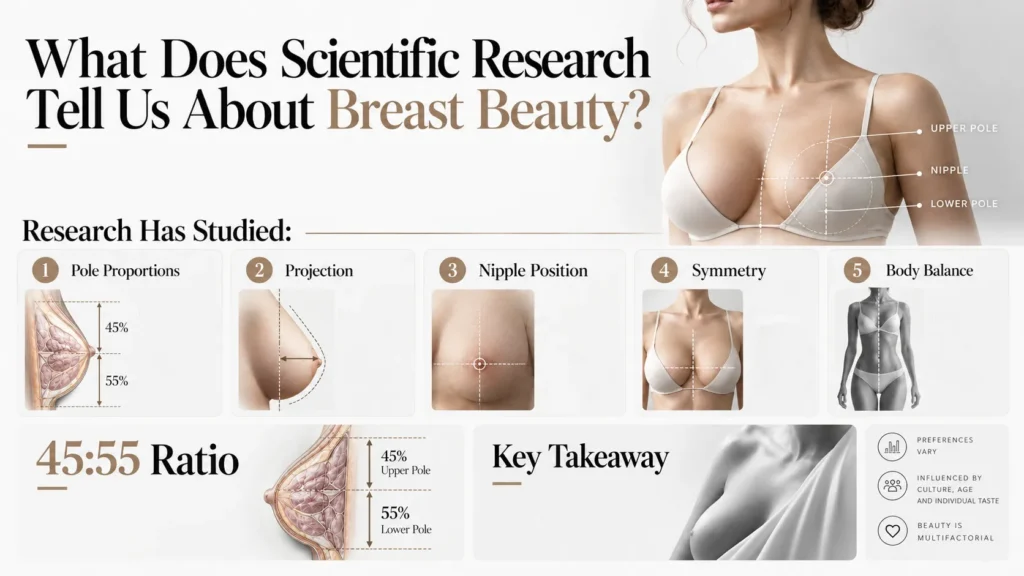
Researchers have spent many years studying which breast characteristics are most commonly perceived as attractive by both medical professionals and the general public. Although preferences vary, several anatomical features consistently appear across published studies.
Scientific research has investigated:
- Upper and lower pole proportions
- Breast projection
- Nipple position
- Breast symmetry
- Overall body proportions
One of the best-known concepts is the 45:55 upper-to-lower-pole ratio, which suggests slightly greater fullness beneath the nipple than above it. However, newer research has shown that preferences vary considerably, demonstrating that breast aesthetics cannot be reduced to a single mathematical formula.
Which Breast Proportions Are Considered Most Attractive?
Breast attractiveness is determined by the relationship between several different features rather than by one measurement alone. Width, projection, symmetry, and nipple position all contribute to whether the breast appears balanced and proportionate.
Important breast proportions include:
- Upper and lower pole balance
- Breast projection
- Breast width
- Nipple position
- Cleavage
No individual measurement guarantees an attractive result because every anatomical feature influences the others. The most successful surgical plans consider the breast as part of the patient’s overall physique instead of focusing on isolated proportions.
✓ What Is the Ideal Upper-to-Lower Pole Ratio?
The upper pole is the area above the nipple, while the lower pole extends from the nipple to the breast crease. Many naturally attractive breasts have a gentle upper slope with slightly greater fullness in the lower pole.
Upper and lower pole balance depends on:
- Existing breast tissue
- Implant shape
- Implant profile
- Skin elasticity
- Implant position
Some patients prefer a fuller upper breast, whereas others favour a softer and more natural contour. The ideal ratio should therefore reflect the patient’s anatomy and aesthetic goals rather than a fixed scientific measurement.
✓ How Important Is Breast Projection?
Breast projection describes how far the breast extends forwards from the chest wall rather than how large it is. Appropriate projection helps create an attractive side profile while maintaining natural body proportions.
Projection is influenced by:
- Chest width
- Breast base diameter
- Implant profile
- Existing breast tissue
- Skin quality
Excessive projection can appear disproportionate and increase tension on the surrounding tissues. Insufficient projection may leave the breasts looking flatter than the patient expected despite an increase in volume.
✓ Why Does Nipple Position Matter?
The position of the nipple has a major influence on the overall appearance of the breast because it acts as the visual centre of the breast mound. Even a well-sized breast may appear less balanced if the nipple sits too high, too low, or points in an unnatural direction.
Nipple position is affected by:
- Pregnancy and breastfeeding
- Ageing
- Weight changes
- Skin laxity
- Natural breast development
Breast implants increase volume but cannot reliably correct significant nipple drooping on their own. Patients with noticeable breast ptosis may achieve a better result by combining breast augmentation with a breast uplift.
✓ How Does Breast Width Affect Appearance?
Breast width refers to the natural footprint of the breast across the chest wall and is one of the most important measurements during breast surgery planning. Choosing an implant that matches this width helps create a smooth and proportionate breast contour.
Breast width influences:
- Side breast contour
- Cleavage
- Implant positioning
- Overall projection
- Body proportions
An implant that is too wide or too narrow can produce an unnatural appearance even if the volume is appropriate. Careful measurements help ensure the implant fits the patient’s anatomy instead of forcing the tissues beyond their natural limits.
✓ Is Cleavage Determined by Breast Implants?
Cleavage is influenced primarily by a patient’s natural anatomy rather than by implant size alone. Breast implants can improve fullness, but they cannot safely eliminate every natural gap between the breasts.
Several factors influence cleavage:
- Chest wall shape
- Natural breast spacing
- Implant width
- Existing breast tissue
- Surgical pocket design
Attempting to create excessively close cleavage may increase the risk of implant malposition or other complications. Realistic expectations help patients understand what can safely be achieved through surgery.
✓ Can Breast Surgery Create Perfect Symmetry?
Perfect breast symmetry is uncommon because almost everyone has natural differences between the two sides of the body. Breast surgery can improve asymmetry considerably, but complete equality is rarely possible.
Breast asymmetry may involve differences in:
- Breast size
- Breast shape
- Nipple position
- Breast crease height
- Chest wall anatomy
The aim of surgery is to create better balance rather than identical breasts. Small differences often remain after surgery and usually appear entirely natural.
How Does Overall Body Shape Influence Breast Aesthetics?
The breasts should always be assessed in relation to the rest of the body because proportion is more important than breast size alone. Factors such as height, shoulder width, waist definition, and ribcage shape all influence how the breasts are perceived.
Important anatomical considerations include:
- Chest width
- Ribcage shape
- Waist-to-hip proportions
- Existing breast tissue
- Skin quality
The same implant may produce a subtle enhancement in one patient and a dramatic change in another. Individual anatomy therefore plays a far greater role than implant volume alone when planning surgery.
How Does Breast Augmentation Create a Balanced Result?
Breast augmentation is designed to improve breast shape and volume while maintaining natural proportions. Successful surgery depends on careful planning rather than selecting the largest implant available.
Treatment planning includes assessment of:
- Breast base width
- Tissue thickness
- Skin elasticity
- Existing asymmetry
- Nipple position
Every surgical decision is based on detailed measurements taken during consultation rather than estimates or cup size alone. This personalised approach helps achieve results that look balanced immediately after healing and continue to look natural over time.
How Is the Right Breast Implant Selected?
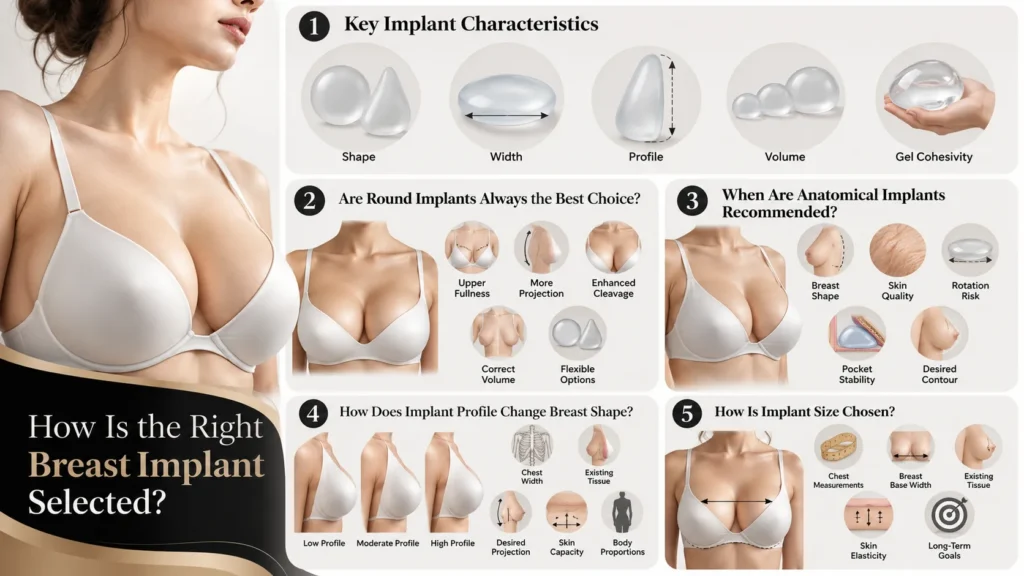
Selecting the right implant involves much more than choosing a preferred size because every implant has different characteristics. The final choice should complement the patient’s anatomy, lifestyle, and desired appearance.
Important implant characteristics include:
- Shape
- Width
- Profile
- Volume
- Silicone gel cohesivity
The ideal implant is the one that produces the most balanced result rather than simply the largest increase in breast size. Careful implant selection is one of the most important factors influencing both appearance and long-term satisfaction.
✓ Are Round Breast Implants Always the Best Choice?
Round implants are the most commonly used implants and can produce either natural or fuller-looking breasts depending on how they are selected and positioned. Their versatility makes them suitable for many patients with different aesthetic goals.
Round implants may be chosen to provide:
- Increased upper pole fullness
- Improved breast projection
- Enhanced cleavage
- Correction of volume loss
- Flexible shaping options
The final appearance depends on far more than implant shape alone. Tissue quality, implant profile, breast width, and surgical technique all influence the eventual result.
✓ When Are Anatomical Breast Implants Recommended?
Anatomical implants have a teardrop shape that places more volume in the lower part of the breast. They may be appropriate for selected patients who wish to achieve a gently sloping upper breast contour.
Factors considered when using anatomical implants include:
- Existing breast shape
- Skin quality
- Implant rotation risk
- Pocket stability
- Desired breast contour
These implants require careful positioning because rotation can change the breast’s appearance. Whether they are appropriate depends on the patient’s anatomy rather than on the assumption that they always look more natural.
✓ How Does Implant Profile Change Breast Shape?
Implant profile describes how much the implant projects forwards relative to its width. Different profiles allow surgeons to achieve different breast shapes while remaining within the limits of the patient’s anatomy.
Profile selection depends on:
- Chest width
- Existing breast tissue
- Desired projection
- Skin capacity
- Body proportions
Higher-profile implants are not automatically better because they may appear excessive on some body types. Selecting the correct profile helps create a balanced result that complements the patient’s natural proportions.
✓ How Is Implant Size Chosen?
Implant size should always be selected using detailed anatomical measurements instead of relying on bra cup sizes. This approach provides a more predictable result because cup sizing varies considerably between manufacturers.
Implant size selection considers:
- Chest measurements
- Breast base width
- Existing tissue volume
- Skin elasticity
- Long-term aesthetic goals
Three-dimensional imaging and implant sizing can help patients visualise different options before surgery. The final decision should balance the patient’s wishes with what can be achieved safely and proportionately.
What Are Internal Bra Techniques?
Internal bra techniques are surgical methods used to reinforce and support the breast from within. They may be considered when additional control is needed over breast shape, implant position, or lower pole support.
Internal support may involve:
- Strategic internal sutures
- Reinforcement of the breast fold
- Adjustment of the implant pocket
- Supportive mesh in selected cases
- Reshaping of the internal breast tissue
These techniques do not create a visible bra and cannot prevent all future changes. Their purpose is to improve internal stability and help maintain the intended breast contour.
When Might an Internal Bra Be Recommended?
An internal bra may be considered when the breast tissues are weak, stretched, or unable to support the desired shape adequately. It can also be useful during revision surgery when an implant has moved from its intended position.
Possible indications include:
- Significant skin or tissue laxity
- Implant bottoming out
- A poorly defined breast crease
- Recurrent implant displacement
- Revision after previous breast surgery
Not every patient requires additional internal support. The decision depends on tissue quality, implant choice, previous surgery, and the surgeon’s assessment.
Can an Internal Bra Stop the Breasts from Drooping?
An internal bra can provide additional support, but it cannot stop the natural ageing process. The breasts may still change over time because of gravity, pregnancy, weight fluctuation, and loss of skin elasticity.
Factors that continue to affect breast shape include:
- Ageing
- Pregnancy and breastfeeding
- Significant weight change
- Skin quality
- Implant weight
Internal reinforcement may help maintain shape in carefully selected patients. However, it should not be presented as a permanent guarantee against future sagging.
What Are the Most Common Myths About the Perfect Breast?
Many myths about ideal breast shape are based on social media trends, edited images, or unrealistic expectations. These misconceptions can make patients believe that one implant size or breast shape will suit everyone.
Common myths include:
- Larger breasts are always more attractive
- Perfect symmetry can always be achieved
- One implant type looks natural on everyone
- Implants automatically create close cleavage
- Breast surgery produces permanent results
Breast aesthetics are far more individual than these claims suggest. A safe and proportionate result depends on anatomy, tissue quality, and realistic surgical planning.
Are Larger Breasts Always More Attractive?
Larger breasts are not automatically more attractive because size must remain proportionate to the patient’s body. An implant that overwhelms the chest can appear less balanced and may place unnecessary strain on the tissues.
Larger implants may increase the risk of:
- Skin stretching
- Implant visibility
- Rippling
- Breast drooping
- Future revision surgery
The most appropriate implant is usually the one that creates the desired improvement without exceeding the tissues’ safe capacity. Proportion and shape are generally more important than volume alone.
Do Breast Implants Always Look Artificial?
Breast implants do not always look artificial, particularly when their dimensions suit the patient’s anatomy. An unnatural appearance is more likely when the implant is too large, too wide, too projected, or poorly covered by tissue.
A natural-looking result is influenced by:
- Implant width
- Implant profile
- Tissue thickness
- Implant position
- Skin quality
Careful implant selection can create anything from a subtle enhancement to a fuller and more visibly augmented result. The key is matching the surgical plan to the patient’s stated preferences.
Can Breast Implants Create Any Cleavage a Patient Wants?
Breast implants can improve central fullness, but they cannot safely create every type of cleavage. The natural distance between the breasts and the shape of the chest wall place important limits on what surgery can achieve.
Cleavage is influenced by:
- Natural breast spacing
- Chest wall anatomy
- Implant width
- Tissue distribution
- Implant pocket position
Attempting to force the implants too close together can increase the risk of malposition or symmastia. Safe surgery should respect the natural boundaries of the breast.
How Do Culture and Fashion Influence Breast Preferences?
Ideas about the ideal breast vary between cultures, generations, and periods of fashion. Preferences may shift between subtle, natural-looking contours and fuller upper pole volume depending on social influences.
Cultural preferences may be shaped by:
- Fashion trends
- Celebrity images
- Social media
- Advertising
- Regional beauty standards
These influences can affect what patients request during consultation. However, treatment should still be based on individual anatomy rather than a temporary trend.
How Does Psychology Affect Breast Surgery Decisions?
Psychological wellbeing plays an important role in deciding whether breast surgery is appropriate. Patients are more likely to be satisfied when their decision is personal, carefully considered, and supported by realistic expectations.
Helpful signs include:
- A clear personal reason for surgery
- Stable expectations
- Understanding of surgical limitations
- Acceptance of possible asymmetry
- Willingness to consider risks and recovery
Surgery should not be viewed as a guaranteed solution for relationship difficulties, low self-esteem, or external pressure. A responsible consultation explores both physical goals and emotional readiness.
What Happens During a Breast Augmentation Consultation?
A breast augmentation consultation allows the surgeon to assess the patient’s anatomy and understand the desired result. It is also an opportunity for the patient to discuss risks, alternatives, recovery, and long-term implant considerations.
The consultation may include:
- Medical history review
- Breast and chest measurements
- Assessment of skin and tissue quality
- Discussion of implant options
- Examination of existing asymmetry
The consultation should help the patient understand what can realistically be achieved. It should also provide enough information to support a fully informed decision.
What Questions Should Patients Ask During Consultation?
Patients should use the consultation to clarify the surgical plan and understand how it has been tailored to them. Asking detailed questions can help prevent misunderstandings about size, shape, recovery, and long-term results.
Useful questions include:
- Which implant dimensions suit my chest?
- Where will the implant be positioned?
- Will I need an uplift as well?
- What scars should I expect?
- What complications could require revision?
A good consultation should feel informative rather than rushed. Patients should leave with a clear understanding of the proposed procedure and its limitations.
What Are the Risks of Breast Augmentation?
Breast augmentation is a major surgical procedure and carries both short-term and long-term risks. Although many patients recover without serious problems, complications can occur even when surgery is performed carefully.
Possible risks include:
- Infection or bleeding
- Capsular contracture
- Implant rupture
- Changes in nipple sensation
- Implant malposition
Further surgery may be required if a complication develops or the breast changes over time. Patients should understand that breast implants are not lifetime devices.
What Is Capsular Contracture?
Capsular contracture occurs when the natural scar tissue around an implant tightens excessively. This can make the breast feel firm, look distorted, or become painful.
Possible features include:
- Increasing breast firmness
- Change in breast shape
- Implant displacement
- Visible asymmetry
- Breast discomfort
Mild cases may require observation, while more severe cases may need revision surgery. The condition can recur even after treatment.
Breast Augmentation Before and After Photos


How Long Does Recovery Take After Breast Augmentation?
Initial breast enlargement recovery usually takes several weeks, although healing continues for longer. Swelling, tightness, bruising, and changes in breast shape are common during the early stages.
Recovery commonly involves:
- Wearing a supportive surgical bra
- Avoiding heavy lifting
- Taking prescribed pain relief
- Sleeping in an elevated position
- Attending follow-up appointments
Patients often return to light activities before they are ready for strenuous exercise. Final breast shape may take several months to settle.
When Can Patients Return to Work and Exercise?
Return to work depends on the type of job, the extent of surgery, and the individual’s recovery. Patients with desk-based roles may return sooner than those whose work involves lifting or physical activity.
General recovery milestones may include:
- Gentle walking soon after surgery
- Desk work after the initial recovery period
- Driving once movement is comfortable
- Gradual return to exercise
- Delayed heavy chest training
The surgeon’s advice should take priority over general timelines. Returning to strenuous activity too early can increase discomfort and interfere with healing.
What Alternatives Are Available to Breast Implants?
Breast implants are not the only way to improve breast shape or volume. Some patients may be better suited to fat transfer, breast uplift surgery, or a combination of procedures.
Possible alternatives include:
- Breast uplift without implants
- Fat transfer to the breasts
- Implant removal with reshaping
- Padded or supportive bras
- No surgical treatment
Each option has different limitations and advantages. The most suitable choice depends on whether the patient’s main concern is volume loss, drooping, shape, or asymmetry.
Can Fat Transfer Create a Natural Breast Enhancement?
Fat transfer uses the patient’s own fat to create a modest increase in breast volume. It may appeal to patients who prefer to avoid implants and have enough donor fat available.
Potential benefits include:
- Use of the patient’s own tissue
- Subtle volume enhancement
- Improvement in selected asymmetries
- Liposuction of donor areas
- No breast implant device
Not all transferred fat survives, and more than one procedure may be needed. Fat transfer is generally better suited to modest enhancement than a large increase in breast size.
Who Is Suitable for Breast Augmentation?
Suitable candidates are generally in good health, have realistic expectations, and understand the risks and limitations of surgery. They should be considering treatment for personal reasons rather than because of pressure from someone else.
Potential candidates may have:
- Naturally small breasts
- Loss of volume after pregnancy
- Breast asymmetry
- Volume loss after weight reduction
- Realistic expectations about results
Suitability can only be confirmed after a detailed medical assessment. Some patients may be advised to delay surgery or consider a different procedure.
Who May Not Be Suitable for Breast Augmentation?
Breast augmentation may not be appropriate when medical, psychological, or anatomical factors increase the risks or make the desired result unrealistic. Surgery may also need to be postponed during pregnancy, breastfeeding, or active weight change.
Reasons to delay or avoid surgery may include:
- Significant uncontrolled medical conditions
- Active infection
- Unrealistic expectations
- Pregnancy or breastfeeding
- Inability to follow recovery advice
The surgeon may recommend further assessment or an alternative treatment. Declining or delaying surgery can be the safest and most responsible decision.
How Much Does Breast Augmentation Cost?
The cost of breast augmentation varies according to the hospital, implant type, surgical plan, and whether additional procedures are required. An accurate quotation can only be provided after consultation and examination.
The overall fee may include:
- Surgeon’s fees
- Hospital and theatre costs
- Anaesthetic fees
- Breast implants
- Follow-up care
Patients should ask what is included and whether future revision surgery would involve additional costs. Price should be considered alongside surgeon qualifications, hospital standards, and continuity of care.
What Should Patients Consider Beyond the Initial Cost?
Breast implants may create future expenses because they are not lifetime devices. Patients should consider the possibility of monitoring, implant replacement, or revision surgery later in life.
Long-term considerations include:
- Future implant replacement
- Revision for capsular contracture
- Correction of implant movement
- Imaging or medical assessment
- Surgery after pregnancy or ageing
Choosing surgery should involve financial planning as well as aesthetic decision-making. The lowest initial price may not provide the safest or most comprehensive care.
What Is the Main Message About the Perfect Breast?
Science identifies several proportions that are often perceived as attractive, but it does not define one perfect breast. The most successful result is based on balance, individual anatomy, and realistic expectations.
The key principles are:
- Beauty is not defined by size alone
- Proportion matters more than a fixed ratio
- Implant choice must be personalised
- Natural anatomy creates surgical limits
- Long-term safety should guide planning
Breast augmentation should enhance the patient’s existing proportions rather than reproduce someone else’s body. Careful consultation and tailored planning are essential to achieving a safe and satisfying result.
Perfect Boob And Breast Augmentation FAQs

What does research say about the “ideal breast shape”?
Scientific studies, such as those published in Plastic and Reconstructive Surgery, highlight proportions like a 45:55 upper‑to‑lower pole ratio as visually appealing to many observers. However, this is descriptive rather than prescriptive. Individualised planning remains key to achieving results that fit your own body and aesthetic goals.
Can implants make my breasts perfectly symmetrical?
Perfect symmetry is rare, even among people without surgery. Skilled surgical planning can improve symmetry significantly, but slight differences often remain and can look natural. Many patients find that enhanced symmetry still reflects their own unique anatomy.
Is there a universal “perfect boob” size?
No, perfect size varies by body type, proportions, and personal preference. The concept of perfection is individual, and what looks harmonious on one person may not suit another. Miss Breahna’s consultations prioritise personalised goals over societal norms.
Do bigger implants always look better?
No. Larger implants do not necessarily equate to better aesthetics. Proportionate enhancement that respects anatomy tends to result in more elegant, long‑lasting outcomes.
Will breast augmentation look natural?
With modern techniques and personalised planning, breast augmentation can look and feel natural. Considerations include implant type, placement, profile, and your natural tissue quality. Miss Breahna focuses on outcomes that complement your body’s unique shape.
Can breast implants impact my posture or activity?
When sized appropriately for your frame and lifestyle, implants have minimal impact on daily activity or posture. Oversized implants can place strain on the back or shoulders, which is why proportion is essential in planning.
What is the recovery time after breast augmentation?
Recovery varies by individual but typically involves a few weeks of limited activity, followed by gradual return to normal exercise. Full settling of implants and final shape can take several months.
Do different implant shapes affect the aesthetic outcome?
Yes, round and anatomical (teardrop) implants offer different contours and slopes. Shape choice depends on your body goals, tissue coverage, and desired projection.
How does cultural perception influence breast aesthetics?
Cultural standards vary across regions, generations, and individuals. What is considered beautiful in one context may differ in another, which is why personal goals should drive surgical planning.
Can breast augmentation be adjusted later if I want something different?
Yes, revision procedures are common and may be considered if your goals change. Miss Breahna discusses long‑term planning to help patients make informed decisions at every stage.
Medical References
- 553 Defining the Ideal Breast: A Systematic Review of Aesthetic Preferences and Anthropometric Standards / British Journal of Surgery / https://academic.oup.com/bjs/article/112/Supplement_10/znaf128.666/8164955
- Analysis of the Visual Perception of Female Breast Aesthetics and Symmetry: An Eye-Tracking Study / Plastic and Reconstructive Surgery / https://journals.lww.com/plasreconsurg/abstract/2019/12000/analysis_of_the_visual_perception_of_female_breast.1.aspx
- Concepts in aesthetic breast dimensions: Analysis of the ideal breast / Journal of Plastic, Reconstructive & Aesthetic Surgery / https://www.sciencedirect.com/science/article/abs/pii/S1748681511004359
Download Miss Anca Breahna’s Breast Augmentation Surgery Guide
Next Steps: Starting The Ideal Shape Journey With Miss Breahna
Ready to explore breast enhancement that’s tailored, natural, and uniquely yours? Book a private consultation with Miss Anca Breahna, Consultant Plastic & Reconstructive Surgeon located in Chester. You can also start with a Complimentary Photo Assessment to receive early expert guidance. Visit our Contact Page today and take the first step toward beautifully balanced results.
Further Reading
- Read more about Breast Implant Choices
- Read more about Mastopexy Augmentation (Uplift With Implants)
- Read more about Breast Implant Removal And Replacement or Exchange (Capsulectomy)
- Read Miss Anca Breahna’s Blogs on Glamorous Breasts with Large Breast Implants
- Read Miss Anca Breahna’s Blogs on How Can You Tell if You Have a Ruptured Breast Implant?
About Anca Breahna – Consultant Plastic Surgeon
 Miss Anca Breahna, PhD, MSc, FEBOPRAS, FRCS (Plast), is a Consultant Plastic, Reconstructive and Aesthetic Surgeon in Chester with extensive experience in breast surgery. Her reconstructive and aesthetic background gives her a detailed understanding of breast shape, volume, symmetry and tissue characteristics, all of which are important when planning breast enlargement. She assesses each patient’s chest width, existing breast tissue, skin quality and overall proportions before discussing whether augmentation is appropriate.
Miss Breahna performs breast augmentation in Chester for women seeking greater breast volume, improved symmetry or restoration of fullness following pregnancy, breastfeeding or weight loss. Treatment planning includes careful discussion of implant size, shape and placement, as well as incision position, expected scarring and long-term considerations. As an experienced plastic surgeon in Chester, Miss Breahna focuses on selecting an implant and surgical approach that suits the patient’s individual anatomy and goals, while ensuring that expectations, risks and recovery are clearly understood before surgery.
Back to blog