- Where Is the Motiva® Preservé Incision Made?
- Download Miss Anca Breahna's Breast Augmentation Surgery Guide
- Why Is the Incision Usually Placed Under the Breast?
- Can Motiva® Preservé Be Done Without a Scar?
- Is the Motiva® Preservé Scar Smaller Than Traditional Breast Augmentation Scars?
- What Do Patients Often Misunderstand About Motiva® Preservé Scars?
- Can the Incision Be Made Somewhere Other Than Under the Breast?
- Take our Plastic Surgery Quiz to find out if you'd be a good candidate for cosmetic surgery.
- How Visible Are Motiva® Preservé Scars After Healing?
- How Long Do Breast Augmentation Scars Take to Fade?
- What Helps Breast Implant Scars Heal Well?
- Are Smaller Incisions Always Better?
- Who Is a Good Candidate for Motiva® Preservé?
- Breast Augmentation Before and After Photos
- What Happens During a Consultation With Miss Anca Breahna in Chester?
- What Are the Risks of Motiva® Preservé Breast Augmentation?
- Motiva® Preservé Scars and Incisions FAQs
- Considering Motiva® Preservé Breast Augmentation in Chester?
- Further Reading
- About Anca Breahna – Consultant Plastic Surgeon
For many patients considering breast enhancement, the first question is not always about cup size. It is often about scars.
Where will the incision be? Will it be visible? Will it sit under the breast? Can it be hidden in swimwear or lingerie? Will a smaller incision mean a better result?
These are sensible questions. Many patients feel reassured by the idea of a natural-looking breast enhancement, but they still want to know where the evidence of surgery may be.
Miss Anca Breahna, Consultant Plastic & Reconstructive Surgeon in Chester, UK, regularly sees patients who are interested in modern breast augmentation techniques but want clear, honest information before making a decision. Motiva® Preservé breast augmentation is often appealing because it is associated with a tissue-preserving approach, refined planning and potentially smaller scars in suitable patients.
However, Motiva® Preservé is still surgery. An incision is still required. A scar will still form. The aim is not scar-free surgery, because that is not realistic. The aim is careful incision planning, discreet placement, gentle tissue handling and good support during healing.
Where Is the Motiva® Preservé Incision Made?
In most suitable patients, the Motiva® Preservé incision is placed in or close to the inframammary fold. This is the natural crease beneath the breast, where the lower breast meets the chest wall.
This position is commonly used in breast augmentation because it gives controlled access for implant placement while allowing the scar to sit in a natural crease. Once healing has progressed and the breast has settled, the scar can often be concealed beneath the lower curve of the breast.
This does not mean the scar will be invisible. It means the incision is planned in a position where it is usually less intrusive in day-to-day life.
The inframammary fold incision may be easier to hide in many bras, lingerie and swimwear styles, depending on breast shape, implant size, scar healing and the design of the garment.
In Miss Anca Breahna’s Chester practice, incision placement is never considered as a separate detail. It is part of the whole surgical plan. The incision must support safe implant placement, a natural breast shape and reliable healing.
Download Miss Anca Breahna’s Breast Augmentation Surgery Guide

Why Is the Incision Usually Placed Under the Breast?
The breast fold is often chosen because it offers a useful balance between surgical access and scar concealment.
From a surgical point of view, the inframammary fold allows the surgeon to create the implant pocket with good visibility and control. This can help with implant positioning, symmetry and fold definition. In breast augmentation, small differences in implant position can affect the final result, so precision matters.
From a patient point of view, the breast fold incision is often appealing because it avoids an incision around the areola and avoids placing the scar in the armpit. The scar is still on the breast area, but it is positioned where the natural lower curve of the breast may help to conceal it.
The breast fold incision is often chosen because it may offer:
- Controlled access for accurate implant placement
- A scar positioned in a natural crease
- Less need to place an incision around the nipple
- A discreet location beneath the lower breast curve
This approach also fits well with the philosophy behind Motiva® Preservé. Rather than making unnecessary disruption to the breast tissue, the aim is to work with the patient’s natural anatomy where appropriate.
For patients considering Motiva® Preservé in Chester, this distinction matters. The goal is not simply to make the breasts larger. The goal is to create an enhancement that feels balanced, elegant and in proportion with the body.
Can Motiva® Preservé Be Done Without a Scar?

No. Motiva® Preservé cannot be performed without a scar because an incision is needed to place the implant.
This is an important point to understand before surgery. Some patients hear terms such as “minimally invasive” or “tissue-preserving” and assume this means there will be no visible sign of surgery. That is not accurate.
Motiva® Preservé may allow a more refined approach in suitable patients. It may also allow a shorter incision in some cases. But it does not remove the normal healing process.
A scar forms whenever the skin is opened. The aim is to make that scar as discreet as possible through careful planning, precise closure and appropriate aftercare.
Miss Anca Breahna gives patients realistic information about this from the beginning. A good consultation should make you feel informed, not surprised later.
Is the Motiva® Preservé Scar Smaller Than Traditional Breast Augmentation Scars?
A Motiva® Preservé scar may be smaller than some Traditional Breast Augmentation scars in selected patients, but this is not guaranteed.
Scar length depends on many factors. These include implant size, implant profile, skin elasticity, breast tissue quality, previous surgery, scar history and the amount of space required for safe implant insertion.
A smaller incision can be a benefit when it is suitable. However, the shortest possible incision is not always the safest or most appropriate one. If an incision is too small for the implant, it may place unnecessary pressure on the skin, soft tissues or implant during insertion. This can work against the aim of gentle, controlled surgery.
Miss Anca Breahna does not plan surgery around a marketing claim. She plans surgery around the patient.
In her practice, the aim is not to create the smallest scar at any cost. The aim is to choose the safest incision for a natural, balanced result.
What Do Patients Often Misunderstand About Motiva® Preservé Scars?
One common misunderstanding is that a smaller incision automatically means a better scar. This is not always true.
A scar is influenced by incision placement, surgical technique, skin quality, wound tension, genetics and aftercare. A slightly longer incision placed carefully in the breast fold may heal better and look more discreet than a very short incision placed under too much tension.
Another misunderstanding is that a scar under the breast will never be seen. In many patients, it is well concealed when standing normally, but it may still be visible from certain angles, when the arms are raised, during intimate moments or when very minimal lingerie is worn.
Patients may also underestimate how long scars take to mature. Scars often take months to soften and fade. In some cases, they continue to improve beyond one year.
Motiva® Preservé may reduce unnecessary tissue disruption in suitable patients, but it does not remove the normal biology of healing. The best scar outcome usually comes from personalised planning, careful technique and realistic expectations.
Can the Incision Be Made Somewhere Other Than Under the Breast?
Yes, there are other incision options in breast augmentation surgery. However, they are not suitable for every patient or every implant technique.
A periareolar incision is placed around part of the border of the areola. Some patients like this idea because the scar may blend with the natural colour change between the areola and surrounding skin. However, this approach involves working closer to nipple and breast duct tissue. It may not be ideal for patients who want to preserve breast structures as much as possible or who wish to avoid an incision around the nipple.
A transaxillary incision is placed in the armpit. This avoids a scar on the breast itself, which can sound appealing. However, it can offer less direct access to the breast pocket. It may also be less suitable for certain implant choices, revision surgery or patients where precise fold control is especially important.
When patients compare incision sites, they often focus on visibility. Surgeons must also consider access, safety, tissue handling, implant position and long-term shape. This is why incision planning should be personalised.
For Motiva® Preservé, the breast fold approach is often appropriate because it supports careful access while allowing the scar to sit in a natural crease. Miss Anca Breahna will advise whether this is suitable for your body and your goals.
Take our Plastic Surgery Quiz to find out if you’d be a good candidate for cosmetic surgery.
How Visible Are Motiva® Preservé Scars After Healing?
All surgery creates a scar. This is true even with advanced techniques.
In the early weeks after Motiva® Preservé breast augmentation, the scar may look pink, red, firm, slightly raised or more noticeable than expected. It may also feel sensitive or look slightly different from one side compared with the other. This can be completely normal.
It is also common for scars to look worse before they look better. During the early healing phase, they may appear darker, firmer or more visible. This does not necessarily mean the final scar will look this way.
As the months pass, many scars soften, flatten and fade. For some patients, the incision line becomes much less noticeable. However, healing varies from person to person.
A scar may be influenced by:
- Skin type and genetics
- Previous scar history
- Smoking or vaping
- Sun exposure and aftercare
- Tension on the wound during healing
This is why Miss Anca Breahna gives honest advice about scarring before surgery. A well-placed inframammary scar may be discreet, but it cannot be guaranteed to disappear.
The aim is a scar that is carefully planned, neatly closed, well supported and positioned as discreetly as possible.
How Long Do Breast Augmentation Scars Take to Fade?
Initial wound healing usually happens over the first few weeks, but scar maturation takes much longer.
Many patients focus on the first six weeks after surgery because this is when they are recovering, wearing supportive garments and gradually returning to normal routines. However, the scar continues to remodel well beyond this early period.
In the first few days, the incision is protected and early healing begins. Over the first few weeks, the wound becomes more secure, although the scar may still look pink or red. During the first few months, it may feel firmer or slightly raised before it starts to settle. From around six to twelve months, many scars become softer, flatter and paler.
Some patients continue to notice subtle improvement beyond one year.
This slow process requires patience. It is important not to judge the final scar too early. It is also important to follow aftercare instructions carefully, attend follow-up appointments and contact the practice if you have concerns.
Miss Anca Breahna and her team will guide you through recovery so that you understand what is expected and when to seek advice.
What Helps Breast Implant Scars Heal Well?
Good scar healing begins before surgery. Your general health, lifestyle and skin quality all play a role.
Smoking and vaping can affect blood supply and wound healing, so you may be advised to stop before and after surgery. Nutrition, hydration and rest are also important. Before surgery, it is helpful to be honest about your medical history, previous scars, medication, smoking status and any concerns you have about healing.
During surgery, careful technique matters. Gentle tissue handling, precise closure and reducing unnecessary tension on the incision can all support a better scar outcome.
After surgery, the most important steps are usually to:
- Follow wound care instructions closely
- Wear your support bra as recommended
- Avoid strenuous activity until cleared
- Keep your follow-up appointments
- Use scar treatments only when advised
It is equally important to know what not to do. Do not apply scar products until the wound is fully closed and your surgeon has advised it is safe. Do not expose fresh scars to sunbeds or direct sun. Do not restart upper body exercise too early. Do not massage the scar unless specifically advised. Do not ignore increasing redness, discharge, swelling or worsening pain.
Even when two patients have the same procedure, their scars can heal differently. Miss Anca Breahna’s approach is to provide clear, practical advice so patients feel supported rather than left to guess.
Are Smaller Incisions Always Better?
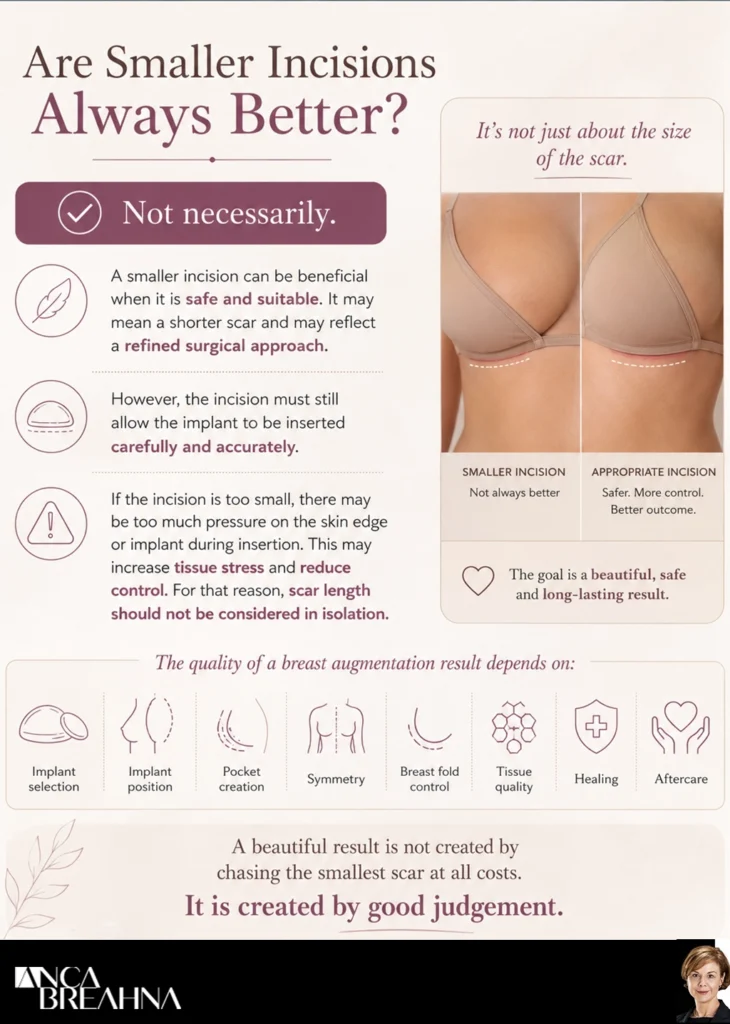
Not necessarily.
A smaller incision can be beneficial when it is safe and suitable. It may mean a shorter scar and may reflect a refined surgical approach. However, the incision must still allow the implant to be inserted carefully and accurately.
If the incision is too small, there may be too much pressure on the skin edge or implant during insertion. This may increase tissue stress and reduce control. For that reason, scar length should not be considered in isolation.
The quality of a breast augmentation result depends on implant selection, implant position, pocket creation, symmetry, breast fold control, tissue quality, healing and aftercare.
A beautiful result is not created by chasing the smallest scar at all costs. It is created by good judgement.
As a Consultant Plastic & Reconstructive Surgeon, Miss Anca Breahna brings detailed anatomical knowledge and reconstructive surgical experience to aesthetic breast surgery. This is especially important when planning a result that should look natural, feel comfortable and age well.
Who Is a Good Candidate for Motiva® Preservé?
Motiva® Preservé may be suitable for patients who want a natural-looking breast enhancement and are interested in a tissue-preserving approach.
It may be considered for patients who want:
- Subtle to moderate breast volume
- Improved breast shape and body proportion
- Restoration of fullness after weight change, pregnancy or breastfeeding
- A soft, natural-looking result
- A refined enhancement rather than an obvious change
It may also appeal to active patients who want enhancement without an overly heavy or exaggerated look.
However, suitability depends on examination. Some patients may need a different approach, including those with significant breast sagging, a need for breast uplift, a desire for a very large size increase, previous breast implant surgery, scar tissue around older implants, noticeable breast asymmetry or thin soft tissue coverage.
Some male or gender-diverse patients may also seek chest or breast enhancement. In these cases, planning must be especially individualised, respectful and anatomy-led.
Miss Anca Breahna sees patients as individuals, not procedure types. During consultation in Chester, she will assess your goals, body frame, tissue quality and expectations before advising whether Motiva® Preservé or Traditional Breast Augmentation is more appropriate.
Breast Augmentation Before and After Photos


What Happens During a Consultation With Miss Anca Breahna in Chester?
A consultation is where incision planning becomes personal.
Online information can help you understand your options, but it cannot tell you where your own scar should be placed. That requires an examination and a detailed discussion.
During your consultation with Miss Anca Breahna in Chester, you can expect to discuss:
- Your reasons for considering breast augmentation
- Your desired breast size and shape
- Your concerns about scars
- Your medical history and previous surgery
- Your lifestyle, work and exercise commitments
- Your expectations from surgery and recovery
Your assessment may include breast measurements, skin quality, breast tissue thickness, nipple position, chest wall shape, natural breast fold position, existing asymmetry and previous scars.
You will also have the opportunity to discuss implant options, including size, profile and feel. Miss Breahna will explain how these choices may influence the incision, scar position and final result.
By the end of the consultation, you should have a clearer understanding of where the incision is likely to be placed, why that incision site is recommended, whether Motiva® Preservé is suitable for you, what breast augmentation recovery may involve and what risks or limitations apply.
Patients often travel to Miss Anca Breahna’s Chester practice from across Cheshire, North Wales, Wirral and Liverpool because they want specialist breast surgery advice without feeling rushed or pressured.
What Are the Risks of Motiva® Preservé Breast Augmentation?
Every surgical procedure carries risks. This includes Motiva® Preservé and Traditional Breast Augmentation.
Possible risks of breast implant surgery include bleeding, infection, delayed wound healing, visible scarring, altered nipple or breast sensation, asymmetry, implant malposition, capsular contracture, implant-related complications and the possible need for further surgery in the future.
Scarring is only one part of informed consent. It is important that patients understand both the benefits and limitations of surgery before deciding to proceed.
Miss Anca Breahna discusses risks carefully during consultation so patients can make an informed, unpressured decision. The aim is always to recommend surgery only when it is appropriate, safe and aligned with the patient’s goals.

Motiva® Preservé Scars and Incisions FAQs
Can I choose exactly where my Motiva® Preservé scar goes?
You can discuss your preference, but the final incision position must be guided by your anatomy, implant choice and surgical safety. Miss Anca Breahna will explain why a particular scar position is recommended for your body.
Will the scar move as the breast settles after surgery?
The scar itself does not move significantly, but its position may appear slightly different as swelling reduces and the breast settles. This is one reason incision planning must consider the final breast shape, not just the immediate appearance after surgery.
Can a very small implant mean an almost invisible scar?
A smaller implant may allow a shorter incision in some patients, but it does not guarantee an almost invisible scar. Scar quality depends on healing, skin type, surgical closure, tension and aftercare.
Will the scar feel different to touch?
Yes, it can. Some patients notice firmness, numbness, sensitivity or a slightly raised texture during early healing, but this often improves gradually as the scar matures.
Can the breast fold scar be affected by underwired bras?
Underwired bras may irritate a healing incision if worn too early. Miss Anca Breahna will advise when it is safe to return to underwired bras based on your healing and scar position.
Will fake tan make my breast augmentation scar more noticeable?
Fake tan can gather around uneven or immature scars, making them appear darker or more visible. It is best to avoid applying fake tan directly over healing incisions until Miss Breahna advises it is safe.
Can exercise stretch a Motiva® Preservé scar?
Returning to upper body exercise too early may place tension on the incision and affect healing. This is why activity is reintroduced gradually after surgery.
Will the scar look different if I lose or gain weight later?
Weight change can alter breast shape, skin tension and how the breast fold sits. The scar may not change dramatically, but its visibility can be affected by changes in breast volume and skin laxity.
Can Motiva® Preservé scars be revised later if I am unhappy with them?
Scar revision may be possible in selected cases, but it is not always necessary or appropriate. It is usually best to allow the scar to mature fully before considering any revision treatment.
Will both breast scars heal in exactly the same way?
Not always. Even when the same technique is used on both sides, each scar may heal slightly differently because of small differences in tissue tension, swelling, movement and natural xreserve tissues where possible.
It may be especially appealing if you are concerned about scar position, scar length, recovery, breast softness, an overly obvious augmented appearance or maintaining natural proportions.
However, the decision should always be based on a proper surgical assessment.
Some patients are better suited to Traditional Breast Augmentation. Others may benefit from breast uplift with implants, implant exchange, asymmetry correction, revision breast surgery, a staged approach or no surgery at this stage.
Miss Anca Breahna will give you honest advice, including when a procedure is not suitable or when another option may achieve a safer and more reliable result.
This honesty is an important part of patient care.
Considering Motiva® Preservé Breast Augmentation in Chester?
If you are considering Motiva® Preservé, one of the most important things to understand is that the incision is usually placed in or near the breast fold. This location allows controlled access, supports accurate implant placement and can often be concealed beneath the natural curve of the breast.
Miss Anca Breahna, Consultant Plastic & Reconstructive Surgeon in Chester, UK, offers personalised consultations for patients considering Motiva® Preservé, Traditional Breast Augmentation and other breast surgery options. Her approach is measured, honest and focused on natural-looking outcomes that respect each patient’s body.
If you are considering Motiva® Preservé breast augmentation in Chester and want to understand where your incision would be placed, book a consultation with Miss Anca Breahna. Your consultation will include a personalised assessment of your anatomy, scar concerns, implant options and whether Motiva® Preservé or Traditional Breast Augmentation is more suitable for you.
Further Reading
- Read more about Fat Transfer To Breasts / Lipofilling
- Read more about Mastopexy Augmentation (Uplift With Implants)
- Read more about Breast Uplift – Mastopexy
- Read Anca Breahna’s Blog on What Do Breast Uplift Scars Look Like and How Can They Be Faded
- Read Anca Breahna’s Blog on Breast Implant Incisions – Inframammary, Periareolar, Transaxiliary
About Anca Breahna – Consultant Plastic Surgeon
 Miss Anca Breahna, PhD, MSc, FEBOPRAS, FRCS (Plast), is a Consultant Plastic, Reconstructive and Aesthetic Surgeon in Chester with extensive experience in breast surgery. Her reconstructive and aesthetic background gives her a detailed understanding of breast shape, volume, symmetry and tissue characteristics, all of which are important when planning breast enlargement. She assesses each patient’s chest width, existing breast tissue, skin quality and overall proportions before discussing whether augmentation is appropriate.
Miss Breahna performs breast augmentation in Chester for women seeking greater breast volume, improved symmetry or restoration of fullness following pregnancy, breastfeeding or weight loss. Treatment planning includes careful discussion of implant size, shape and placement, as well as incision position, expected scarring and long-term considerations. As an experienced plastic surgeon in Chester, Miss Breahna focuses on selecting an implant and surgical approach that suits the patient’s individual anatomy and goals, while ensuring that expectations, risks and recovery are clearly understood before surgery.
Back to blog