- Article Summary
- What Does Childbirth Actually Do to the Vulva?
- How Common Are Post-Childbirth Vulval Changes?
- ✓ The Prevalence Women Are Rarely Told About
- What Are the Specific Changes Women Notice After Childbirth?
- ✓ Labia Minora Changes
- ✓ Labia Majora Changes
- ✓ Perineal Changes
- ✓ Vaginal Introitus Changes
- ✓ Clitoral Hood and Prepuce Changes
- How Does Miss Breahna Assess Post-Childbirth Vulval Changes?
- ✓ What Happens at a Post-Partum Consultation?
- What Are the Treatment Options for Post-Childbirth Vulval Changes?
- ✓ Non-Surgical Options - Always Considered First
- ✓ Surgical Options - Matched to Individual Anatomy
- Miss Breahna's Specific Approach to Post-Partum Vulval Restoration
- Download Miss Anca Breahna's Labiaplasty Surgery Guide
- Recovery: What to Expect After Post-Partum Vulval Surgery
- ✓ Days 1 - 5
- ✓ Days 5 - 14
- ✓ Weeks 3 - 6
- ✓ Months 2 - 6
- Post-Childbirth Vulval Changes FAQs
- Labiaplasty Before and After Photos
- Why Choose Miss Anca Breahna for Post-Partum Vulval Surgery in North West England?
- Areas Served by Miss Anca Breahna
- Take our Plastic Surgery Quiz to find out if you'd be a good candidate for cosmetic surgery.
- Book a Consultation with Miss Anca Breahna in North West England
- Further Reading
- About Anca Breahna – Consultant Plastic Surgeon
Article Summary
Yes – childbirth can cause temporary or lasting anatomical changes to the vulva, labia, perineum and surrounding tissues. Many changes are normal and do not require treatment. Where persistent labial changes cause discomfort, irritation or functional problems, assessment can help determine whether conservative care, specialist referral or labiaplasty surgery may be appropriate. Miss Anca Breahna explains what changes may occur and when clinical advice could help.
What Does Childbirth Actually Do to the Vulva?
The vulva is the collective term for all external female genital structures – the labia majora, labia minora, clitoral hood, vaginal opening (introitus), and perineum. During vaginal delivery, these structures are subjected to significant mechanical stress: stretching, compression, tearing, and, in many cases, surgical incision (episiotomy).
Understanding what changes – and why – requires a brief anatomical overview:
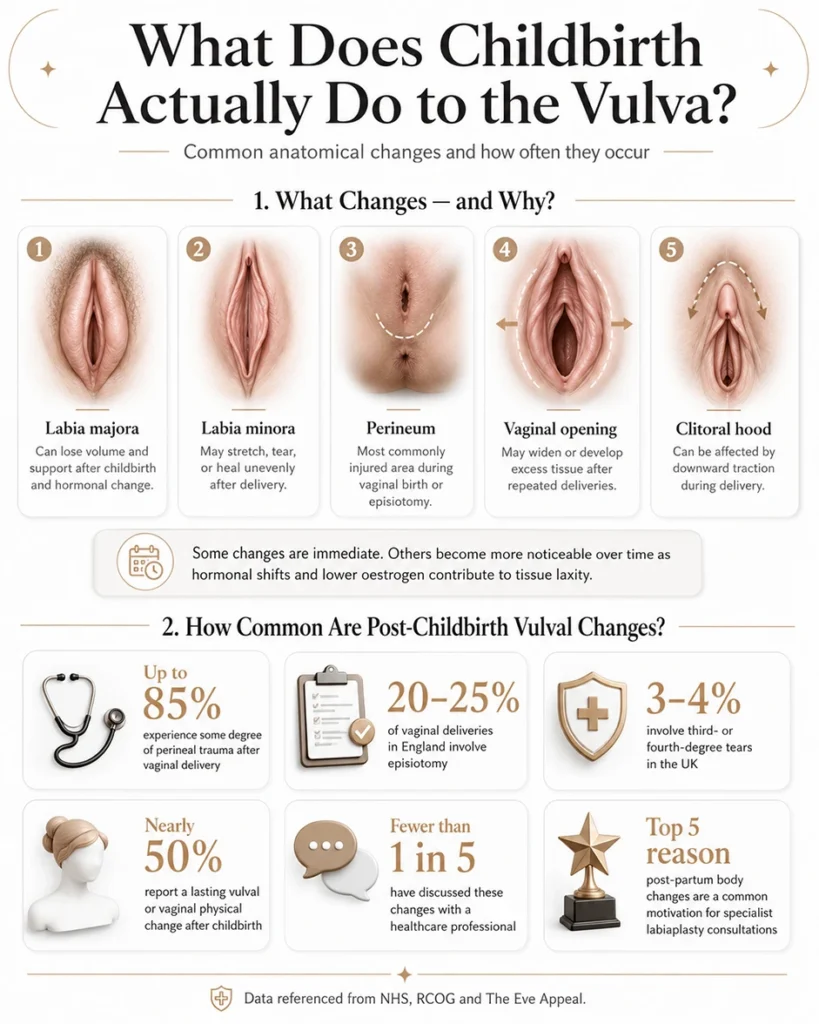
- Labia majora are fatty, skin-covered folds that provide structural support and protection. They are susceptible to volume loss and laxity following childbirth and hormonal changes
- Labia minora are thin, highly vascular mucous membrane folds. They can be stretched or torn during delivery, and may heal asymmetrically
- Perineum is the tissue between the vaginal opening and the anus. It is the most commonly injured region during vaginal delivery – through spontaneous tearing or episiotomy
- Vaginal introitus (opening) may become widened or develop excess tissue following repeated deliveries or poorly healed tears
- Clitoral hood and surrounding prepuce tissue can be affected by downward traction during delivery, altering appearance or sensation
These changes may be immediate or may become more pronounced over months and years as hormonal shifts following breastfeeding and the transition into perimenopause reduce oestrogen levels and accelerate tissue laxity.
How Common Are Post-Childbirth Vulval Changes?
✓ The Prevalence Women Are Rarely Told About
Post-partum vulval and perineal changes are far more prevalent than clinical conversations typically acknowledge. Key UK and international data:
-
- Up to 85% of women sustaining a vaginal delivery experience some degree of perineal trauma, according to NHS and Royal College of Obstetricians and Gynaecologists (RCOG) data
- Episiotomy is performed in approximately 20–25% of vaginal deliveries in England (NHS Digital), leaving a surgical scar in the perineum that does not always heal symmetrically
- Third and fourth-degree tears – involving the anal sphincter complex – affect approximately 3–4% of vaginal deliveries in the UK (RCOG, 2023), with long-term implications for perineal anatomy and function
- A 2020 survey by The Eve Appeal found that nearly half of women reported a persistent physical change to the vulval or vaginal area after childbirth, yet fewer than 1 in 5 had discussed it with a healthcare professional
- Labiaplasty requests following childbirth account for a significant proportion of consultations at specialist centres – post-partum body changes are among the top five motivating factors cited by UK patients
What Are the Specific Changes Women Notice After Childbirth?
✓ Labia Minora Changes
- Asymmetry – one side larger, thicker, or lower than the other following tearing or uneven healing
- Elongation or increased protrusion – stretching during delivery may permanently alter labial dimensions
- Darkening or textural change of the labial skin – a normal consequence of hormonal shifts and mechanical trauma
- Excess or irregular tissue at the site of a healed tear
✓ Labia Majora Changes
- Volume deflation – the labia majora lose their fullness as subcutaneous fat redistributes or reduces, particularly following breastfeeding. This is often described by patients as the labia looking “flat,” “saggy,” or “empty”
- Skin laxity – loss of skin elasticity leads to a loose, wrinkled appearance
- Asymmetry – may be pre-existing but often becomes more pronounced after delivery
✓ Perineal Changes
- Visible scarring from episiotomy or sutured tears
- Irregular or asymmetrical perineal skin
- Painful or thickened scar tissue (dyspareunia)
- Skin tags or excess tissue at the posterior fourchette (the junction of the labia minora at the base of the vaginal opening)
✓ Vaginal Introitus Changes
- Widening of the vaginal opening following multiple deliveries
- Loose mucous membrane tissue at the introitus
- Reduced sensation during intercourse in some cases
✓ Clitoral Hood and Prepuce Changes
- Increased prominence of the clitoral hood due to surrounding tissue changes
- Altered position of the clitoris relative to the labia
How Does Miss Breahna Assess Post-Childbirth Vulval Changes?
✓ What Happens at a Post-Partum Consultation?
Miss Breahna’s consultations for post-childbirth vulval concerns are structured to distinguish between changes that are:
- Normal anatomical variation – common, expected, and not requiring surgical intervention
- Functionally symptomatic changes – causing physical discomfort, hygiene difficulties, or pain that warrants treatment
- Psychologically distressing changes – impacting intimacy, self-image, or quality of life in a meaningful, documented way
Pathological findings – including persistent vulval pain, scarring neuropathy, or signs of a vulval dermatological condition requiring specialist referral
A full consultation with Miss Breahna includes:
Detailed History
- Obstetric history: number of deliveries, mode of delivery, documented tears or episiotomy grade, post-partum complications
- Current symptoms: physical discomfort, pain during sex (dyspareunia), hygiene difficulties, urinary symptoms
- Breastfeeding status and hormonal context – important as oestrogen suppression during breastfeeding accelerates laxity
- Psychological impact – self-reported quality of life using validated measures where appropriate
Physical Examination
- Systematic visual assessment of labia majora, labia minora, perineum, introitus, and clitoral hood
- Scar assessment – location, thickness, mobility, tenderness
- Tissue quality – vascularity, elasticity, and oestrogen effect on mucosa
- Identification of any coexisting vulval condition (lichen sclerosus, vulvodynia) requiring separate management
Photographic Documentation
- Standardised pre-operative photography for baseline and planning
- Discussion of realistic achievable outcomes based on individual anatomy
Miss Breahna will never recommend surgical intervention during a first consultation without allowing a period of reflection. For post-partum patients, she advises waiting a minimum of 12 months following delivery – or until breastfeeding has ceased and hormonal levels have restabilised – before proceeding with any surgical correction.
What Are the Treatment Options for Post-Childbirth Vulval Changes?
✓ Non-Surgical Options – Always Considered First
- Topical oestrogen Low-dose topical oestrogen cream applied to the vulva and vaginal introitus is highly effective for post-partum and peri-menopausal atrophic changes. It restores mucosal moisture, improves tissue elasticity, and can reduce dyspareunia without surgery. Available on NHS prescription; Miss Breahna can recommend this as a first-line measure.
- Pelvic floor physiotherapy Specialist women’s health physiotherapists can address post-partum perineal pain, scar desensitisation, and pelvic floor dysfunction – all of which may contribute to discomfort that a patient might attribute solely to external anatomy. Miss Breahna works collaboratively with physiotherapy colleagues in the Chester and North West region.
- Scar massage and desensitisation For episiotomy or perineal tear scars that are tender or restricting movement, a structured scar massage protocol – typically guided by a physiotherapist – can significantly improve mobility and comfort within 3–6 months post-partum.
- Dermatological management Any coexisting vulval dermatosis – lichen sclerosus, contact dermatitis, vulvodynia – must be diagnosed and managed by a specialist dermatologist or gynaecologist before surgical treatment is considered. Miss Breahna will refer where appropriate.
✓ Surgical Options – Matched to Individual Anatomy
The following procedures may be considered individually or in combination, depending on which structures are affected:
- Labiaplasty (labia minora reduction) Reshapes or reduces enlarged, asymmetrical, or irregular labia minora following stretching or tearing during delivery. The most commonly performed post-partum genital procedure. Performed under general or local anaesthesia with sedation; 60–90 minutes; recovery 4–6 weeks.
- Labia majora augmentation For volume deflation of the labia majora – the “flat” or “empty” appearance following fat redistribution – the labia majora can be augmented using autologous fat transfer (fat taken from another area of the body via liposuction and injected) or, in selected cases, with injectable filler. This restores youthful fullness and structural support.
- Labia majora reduction (majoraplasty) Where the labia majora have become excessively loose or elongated – more common following significant weight changes alongside pregnancy – excess skin can be surgically excised to restore a tighter contour.
- Perineoplasty Surgical reconstruction of the perineum – the tissue between the vaginal opening and anus. This procedure addresses visible perineal scarring from episiotomy or tears, excess tissue at the posterior fourchette, and perineal skin tags. It also tightens the posterior vaginal opening (introital tightening), which many women request alongside correction of external appearance. Perineoplasty is distinct from full vaginoplasty (internal vaginal tightening) and is performed as a day-case procedure.
- Composite procedures (mummy makeover – genital component) Women seeking correction of multiple post-partum changes may combine labiaplasty, perineoplasty, and labia majora augmentation in a single surgical episode, reducing anaesthetic exposure and overall recovery time. Miss Breahna will advise on the safest and most appropriate combination based on individual anatomy.
| Procedure | What it addresses | Approximate UK cost |
|---|---|---|
| Labiaplasty | Labia minora size, asymmetry, irregularity | £2,500 – £5,000 |
| Labia majora augmentation (fat transfer) | Volume deflation, flatness | £3,000 – £5,500 |
| Labia majora reduction | Excess skin laxity | £2,500 – £4,500 |
| Perineoplasty | Perineal scarring, introital laxity | £2,500 – £4,500 |
| Combined procedures | Multiple post-partum changes | £5,000 – £9,000+ |
Prices are indicative UK ranges for BAAPS/BAPRAS consultant surgeons (2024–2025). Miss Breahna’s fees are confirmed following consultation.
Miss Breahna’s Specific Approach to Post-Partum Vulval Restoration
Miss Breahna brings a reconstructive as well as aesthetic perspective to post-partum vulval surgery – a distinction that matters clinically.
Her training in plastic and reconstructive surgery means she approaches the vulva as a functional anatomical unit, not just a cosmetic structure. Every surgical plan she develops considers:
- Nerve preservation – avoiding damage to the dorsal clitoral nerve branches and perineal nerve during dissection
- Vascular anatomy – respecting the rich blood supply of the labia minora to ensure reliable wound healing
- Scar positioning – placing incisions along natural anatomical junctions (the interlabial sulcus, the posterior fourchette) where scars are least visible and least likely to cause restriction
- Tissue economy – conservative resection to avoid over-correction, which is the primary cause of poor long-term outcomes in genital surgery
- Functional outcome alongside aesthetic outcome – a successful result is one that both looks and feels right for the individual patient
Miss Breahna does not offer a “standard” post-partum procedure. Every surgical plan is drawn up following examination, discussion of priorities, and review of photographic documentation.
Download Miss Anca Breahna’s Labiaplasty Surgery Guide
Recovery: What to Expect After Post-Partum Vulval Surgery
Recovery timelines vary depending on the procedure or combination performed. General guidance:
✓ Days 1 – 5
- Swelling, bruising, and mild discomfort are expected
- Ice packs (wrapped in cloth) applied for 10 minutes every few hours
- Loose cotton underwear and loose-fitting clothing essential
- Rest; avoid prolonged sitting or standing
✓ Days 5 – 14
- Swelling peaks around days 3–4, then gradually reduces
- Dissolvable sutures in situ – no removal required
- Gentle warm-water hygiene twice daily; no soap directly on wounds
- Light desk-based work typically possible from day 7
✓ Weeks 3 – 6
- Avoid all exercise, swimming, cycling, and sexual activity
- Itching and nerve sensitivity are normal signs of healing
- Post-partum patients who are breastfeeding should discuss timing with Miss Breahna – topical oestrogen and hormonal status affect healing
✓ Months 2 – 6
- Final result visible at 3–6 months as residual swelling resolves and scars mature
- Sexual activity can typically resume at 6 weeks post-operatively, subject to Miss Breahna’s review
- Scar colour continues to fade for up to 12 months

Post-Childbirth Vulval Changes FAQs
Is it normal for the vulva to look different after having a baby?
Yes, this is extremely common and rarely discussed openly. Stretching, tearing, episiotomy, and hormonal changes following childbirth and breastfeeding all contribute to changes in the labia, perineum, and vaginal opening. The fact that these changes are common does not mean women have to accept symptoms that affect their quality of life. Treatment options, both non-surgical and surgical, are available.
How long should I wait after giving birth before considering surgery?
Miss Breahna recommends waiting a minimum of 12 months after delivery, and until breastfeeding has fully ceased, before undergoing surgical correction. This allows tissue to stabilise, hormonal levels to normalise, and the full extent of any changes to become apparent. Operating on recently post-partum tissue carries a higher risk of complications and suboptimal outcomes.
Can perineoplasty improve sexual sensation as well as appearance?
Perineoplasty primarily addresses the external anatomy and the posterior vaginal opening. Many women report improved sensation and reduced discomfort during intercourse following the procedure – partly because it corrects painful scarring, and partly because introital tightening restores more comfortable tissue apposition during sex. It does not directly alter internal vaginal anatomy or clitoral function.
Will these procedures affect my ability to have more children?
Labiaplasty and labia majora procedures do not affect the internal reproductive system and do not prevent future pregnancy. Perineoplasty involves the perineal body and posterior vaginal introitus. If you plan to have further children, Miss Breahna will typically advise waiting until your family is complete before undertaking perineoplasty, as a subsequent vaginal delivery would re-stretch the corrected tissue.
Can I combine post-partum vulval surgery with a tummy tuck or other procedures?
Yes, combining procedures in a single surgical episode is common, reduces overall recovery time, and can be cost-effective. Miss Breahna regularly discusses combination planning with post-partum patients who have concerns about both the vulva and the abdominal area. Safety is always the primary consideration: combined procedures must be planned within safe total anaesthetic and surgical time limits.
Is this surgery available on the NHS?
NHS funding for post-partum vulval surgery is extremely limited and restricted to cases with documented functional impairment – typically severe dyspareunia, significant scar contracture, or sphincter dysfunction following obstetric injury. Cosmetic concerns are not funded by the NHS. Miss Breahna can advise during consultation whether a clinical referral pathway may apply to your situation.
How do I know if what I am experiencing is normal or something that needs treatment?
A useful guide: if the change is causing physical discomfort (pain, chafing, hygiene difficulties), affecting your sex life, or consistently affecting your confidence or wellbeing, it is worth a clinical opinion. Miss Breahna’s consultation is £150 and is not a commitment to surgery – it is an opportunity to get an honest, qualified assessment of what is happening anatomically and what options exist.
Medical References
- What vaginal changes can a person expect after giving birth? – Medical News Today – https://www.medicalnewstoday.com/articles/vagina-after-giving-birth#summary
- Anatomical Changes of the Vulva Due to Childbirth and Aging – Clinics in Plastic Surgery – https://www.researchgate.net/publication/363815345_Anatomical_Changes_of_the_Vulva_Due_to_Childbirth_and_Aging
- Genital perception and vulvar appearance after childbirth: a cohort analysis of genital body image and sexuality – General Gynecology – https://link.springer.com/article/10.1007/s00404-022-06826-4
- Laxity of the Vaginal Introitus After Childbirth: Nonsurgical Outpatient Procedure for Vaginal Tissue Restoration and Improved Sexual Satisfaction Using Low-Energy Radiofrequency Thermal Therapy – Sage Journals – https://journals.sagepub.com/doi/abs/10.1089/jwh.2012.4123
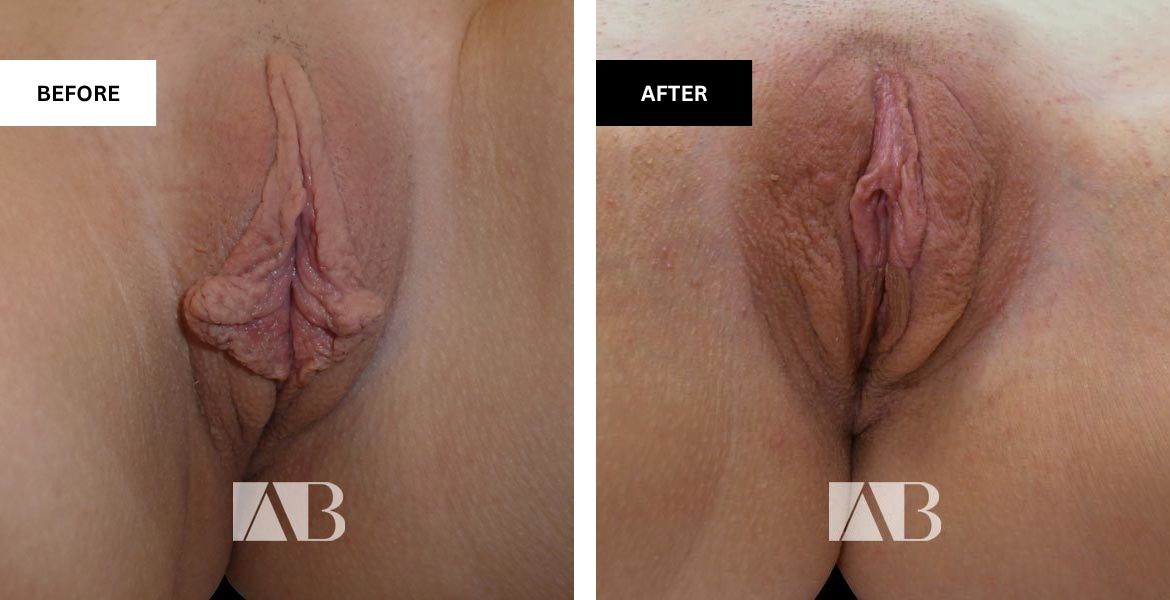
Labiaplasty Before and After Photos


Why Choose Miss Anca Breahna for Post-Partum Vulval Surgery in North West England?
Post-partum vulval surgery requires a surgeon who combines reconstructive precision with aesthetic sensitivity. Miss Breahna’s background in plastic and reconstructive surgery distinguishes her from gynaecologists or general cosmetic practitioners offering similar procedures:
- Consultant Plastic & Reconstructive Surgeon – the highest surgical grade in the UK, with specialist training in tissue handling and wound closure
- Full BAAPS and BAPRAS member – verified professional standing in aesthetic and reconstructive plastic surgery
- GMC No. 6168616 – verifiable at gmc-uk.org/doctors/6168616
- Reconstructive approach to genital surgery – nerve-sparing technique, anatomical dissection planes, function-first philosophy
- 12-month post-partum waiting policy – Miss Breahna will not operate on recently post-partum patients; this protects outcomes and reflects genuine clinical judgement
- CQC-registered surgical facilities in Chester
- Collaborative care network – works alongside women’s health physiotherapists, dermatologists, and gynaecologists in the North West to ensure comprehensive patient management
Areas Served by Miss Anca Breahna
Miss Breahna sees post-partum patients from across the North West of England and North Wales, including:
- Chester (primary clinic location)
- Liverpool and Merseyside
- Manchester and Greater Manchester
- Wirral
- Warrington
- Macclesfield and Cheshire East
- Wrexham and North Wales
Take our Plastic Surgery Quiz to find out if you’d be a good candidate for cosmetic surgery.
Book a Consultation with Miss Anca Breahna in North West England
If you have noticed changes to your vulva following childbirth and are wondering what – if anything – can be done, a consultation with Miss Breahna is the right first step.
Consultation fee: £150 – in-person (Chester) or virtual. Strictly confidential.
Book your consultation → 📍 Find Miss Breahna’s clinic on Google: View on Google Business Profile
You do not need a GP referral to book a private consultation. Miss Breahna welcomes patients who are simply curious about their options, as well as those who are ready to proceed with treatment.
Further Reading
- Read more about Preparing for Your Surgery – Patient Instructions
- Read more about How to Stop Smoking and Vaping before and after Surgery
- Read Miss Breahna’s Blog on What Is a Normal Labia – What Medical Science Says
- Read Miss Breahna’s Blog on Has My Labia Stretched with Childbirth – and What Can Be Done?
- Read Miss Breahna’s Blog on Can My Labia Be Reduced? – About Labia Reduction Surgery
- Read Miss Breahna’s Blog on What Is A Labiaplasty Or So Called Designer Vagina?
Disclaimer: This article is written for informational purposes and does not constitute medical advice. Individual outcomes vary. Always consult a qualified surgeon before making decisions about surgical procedures. If you are experiencing acute post-partum symptoms – including pain, bleeding, or infection – contact your GP or midwife in the first instance.
About Anca Breahna – Consultant Plastic Surgeon
 Miss Anca Breahna, PhD, MSc, FEBOPRAS, FRCS (Plast), is a Consultant Plastic, Reconstructive and Aesthetic Surgeon based in Chester. Her extensive training in reconstructive and aesthetic surgery gives her a detailed understanding of tissue handling, symmetry, proportion and function, all particularly important in intimate procedures such as labiaplasty. She is listed on the GMC Specialist Register for Plastic Surgery and brings a careful, discreet and patient-focused approach to consultation and treatment.
Miss Breahna performs labiaplasty in Chester for women who may experience discomfort, irritation, asymmetry or concerns about the appearance of the labia minora. During consultation, she considers anatomy, tissue quality, symptoms, degree of asymmetry and personal goals before advising whether surgery is appropriate and which technique may be most suitable. Her approach prioritises preserving natural anatomy, maintaining function, thoughtful scar placement and realistic expectations. As an experienced plastic surgeon in Chester, Miss Breahna provides individualised care in a professional and confidential setting.
Back to blog