
- Quick Answer
- Key Takeaways
- What Is Breast Implant Placement?
- ✓ What Is Subglandular Breast Augmentation?
- ✓ What Is Subfascial Breast Augmentation?
- ✓ What Is Dual Plane Breast Augmentation?
- Why Is Implant Placement Important?
- ✓ How Does Tissue Thickness Affect Implant Placement?
- ✓ How Does Existing Breast Shape Affect Placement?
- Why Is Subglandular Breast Augmentation Performed?
- Why Is Subfascial Breast Augmentation Performed?
- Why Is Dual Plane Breast Augmentation Performed?
- Who Is a Good Candidate?
- ✓ Who May Be Suitable for Subglandular Placement?
- ✓ Who May Be Suitable for Subfascial Placement?
- ✓ Who May Be Suitable for Dual Plane Placement?
- What Are the Benefits of Subglandular Placement?
- What Are the Benefits of Subfascial Placement?
- What Are the Benefits of Dual Plane Placement?
- What Are the Limitations of Subglandular Placement?
- What Are the Limitations of Subfascial Placement?
- What Are the Limitations of Dual Plane Placement?
- How Is Breast Augmentation Performed?
- ✓ How Is a Subglandular Pocket Created?
- ✓ How Is a Subfascial Pocket Created?
- ✓ How Is a Dual Plane Pocket Created?
- Breast Augmentation Before and After Photos
- What Is Recovery Like After Breast Augmentation?
- ✓ Is Recovery Different Between Implant Planes?
- ✓ When Can Patients Return to Work and Exercise?
- What Are the Risks of Breast Augmentation?
- ✓ What Risks Are More Relevant to Above-Muscle Placement?
- ✓ What Risks Are More Relevant to Dual Plane Placement?
- What Results Can Patients Expect?
- ✓ Which Implant Placement Looks Most Natural?
- ✓ How Long Do Breast Augmentation Results Last?
- Related Procedures
- Subglandular, Subfascial, and Dual Plane Breast Augmentation FAQs
- Download Miss Anca Breahna's Breast Augmentation Surgery Guide
- Arrange a Breast Augmentation Consultation With Miss Anca Breahna
- Further Reading
- About Anca Breahna – Consultant Plastic Surgeon
Miss Anca Breahna, PhD, MSc, FEBOPRAS, FRCS (Plast), Consultant Plastic, Reconstructive and Aesthetic Surgeon in Chester, explains that breast implants can be placed in different anatomical layers depending on the patient’s body and surgical goals. Subglandular placement sits above the chest muscle, subfascial placement sits beneath the thin covering of the muscle, and dual plane placement sits partly beneath the muscle and partly beneath the breast tissue.
The choice of implant plane affects tissue coverage, breast shape, recovery, implant movement, and the risk of visible edges or rippling. No single approach is best for everyone because patients differ in breast tissue thickness, chest shape, skin quality, lifestyle, and the amount of volume they wish to add.
A careful examination is therefore essential before deciding where an implant should sit. The safest and most natural-looking result usually comes from matching the implant size, shape, and position to the patient’s existing anatomy rather than choosing a technique based on preference alone.
Quick Answer
Subglandular breast augmentation places the implant above the chest muscle, subfascial placement positions it beneath the muscle fascia, and dual plane surgery places it partly beneath the muscle. Each approach has different benefits and limitations, and the most suitable option depends on breast tissue, anatomy, implant choice, lifestyle, and aesthetic goals.
Key differences include:
- The amount of tissue covering the implant
- The degree of chest muscle involvement
- The likelihood of visible implant edges
- The amount of discomfort during early recovery
- The potential for movement during muscle contraction
The selected plane should provide sufficient coverage while supporting the desired breast shape. It should also account for the patient’s activity level, skin quality, and long-term tissue support.
Key Takeaways
Breast implant placement is an important part of augmentation planning because it influences both the early recovery and the long-term result. The best plane is selected after assessing breast tissue, chest anatomy, implant dimensions, lifestyle, and the appearance the patient hopes to achieve.
The main points to understand are:
- Subglandular implants sit above the pectoral muscle
- Subfascial implants sit beneath the fascia covering the muscle
- Dual plane implants sit partly beneath the muscle
- Thin patients may benefit from greater upper-pole coverage
- Athletic patients may wish to reduce muscle-related implant movement
Implant placement cannot be considered separately from implant size, width, projection, and tissue quality. A suitable plane helps the implant blend with the natural breast while reducing avoidable strain on the tissues.
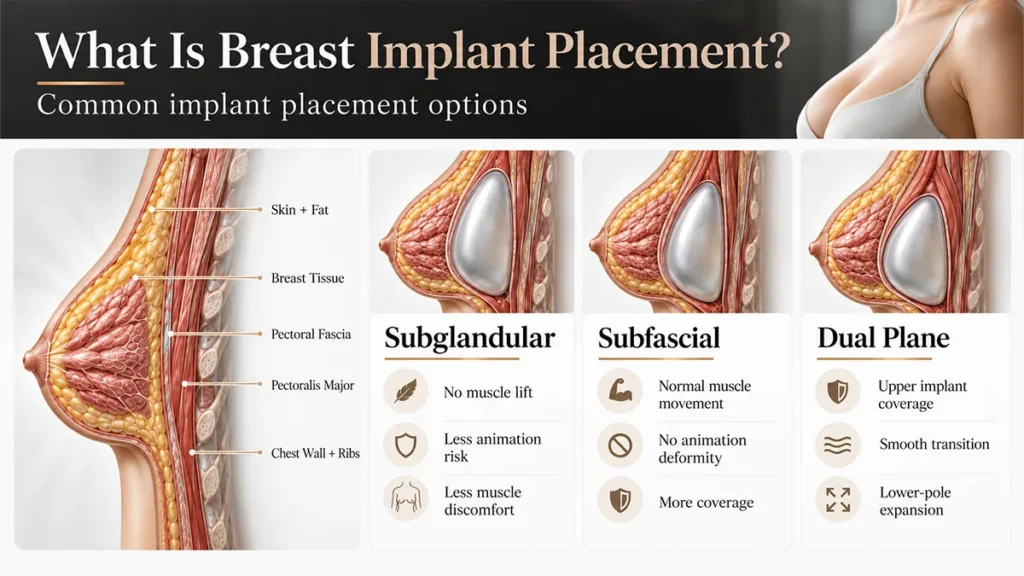
What Is Breast Implant Placement?
Breast implant placement describes the anatomical pocket created to hold the implant within the chest. The pocket may sit above the pectoral muscle, beneath its fascia, or partly beneath the muscle depending on the technique selected.
Important anatomical layers include:
- Skin and subcutaneous fat
- Natural breast tissue
- Pectoral fascia
- Pectoralis major muscle
- Chest wall and ribs
The amount and quality of tissue covering the implant influence how visible or palpable it may become. Placement also affects breast movement, chest muscle function, recovery discomfort, and the way the lower breast develops around the implant.
✓ What Is Subglandular Breast Augmentation?
Subglandular breast augmentation places the implant directly beneath the natural breast tissue and above the pectoralis major muscle. The implant is therefore covered mainly by skin, fat, and the patient’s existing breast tissue.
This technique may offer:
- No surgical lifting of the chest muscle
- Reduced risk of animation deformity
- Potentially less muscle-related discomfort
- Direct expansion of the lower breast
- Easier access during some revision procedures
Subglandular placement generally requires adequate natural tissue to conceal the implant. In patients with thin skin or limited breast tissue, implant edges, rippling, or surface irregularities may be more noticeable.
✓ What Is Subfascial Breast Augmentation?
Subfascial breast augmentation positions the implant beneath the thin layer of fascia covering the pectoral muscle while leaving the muscle itself undisturbed. This creates an above-muscle pocket with a small additional layer of tissue over the implant.
Potential features of the technique include:
- Preservation of normal muscle movement
- No muscle-related animation deformity
- Slightly more coverage than subglandular placement
- Potentially less early muscle discomfort
- Suitability for selected active patients
The pectoral fascia is thin and does not provide the same coverage as the muscle. Patients still need sufficient skin and breast tissue to reduce the risk of implant visibility and rippling.
✓ What Is Dual Plane Breast Augmentation?
Dual plane breast augmentation places the upper part of the implant beneath the pectoral muscle while the lower part sits directly beneath the breast tissue. The technique combines upper-pole muscle coverage with greater freedom for the lower breast to expand and reshape.
Dual plane surgery may provide:
- Additional coverage over the upper implant
- A smoother upper breast transition
- Improved lower-pole expansion
- Support for selected patients with mild sagging
- Greater flexibility when reshaping the breast
The degree of muscle release can be adjusted according to the patient’s anatomy and nipple position. Dual plane surgery is more complex than a fully above-muscle pocket and may involve greater early tightness or discomfort.
Why Is Implant Placement Important?
Implant placement affects how the implant is covered, how the breast moves, and how natural the final contour may appear. It can also influence recovery, muscle function, rippling, palpability, and the likelihood of implant movement during exercise.
Placement can affect:
- Upper-pole smoothness
- Implant-edge visibility
- Cleavage and breast projection
- Muscle-related movement
- Long-term tissue stretching
A suitable pocket helps the implant sit securely while blending with the patient’s breast tissue. Poorly matched placement may increase the risk of an artificial contour, visible edges, movement, or dissatisfaction.
✓ How Does Tissue Thickness Affect Implant Placement?
Tissue thickness determines how effectively the patient’s own breast and skin can cover the implant. Patients with limited tissue may require greater upper-pole coverage to reduce the chance of visible implant edges or rippling.
Assessment may consider:
- Skin thickness
- Breast tissue volume
- Upper-pole coverage
- Breast fold strength
- Existing tissue stretch
A surgeon may use physical examination and tissue measurements to estimate the available coverage. Thin tissues do not automatically rule out augmentation, but they influence implant size, profile, placement, and the need for careful long-term planning.
✓ How Does Existing Breast Shape Affect Placement?
Existing breast shape influences how the implant pocket must be created and how the tissues will settle around the implant. Features such as mild drooping, a tight lower pole, asymmetry, or constricted breast anatomy may make one plane more suitable than another.
Important features include:
- Breast width and volume
- Nipple position
- Lower-pole tightness
- Skin elasticity
- Differences between the breasts
Implant placement alone cannot reliably correct moderate or severe breast sagging. Some patients may need breast uplift surgery, tissue reshaping, or a combined procedure to achieve a balanced result.
Why Is Subglandular Breast Augmentation Performed?
Subglandular placement may be selected when the patient has enough natural tissue to cover the implant and wishes to avoid disruption of the chest muscle. It may also suit patients whose lifestyle involves frequent pectoral muscle activity.
Reasons for considering this plane include:
- Adequate breast tissue coverage
- Desire to avoid animation deformity
- Athletic or bodybuilding activity
- Need for lower-pole expansion
- Selected revision surgery requirements
The technique may offer a more comfortable early recovery because the muscle is not elevated. Its suitability depends heavily on tissue thickness, implant dimensions, skin quality, and the risk of long-term visibility.
Why Is Subfascial Breast Augmentation Performed?
Subfascial placement may be chosen when the surgeon wishes to preserve chest muscle movement while adding a thin layer of fascial coverage over the implant. It can be considered in selected patients with adequate breast tissue who prefer an above-muscle approach.
Possible reasons include:
- Active or athletic lifestyle
- Concern about animation deformity
- Desire to preserve muscle function
- Adequate natural tissue thickness
- Suitability for a controlled above-muscle pocket
The fascia offers limited additional coverage and cannot compensate for very thin tissues. Careful patient selection remains essential to reduce the likelihood of visible implant edges or rippling.
Why Is Dual Plane Breast Augmentation Performed?
Dual plane breast augmentation is often selected when greater upper-pole coverage is required but the lower breast also needs room to expand. It may be particularly useful for patients with limited upper breast tissue, mild deflation, or selected degrees of breast sagging.
Reasons for considering dual plane placement include:
- Thin upper-pole tissue
- Mild breast drooping
- Post-pregnancy deflation
- Need for a smoother upper contour
- Requirement for lower-pole reshaping
The technique can combine some advantages of above-muscle and below-muscle placement. However, it still involves muscle-related risks and does not replace uplift surgery when substantial loose skin or low nipple position is present.
Who Is a Good Candidate?
A good candidate for breast augmentation is generally healthy, has realistic expectations, and understands the long-term responsibilities associated with implants. The most suitable implant plane depends on tissue thickness, breast position, chest shape, lifestyle, and the chosen implant.
Potential candidates should have:
- Stable general health
- Realistic aesthetic goals
- Adequate understanding of risks
- A stable body weight
- Willingness to follow recovery advice
Suitability must be confirmed through consultation and physical examination. The selected technique should reflect the patient’s anatomy rather than a belief that one implant plane is universally superior.
✓ Who May Be Suitable for Subglandular Placement?
Subglandular placement may suit patients with enough natural breast tissue to cover the implant and support its weight. It may also appeal to active patients who wish to avoid muscle-related implant distortion.
Suitable features may include:
- Good breast tissue thickness
- Minimal risk of implant visibility
- Strong skin support
- Frequent chest muscle activity
- A proportionate implant choice
This approach may be less suitable for very thin patients or those requesting an implant that exceeds their tissue capacity. The implant must remain compatible with the patient’s breast width, skin quality, and long-term support.
✓ Who May Be Suitable for Subfascial Placement?
Subfascial placement may suit patients who have adequate soft-tissue coverage but wish to preserve normal pectoral muscle movement. It can provide a controlled above-muscle pocket while avoiding the contraction-related movement associated with dual plane placement.
Suitable features may include:
- Adequate breast tissue
- Active lifestyle
- Concern about animation
- Good skin quality
- Realistic implant expectations
The technique does not provide substantial extra coverage in patients with thin tissues. Implant size and profile must therefore be selected carefully to avoid excessive pressure on the skin and breast envelope.
✓ Who May Be Suitable for Dual Plane Placement?
Dual plane placement may suit patients who need more upper-pole coverage while also requiring lower-pole expansion. It is often considered when natural breast tissue is limited or mild sagging and deflation are present.
Suitable features may include:
- Thin upper breast tissue
- Mild post-pregnancy deflation
- Limited upper-pole coverage
- A tight lower breast
- Mild nipple or tissue descent
The procedure may not suit patients who wish to avoid all muscle-related movement. It also cannot correct substantial sagging when breast uplift surgery is required.
What Are the Benefits of Subglandular Placement?
Subglandular placement avoids lifting or dividing the pectoral muscle, which can make the early recovery feel more comfortable for some patients. It may also suit patients who regularly use their chest muscles and wish to minimise implant movement during contraction.
Potential benefits include:
- No muscle-related animation deformity
- Less disruption of pectoral muscle function
- Potentially reduced early tightness
- Effective lower-pole expansion
- Easier access during selected revision procedures
These advantages are most relevant when the patient already has enough breast tissue to cover the implant. Good tissue thickness and a proportionate implant remain essential for a natural-looking result.
What Are the Benefits of Subfascial Placement?
Subfascial placement preserves the pectoral muscle while placing the implant beneath the thin fascial layer covering it. This may provide a small amount of extra coverage compared with a purely subglandular pocket.
Possible benefits include:
- Preservation of chest muscle movement
- No muscle-related implant distortion
- A thin additional tissue layer
- Potentially less muscle discomfort
- Suitability for selected athletic patients
The fascia does not provide the same thickness or support as the muscle itself. The technique therefore works best in patients who already have adequate skin and breast tissue coverage.
What Are the Benefits of Dual Plane Placement?
Dual plane placement provides muscle coverage over the upper part of the implant while allowing the lower breast to expand more freely. This can create a smoother transition in the upper breast and help shape the lower pole.
Potential advantages include:
- Greater upper-pole implant coverage
- Reduced visibility of the upper implant edge
- Improved lower-pole expansion
- Better control in selected mild ptosis
- A more gradual upper breast contour
The technique can be useful when the upper breast is thin but the lower breast needs additional shaping. It should still be selected according to the patient’s anatomy rather than used as a routine choice for every augmentation.
What Are the Limitations of Subglandular Placement?
Subglandular implants have less tissue covering them because the pectoral muscle remains beneath the implant. This can make the implant more visible or easier to feel in patients with thin skin or limited breast tissue.
Possible limitations include:
- Increased risk of visible implant edges
- Greater chance of rippling
- More noticeable implant palpability
- Reduced upper-pole coverage
- Increased strain on thin tissues
These concerns may become more noticeable over time as skin and breast tissue naturally thin or stretch. Choosing an implant that is too large can increase these limitations.
What Are the Limitations of Subfascial Placement?
Subfascial placement provides only a very thin additional layer over the implant. It cannot reliably compensate for poor breast tissue coverage or very delicate skin.
Limitations may include:
- Limited extra implant concealment
- Ongoing risk of rippling
- Possible visible implant edges
- Dependence on careful fascial dissection
- Reduced suitability for very thin patients
The technique should not be viewed as providing the same protection as muscle coverage. Its success depends on patient selection, implant size, and the quality of the breast envelope.
What Are the Limitations of Dual Plane Placement?
Dual plane augmentation involves lifting part of the pectoral muscle, so patients may experience more tightness or discomfort during early recovery. The implant may also move or change shape when the chest muscle contracts.
Possible limitations include:
- Animation deformity
- Muscle-related discomfort
- More complex pocket creation
- Implant movement during contraction
- Possible double-bubble contour changes
These issues are not experienced by every patient and may be mild when they occur. They are particularly important to discuss with athletes, bodybuilders, and patients who frequently perform chest-focused exercise.
How Is Breast Augmentation Performed?
Breast augmentation is usually performed under general anaesthesia using an incision designed to provide safe access to the selected pocket. The surgeon creates the implant space, checks symmetry, inserts the implants, and closes the wounds carefully.
The procedure generally involves:
- Preoperative breast markings
- An incision near the breast crease
- Creation of the chosen implant pocket
- Implant insertion and position assessment
- Closure with dressings and a surgical bra
The exact method varies according to the implant plane, implant type, and the patient’s anatomy. Careful pocket control is essential because implant position has a major effect on the final breast shape.
✓ How Is a Subglandular Pocket Created?
A subglandular pocket is created by separating the natural breast tissue from the surface of the pectoral muscle. The implant is then placed directly beneath the breast gland without lifting the muscle.
The main steps include:
- Making the planned incision
- Identifying the plane above the muscle
- Creating a pocket matched to implant dimensions
- Checking breast fold position and symmetry
- Inserting the implant before wound closure
Precise dissection helps prevent the pocket from becoming too wide or too low. The implant must sit securely within the natural boundaries of the breast.
✓ How Is a Subfascial Pocket Created?
A subfascial pocket is created by carefully lifting the pectoral fascia away from the underlying muscle. The implant is placed beneath this fascial layer while the muscle itself remains undisturbed.
The technique involves:
- Identifying the pectoral fascia
- Elevating the fascia in a controlled manner
- Preserving the underlying muscle
- Creating a pocket of appropriate dimensions
- Checking implant position before closure
The fascia can be delicate, so controlled dissection is important. The technique may not be possible or useful in every patient because fascial thickness varies.
✓ How Is a Dual Plane Pocket Created?
A dual plane pocket is created by lifting the upper part of the pectoral muscle and selectively releasing its lower attachments. This allows the implant to sit beneath the muscle above and beneath the breast tissue below.
The procedure may include:
- Elevating the upper pectoral muscle
- Releasing selected lower muscle attachments
- Adjusting the degree of release to breast shape
- Placing the implant beneath both tissue planes
- Assessing lower-pole contour and symmetry
Different degrees of release may be used depending on nipple position, breast tightness, and mild drooping. The technique requires careful planning to avoid unwanted contour irregularities.
Breast Augmentation Before and After Photos


What Is Recovery Like After Breast Augmentation?
Recovery after breast enlargement usually involves swelling, tightness, bruising, and temporary changes in breast sensation. Patients with dual plane placement may notice more muscle-related discomfort than those with above-muscle implants.
Early recovery commonly includes:
- Wearing a supportive surgical bra
- Taking prescribed pain relief
- Avoiding heavy lifting
- Sleeping in a supported position
- Attending postoperative reviews
Most patients gradually return to light daily activities as discomfort improves. The implants continue to settle and the breasts soften over the following weeks and months.
✓ Is Recovery Different Between Implant Planes?
Recovery can differ because subglandular and subfascial techniques do not involve lifting the chest muscle. Dual plane surgery may produce more tightness, restricted arm movement, or discomfort during muscle use.
Differences may include:
- Less muscle pain with above-muscle placement
- More chest tightness after dual plane surgery
- Slower return to chest exercise
- Temporary arm movement restriction
- Greater awareness of muscle contraction
Recovery still varies significantly between individuals. Implant size, surgical technique, pain tolerance, and the patient’s general health also affect healing.
✓ When Can Patients Return to Work and Exercise?
Return to work depends on the physical demands of the job and the patient’s early recovery. Exercise should be resumed gradually, with chest and upper-body training delayed until healing is sufficiently advanced.
General considerations include:
- Light walking during early recovery
- Desk-based work before physical employment
- Driving only when movement is comfortable
- Delayed heavy lifting
- Gradual return to chest training
Fixed timelines are not suitable for every patient. The surgeon’s postoperative advice should take priority over general guidance.

What Are the Risks of Breast Augmentation?
Breast augmentation carries general surgical risks as well as complications related specifically to implants. These risks should be understood before choosing the procedure or implant plane.
Possible complications include:
- Bleeding, infection, or delayed healing
- Capsular contracture
- Implant rupture or displacement
- Changes in nipple sensation
- Need for revision surgery
Some complications develop soon after surgery, while others may appear years later. Breast implants are not lifetime devices and may eventually require monitoring, replacement, or removal.
✓ What Risks Are More Relevant to Above-Muscle Placement?
Subglandular and subfascial placement can make implant edges or surface changes more visible because there is no muscle covering the implant. These risks are more relevant in thin patients or when an implant is too large for the available tissues.
Possible concerns include:
- Visible implant edges
- Rippling
- Palpable implants
- Progressive tissue thinning
- Bottoming out or displacement
Careful implant selection can reduce these risks but cannot eliminate them completely. Ageing, weight loss, pregnancy, and tissue stretching may also make the implant more noticeable over time.
✓ What Risks Are More Relevant to Dual Plane Placement?
Dual plane placement introduces risks related to pectoral muscle contraction and selective muscle release. The implant may move or temporarily change shape when the chest muscle is used.
Potential concerns include:
- Animation deformity
- Muscle-related pain
- Implant movement during exercise
- Uneven muscle release
- Double-bubble deformity
These effects vary in severity and may not be troublesome for every patient. They should be considered carefully when the patient has a highly active or chest-focused lifestyle.
What Results Can Patients Expect?
Breast augmentation creates an immediate increase in volume, but the breasts may initially appear swollen, firm, or higher than expected. The implants usually settle gradually as swelling reduces and the surrounding tissues relax.
Early changes may include:
- Temporary upper-breast fullness
- Swelling and firmness
- Mild asymmetry
- Gradual implant settling
- Progressive softening of the breasts
The final contour develops over several months rather than immediately after surgery. Small natural differences between the breasts usually remain even after careful surgical planning.
✓ Which Implant Placement Looks Most Natural?
No implant plane produces the most natural result in every patient. A natural appearance depends on tissue coverage, implant dimensions, breast shape, skin quality, and careful pocket creation.
Important factors include:
- Adequate implant coverage
- Proportionate implant width
- Appropriate projection
- Balanced upper-pole fullness
- Respect for natural breast boundaries
A well-matched implant can look natural in any of the three planes discussed. An implant that is too large or poorly positioned may look artificial regardless of where it is placed.
✓ How Long Do Breast Augmentation Results Last?
Breast augmentation results can remain satisfactory for many years, but implants are not permanent lifetime devices. The breasts also continue to change because of ageing, gravity, pregnancy, and weight fluctuation.
Long-term changes may involve:
- Skin and tissue stretching
- Implant displacement
- Capsular contracture
- Implant rupture
- Need for revision surgery
Patients should maintain long-term follow-up and seek assessment if the breast changes in shape, firmness, or comfort. Future surgery may be required even when the original operation was uncomplicated.
Related Procedures
Related breast procedures may be considered when augmentation alone cannot address all aspects of breast shape, position, or volume. The most appropriate option depends on whether the concern involves drooping, asymmetry, implant complications, or loss of tissue support.
Related treatments include:
- Breast uplift
- Breast augmentation with uplift
- Fat transfer to the breasts
- Breast implant revision
- Implant removal and reshaping
These procedures may be performed alone or combined in selected patients. Consultation is required to determine which approach best addresses the patient’s anatomy and goals.
Subglandular, Subfascial, and Dual Plane Breast Augmentation FAQs

What is dual plane breast augmentation?
Dual plane breast augmentation places the implant under the pectoral muscle at the top while allowing the lower portion to sit under the breast gland. This combination creates a natural slope and balanced projection, blending the benefits of muscle coverage and direct gland support.
Is dual plane better than subglandular placement?
Not necessarily better for everyone. The dual plane is popular because it often combines contour benefits with fewer issues related to rippling or visible edges, but subglandular may be ideal if you have sufficient soft tissue coverage.
Does subfascial placement feel natural?
Subfascial placement can produce a natural-looking and natural-feeling result in suitable patients, but the fascia is thin and does not provide the same implant coverage as muscle. The final result depends on breast-tissue thickness, skin quality, implant dimensions and surgical planning.
Does implant position affect recovery?
Yes, implants placed under the muscle (including dual plane) often result in more initial muscle soreness. Subglandular placements may have a quicker early comfort level, though all positions require a similar period of activity moderation.
Can I switch planes in a revision surgery?
In many cases, yes. Revisional surgery can move implants from subglandular to dual plane or vice versa, depending on your anatomy and goals. Miss Breahna evaluates revisions carefully to ensure safety and optimal results.
Will I look different when I flex my chest muscles?
In submuscular and dual plane placements, the implant may move slightly with muscle contraction. Subglandular and subfascial placements generally do not show this movement, which some patients prefer.
Is there a higher risk of complications with one position?
Each implant plane has its own risk profile. Risks depend on the chosen plane, implant characteristics, tissue coverage, individual anatomy and surgical technique. No single plane has the lowest risk for every patient.
Does position influence scar placement?
No. Scar placement is related to incision choice (typically inframammary, periareolar or transaxillary), not implant plane. Miss Breahna will explain scar options during your consultation.
Can implant position affect breastfeeding?
Appropriately placed implants do not usually interfere with breastfeeding. The implant plane is less relevant than incision type regarding lactation potential.
Will my breasts look the same if placed differently?
They will look different, because position affects contour, projection and how the implant interacts with surrounding tissues. Your personalised plan determines which position supports your goals best.
Medical References
- Outcomes in Subfascial Versus Subglandular Planes in Breast Augmentation: A Systematic Review and Meta-analysis / Aesthetic Surgery Journal / https://academic.oup.com/asj/article/44/9/NP639/7686579
- Capsular Contracture Rates in Subfascial and Subglandular Breast Augmentation With Smooth vs Textured Implants / Aesthetic Surgery Journal / https://academic.oup.com/asj/advance-article/doi/10.1093/asj/sjag017/8439115
- Subfascial Mini-Muscle Release Dual-Plane Technique: A Modified Procedure for Breast Augmentation / Plastic and Reconstructive Surgery / https://journals.lww.com/plasreconsurg/fulltext/2025/01000/subfascial_mini_muscle_release_dual_plane.12.aspx
Download Miss Anca Breahna’s Breast Augmentation Surgery Guide

Arrange a Breast Augmentation Consultation With Miss Anca Breahna
Whether you’re exploring your first breast augmentation or considering a revision, Miss Anca Breahna offers honest guidance and refined surgical skill to help you make the right decision.
If the information presented here has moved you to schedule an appointment, you’re moving in the right direction. Visit the Contact Page to book your private consultation or explore the Complimentary Photo Assessment for preliminary advice on your suitability and options. Let your journey to confidence and beautifully proportioned results begin with a conversation rooted in expertise, care, and collaboration.
Further Reading
- Read more about Motiva Preservé Breast Augmentation in Chester
- Read more about Tuberous Breast Correction
- Read more about Breast Implant Choices
- Read Miss Anca Breahna’s Blog on Benefits Of A Preservation Breast Augmentation
- Read Miss Anca Breahna’s Blog on Preparing for Breast Augmentation: A Checklist
- Read Miss Anca Breahna’s Blog on What are the Main Types Of Breast Implants Available?
About Anca Breahna – Consultant Plastic Surgeon
 Miss Anca Breahna, PhD, MSc, FEBOPRAS, FRCS (Plast), is a Consultant Plastic, Reconstructive and Aesthetic Surgeon in Chester with extensive experience in breast surgery. Her reconstructive and aesthetic background gives her a detailed understanding of breast shape, volume, symmetry and tissue characteristics, all of which are important when planning breast enlargement. She assesses each patient’s chest width, existing breast tissue, skin quality and overall proportions before discussing whether augmentation is appropriate.
Miss Breahna performs breast augmentation in Chester for women seeking greater breast volume, improved symmetry or restoration of fullness following pregnancy, breastfeeding or weight loss. Treatment planning includes careful discussion of implant size, shape and placement, as well as incision position, expected scarring and long-term considerations. As an experienced plastic surgeon in Chester, Miss Breahna focuses on selecting an implant and surgical approach that suits the patient’s individual anatomy and goals, while ensuring that expectations, risks and recovery are clearly understood before surgery.
Back to blog